 7410 Blackfoot Trail SE, Calgary, Alberta, T2H 1M5, Canada
 16520 - 24th Street Southwest, Calgary, Alberta, T2Y 4W2, Canada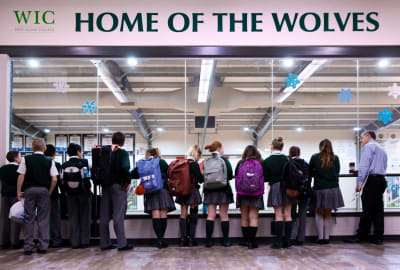



















7410 Blackfoot Trail SE, Calgary, Alberta, T2H 1M5, Canada
16520 - 24th Street Southwest, Calgary, Alberta, T2Y 4W2, Canada
1982
1980
640
1007
7 to 12
JK to 9
Coed
Coed
Day
Day
English, French
English
Academic
Academic
Traditional
Traditional
18 to 22
20 to 25
$21,596 to $28,186
$3,210 to $7,595
No
No
0%
0%
None
None
$0
$0
107
84
0%
0%
0%
50%
7, 8, 9, 10, 11, 12
K, 1, 2, 3, 4, 5, 6, 7, 8, 9
Rolling
Rolling
Not available
Not available
Yes: grades 7 - 11
Yes: grades K - 9
No
No
information not available
information not available
West Island College was founded in Montreal in 1974, and was intended to provide a strong bilingual option for families living on Montreal’s West Island. The program there provided a foundation, and a name, for West Island College in Calgary when it was established in 1982. That said, the school quickly established its own independent operations and identity. As such, it was free to build and grow to meet the needs of its students, and it certainly has. The international programs are robust, as are the language programs, all of which contribute to the overall culture of the school. It’s a very interactive, engaging environment, one that requires a lot of the students who attend while also providing the support they need to succeed. The ideal student is one who shares the school’s foundational values and can thrive in a very active and engaging student environment.
View full reportThe initial draw for families considering Glenmore is the values piece: a full curriculum taught through the Christian lens. Certainly, that’s something which distinguishes the school within the region, and often is the first point of contact. What families find in the school, however, is both that and whole lot more. Given the size of the school, Glenmore is also able to offer a very rich, diverse range of programming, something that understandably is also very attractive. There is a full program of intramurals, and the breadth of the music program—including options for individual lessons—is something that also distinguishes the school. A mission program at the grade 9 level offers an international experience earlier than in a majority of programs, and can provide a very nice punctuation to a student's experience at Glenmore. The ideal student is one who will thrive within a vibrant, challenging, community-centered learning environment.
View full report
"...the teachers at WIC are effective communicators inside and outside of their classrooms"
Jing Li - Parent (May 22, 2020)
We have two sons in WIC, both of whom started from grade seven. My older son is graduating in June 2...
View full review
"WIC provided me with a very balanced set of opportunities that helped me thrive academically in university"
Adam Broniewski - Alumnus (May 29, 2020)
My time at West Island College (WIC) was incredibly memorable and has been influential in shaping me...
View full review
information not available
"West Island College (WIC) in Calgary, Alberta is a Gr. 7-12 independent university preparatory school offering English and French Immersion programming. The College has a diverse school community that encourages unity, collaboration and holistic student development. With comprehensive support, students are nurtured in academic and physical wellness along with emotional well-being. International Studies, Outdoor Education and the Institute Program enhance learning so students can succeed in an ever-changing world."
"Glenmore Christian Academy’s mission is to Teach Truth, Inspire Excellence, Experience Christ and Serve Through Love. Through a Biblical worldview, students learn liberal arts, sciences, fine arts, languages and Phys Ed from specialist educators in our state-of-the-art facility. Extra-curricular options include performing arts, band, intramural and competitive sports. In Junior High, students partake in outdoor leadership programs including an international Mission Trip in Grade 9."
Information not available
"GCA is more than just a school: it is a community. It is our priority to work in partnership with parents to help our students discover their God-given talents. At GCA, Bible is more than just a subject. Our enriched academic program is infused with a Biblical perspective, even in the core subjects. Christ is in everything that we do. These two elements working together allow us to provide students the tools they need to continue to thrive academically and spiritually when they graduate."
Information not available
Information not available
Information not available
Information not available
Information not available
Information not available
Information not available
Information not available
Information not available
"Those that apply to Glenmore Christian Academy are looking for an educational program where their child will be taught how to become a life-long learner, be encouraged to grow in their faith as they learn about Jesus Christ and be given opportunities to put that faith into practice."
Information not available
Information not available
Information not available
"At GCA, we are truly blessed to have a wonderful facility for our students and staff. Our facilities team are all dedicated Christ followers and completely committed to what they do, and are an incredible example to the rest of our staff. The work that goes into keeping our school clean and safe is a huge endeavour, and our facilities team members are truly inspirational."
Information not available
"The culture at GCA is incredibly diverse. Our community is comprised of students whose families are from all over the world, and from more than one sect of Christianity. At GCA, we come together and celebrate our differences all under the banner of Christ."
Information not available
Information not available
Information not available
Information not available
New messaging coming soon.
Stanford Hielema is passionate about education and nurturing an environment where all children have an outstanding learning experience. Previously, as Associate Superintendent for Palliser Regional Schools, he oversaw student learning, fiscal management, policy and administrative procedures, and community relations for the faith-based alternative schools. Before that, Stanford spent over 20 years building Trinity Christian School from 45 students to more than 400. With a strong focus on community, the school thrived in academics and athletics. He built capacity with teachers through instructional best practices to improve student learning. He acted as a Designated Signing Authority for the province during this time, and evaluated 60+ teachers for their Alberta Permanent Teaching Certificate.
Traditional
Information not available
Traditional curricula tend to be very content-based and rooted in the core disciplines. It is a structured approach that involves the teacher delivering a unified curriculum through direct instruction. Students usually learn by observing and listening to their teacher, studying facts and concepts in textbooks, and completing both tests and written assignments - which challenge students to not only demonstrate their mastery of content but their ability to analyze and deconstruct it critically. Class discussions are also used to create critical dialogue around the content of the curriculum.
Traditional curricula tend to be very content-based and rooted in the core disciplines. It is a structured approach that involves the teacher delivering a unified curriculum through direct instruction. Students usually learn by observing and listening to their teacher, studying facts and concepts in textbooks, and completing both tests and written assignments - which challenge students to not only demonstrate their mastery of content but their ability to analyze and deconstruct it critically. Class discussions are also used to create critical dialogue around the content of the curriculum.
Not applicable
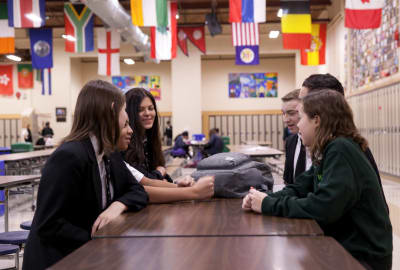
At West Island College incredible opportunities happen every day, in an environment where learning is tailored to each individual student; where relationships are nurtured through effective teamwork and collaboration; and where students are immersed in a community of enthusiastic learners. West Island College emphasizes respect, responsibility and citizenship. We believe that inspiring our students to pursue excellence in academics, leadership, athletics and global awareness prepares them for success in the 21st century. In addition to exceptional teachers, an Advanced Placement Program, Fine Arts Certificate, outstanding athletics, small class sizes and an extensive co-curricular program with leadership opportunities, WIC offers courses in French (Immersion or Second Language) and Spanish and an International Languages Certificate. From our International Studies program and authentic student leadership opportunities to Outdoor Education and WIC’s Business, Health Sciences and Engineering Institutes, students are challenged to go beyond their comfort zones and discover what experiential learning really means.
In partnership with supportive, involved parents, the goal of our educational team is to develop well-educated, faith-filled youth in a creative, active and nurturing environment. With a focus on high academic standards and using an enriched, balanced academic curriculum, our two dedicated principals work alongside our team of specialist educators to ensure your children are receiving the highest quality education.
Traditional Math
Traditional Math typically teaches a method or algorithm FIRST, and THEN teaches the applications for the method. Traditional algorithms are emphasized and practiced regularly: repetition and drills are frequently used to ensure foundational mastery in the underlying mathematical procedures. The traditional approach to math views math education as akin to building a logical edifice: each brick depends on the support of the previously laid ones, which represent mastery over a particular procedure or method. Traditional Math begins by giving students a tool, and then challenges students to practice using that tool an applied way, with progressively challenging problems. In this sense Traditional Math aims to establish procedural understanding before conceptual and applied understanding.
Traditional Math typically teaches a method or algorithm FIRST, and THEN teaches the applications for the method. Traditional algorithms are emphasized and practiced regularly: repetition and drills are frequently used to ensure foundational mastery in the underlying mathematical procedures. The traditional approach to math views math education as akin to building a logical edifice: each brick depends on the support of the previously laid ones, which represent mastery over a particular procedure or method. Traditional Math begins by giving students a tool, and then challenges students to practice using that tool an applied way, with progressively challenging problems. In this sense Traditional Math aims to establish procedural understanding before conceptual and applied understanding.
Information not available
Basic facts are still emphasized.
Information not available
Students don't use calculators until Junior High.
Balanced Literacy
Balanced reading programs are typically Whole Language programs with supplementary phonics training. This training might be incidental, or it might take the form of mini-lessons.
Information not available
Students are assessed twice a year in Elementary using a standardized reading assessment to measure growth.
DIBELS Testing: This school periodically uses DIBELS testing to assess reading progress.
Fountas and Pinnell
Equal balance
Programs that balance systematic and process approaches equally likely have an emphasis on giving young students ample opportunities to write, while providing supplementary class-wide instruction in grammar, parts of sentences, and various writing strategies.
Information not available
Information not available
Equal Balance
Science programs that balance expository and inquiry learning equally will likely have an equal blend of tests and experiments; direct, textbook-based instruction and student-centred projects.
Science programs that balance expository and inquiry learning equally will likely have an equal blend of tests and experiments; direct, textbook-based instruction and student-centred projects.
WIC has a full time Science technician on hand to assist the teachers with preparing experiments. Thus ensuring steady hands on activities at all grade levels.
Information not available
Evolution as consensus theory
Evolution as one of many equally viable theories
Evolution is not taught
Evolution as consensus theory
Evolution as one of many equally viable theories
Evolution is not taught
Zoology
Traditional
These literature programs draw in equal measure from “Traditional” and “Social Justice” programs.
In traditional literature programs students focus on decoding the mechanics of texts: plot, characterization, and themes. These texts tend to include a balance of contemporary and “classic” literature. When studying a past work, students investigate its historical context -- but only insofar as this adds understanding to the work itself. Past works are therefore studied “on their own terms”, and not merely as historical artifacts to be deconstructed: traditional literature programs are firmly rooted in the humanities, and carry the belief that great literature can reveal fundamental and universal truths about the human condition. These programs emphasize class discussions and critical essay writing, and aim to develop in students critical thinking, communication skills, and a cultivated taste and ethos.
Information not available
Information not available
Ancient lit
English lit
World (non-Western) lit
European (continental) lit
American lit
Canadian lit
Ancient lit
English lit
World (non-Western) lit
European (continental) lit
American lit
Canadian lit
Expanding Communities
The Expanding Communities approach organizes the curriculum around students’ present, everyday experience. In the younger grades, students might learn about themselves, for example. As they move through the grades, the focus gradually broadens in scope: to the family, neighbourhood, city, province, country, and globe. The curriculum tends to have less focus on history than Core Knowledge programs.
Information not available
Information not available
Pragmatism
These programs represent an equal balance between the perennialist and pragmatic approach to teaching the humanities and social sciences.
Pragmatism in the humanities and social sciences emphasizes making learning relevant to students’ present-day experience. Assignments tend to centre around projects and tasks rather than argumentative essays; these projects will often have a “real-world” application or relevance. There might be more of a social justice component to a pragmatic program, though that isn’t always the case. Subjects like history and philosophy are still covered/offered, but they play a less prominent role in the overall program than in the case of perennialism. The social sciences (contemporary geography, sociology, psychology, etc), meanwhile, might play a more prominent role in pragmatic programs. The key goals are to make learning progressive and relevant, while teaching students real-life skills and critical thinking.
Information not available
Information not available
Communicative
The communicative method of language acquisition emphasizes the use of the target language in authentic contexts. The approach commonly features interactive group work, games, authentic texts, and opportunities to learn about the cultural background of the language. Drills and quizzes may still be used, but less frequently than with the audio-lingual method.
The communicative method of language acquisition emphasizes the use of the target language in authentic contexts. The approach commonly features interactive group work, games, authentic texts, and opportunities to learn about the cultural background of the language. Drills and quizzes may still be used, but less frequently than with the audio-lingual method.
20% of the school is a French Immersion track. Offering 60% French language classes in the Junior School and 40% in the Senior School. We also offer 125 hours of French or Spanish second Language instruction yearly to the Junior school students. French and Spanish language instruction (along with French immersion) is offered through Grade 12 Most students also complete the DELE or DELF A and B levels.
Information not available
Hebrew
ESL
Spanish
Russian
Latin
Japanese
Italian
Greek
German
French
Chinese-Mandarin
Chinese-Cantonese
Hebrew
ESL
Spanish
Russian
Latin
Japanese
Italian
Greek
German
French
Chinese-Mandarin
Chinese-Cantonese
Information not available
Creative
Creative arts programs are studio-driven. While historical works and movements may still be taught to add context to the program, students mainly engage in making art (visual, musical, theatrical, etc). The goal is use the actual practice of art to help educate students’ emotions, cognition, and ethos.
Creative arts programs are studio-driven. While historical works and movements may still be taught to add context to the program, students mainly engage in making art (visual, musical, theatrical, etc). The goal is use the actual practice of art to help educate students’ emotions, cognition, and ethos.
Information not available
Information not available
Acting
Dance
Drama/Theatre
Graphic Design
Music
Visual Arts
Acting
Dance
Drama/Theatre
Graphic Design
Music
Visual Arts
Medium integration
Effort is made to integrate the development of digital literacy through the curriculum. However, this is not a dominant focus.
Effort is made to integrate the development of digital literacy through the curriculum. However, this is not a dominant focus.
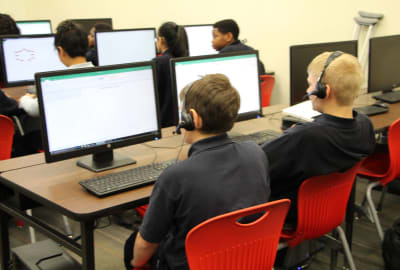
Technology is available in most non movement classes. Including Ipads, Macbooks and PCs. All classes have wireless and teaching presentation stations. Technology is used as a tool in most classrooms, courses. Specific technology units taught at various grades, in multimedia, programming, app development, 3D design and printing, game design, html, website development.
In Elementary, Computers and Technology fit in the light integration category, but in Junior High, it is Heavy Integration.
Web design
Robotics
Computer science
Web design
Robotics
Computer science
Daily phys ed is provided in the Junior School. Mandatory phys ed to Grade 10. We also provide PE 20 30, Sports Performance and Sports Med classes.
From K-Grade 5, students are engaged in physical activity on a daily basis. We have specialized phys ed teachers from Kindergarten to Grade 9.
Academic
Academic-based preschools and Kindergartens are the most structured of the different types, and have a strong emphasis on math and reading readiness skills. These programs aim to expose children to what early-elementary school is like. While time is still allotted to free play, much of the day is built around explicit lessons guided by the teacher. Classrooms often resemble play-based ones (with different stations set up around the room), but at an Academic program the teacher leads students through the stations directly, and ties these activities to a whole-class lesson or theme.
Our Kindergarten program has a strong focus on literacy and numeracy with goals of having students able to read and write for grade one.
Standard-enriched
Broadly-speaking, the main curriculum -- like that of most schools -- paces the provincially-outlined one. This pace is steady and set by the teachers and school. The curriculum might still be enriched in various ways: covering topics more in-depth and with more vigor than the provincial one, or covering a broader selection of topics.
Broadly-speaking, the main curriculum -- like that of most schools -- paces the provincially-outlined one. This pace is steady and set by the teachers and school. The curriculum might still be enriched in various ways: covering topics more in-depth and with more vigor than the provincial one, or covering a broader selection of topics.
Independent and accelerated studies are offered on a case by case basis.
Students have a variety of options on how they can showcase their learning.
Rigorous
A school with a “rigorous” academic culture places a high value on academic performance, and expects their students to do the same. This does not mean the school is uncaring, unsupportive, or non-responsive -- far from it. A school can have a rigorous academic culture and still provide excellent individual support. It does mean, however, the school places a particular emphasis on performance -- seeking the best students and challenging them to the fullest extent -- relative to a normal baseline. High expectations and standards – and a challenging yet rewarding curriculum – are the common themes here. Keep in mind this classification is more relevant for the older grades: few Kindergarten classrooms, for example, would be called “rigorous”.
A school with a “rigorous” academic culture places a high value on academic performance, and expects their students to do the same. This does not mean the school is uncaring, unsupportive, or non-responsive -- far from it. A school can have a rigorous academic culture and still provide excellent individual support. It does mean, however, the school places a particular emphasis on performance -- seeking the best students and challenging them to the fullest extent -- relative to a normal baseline. High expectations and standards – and a challenging yet rewarding curriculum – are the common themes here. Keep in mind this classification is more relevant for the older grades: few Kindergarten classrooms, for example, would be called “rigorous”.
Information not available
"We honour and distinguish our brightest students, using them as examples for other students to follow."
"We honour and distinguish our brightest students, using them as examples for other students to follow."
Balanced
Equal emphasis is placed on a balance of priorities: intellectual, emotional, social and physical cultivation.
Spiritual
The goal is to cultivate "individuals with inner resourcefulness, strong faith and respect for God or a higher power."
Balanced
Equal emphasis is placed on a balance of priorities: intellectual, emotional, social and physical cultivation.
We desire to be recognized as a Christian school that maintains high academic standards with graduates who become responsible citizens, worldview thinkers, and have a commitment to Christian service. We value “arts” and “athletics” each as a medium to build within our students a sense of self-worth, supporting each one to discover his/her God-given gifts.
CompetitiveComp. |
RecreationalRec. |
CompetitiveComp. |
RecreationalRec. |
|
|---|---|---|---|---|
Badminton |
||||
Baseball |
||||
Basketball |
||||
Canoeing/Kayaking |
||||
Cricket |
||||
Cross-country skiing |
||||
Cycling |
||||
Downhill skiing |
||||
Equestrian |
||||
Fencing |
||||
Field Hockey |
||||
Figure Skating |
||||
Football |
||||
Golf |
||||
Gymnastics |
||||
Ice Hockey |
||||
Ice Skating |
||||
Lacrosse |
||||
Martial Arts |
||||
Mountain biking |
||||
Racquet Ball |
||||
Rowing |
||||
Rugby |
||||
Running |
||||
Sailing |
||||
Skateboarding |
||||
Snowboarding |
||||
Soccer |
||||
Softball |
||||
Squash |
||||
Swimming |
||||
Tennis |
||||
Track & Field |
||||
Volleyball |
||||
Weightlifting |
||||
Wrestling |
||||
Archery |
||||
Curling |
||||
Ultimate |
Ballet and Classical Ballet
Yoga
Yearbook
Student Council
Scouting
Science Club
School newspaper
Round Square
Robotics club
Radio club
Poetry/Literature club
Photography
Paintball
Outdoor Education
Outdoor Club
Online Magazine
Musical theatre/Opera
Math Club
Jazz Ensemble
Habitat for Humanity
Foreign Language Club
Environmental Club
Drama Club
Debate Club
Dance Club
Computer Club
Community Service
Choir
Chess Club
Band
Audiovisual Club
Astronomy Club
Art Club
Animation
Ballet and Classical Ballet
Yoga
Yearbook
Student Council
Scouting
Science Club
School newspaper
Round Square
Robotics club
Radio club
Poetry/Literature club
Photography
Paintball
Outdoor Education
Outdoor Club
Online Magazine
Musical theatre/Opera
Math Club
Jazz Ensemble
Habitat for Humanity
Foreign Language Club
Environmental Club
Drama Club
Debate Club
Dance Club
Computer Club
Community Service
Choir
Chess Club
Band
Audiovisual Club
Astronomy Club
Art Club
Animation
0%
0%
$0
$0
0%
50%
7, 8, 9, 10, 11, 12
K, 1, 2, 3, 4, 5, 6, 7, 8, 9
Rolling
Rolling
Not available
Not available
Yes: grades 7 - 11
Yes: grades K - 9
No
No
No
No
Yes: grades 7 - 12
Yes: grades K - 9
Yes: grades 7 - 12
No
No
No
At WIC, we strive to attract and retain students who consistently demonstrate character, have strong morals and will uphold our values. As a university preparatory school, WIC offers challenging curricula that encourages students to explore their passions and work to their full potential. While we consider every applicant’s academic performance, WIC seeks out well-rounded students who are prepared to contribute to school life and the greater community. WIC encourages applications from students ready to embrace the College’s motto: Be Brave. Be Bold. Be Ready.
The student should be curious and interested in learning, dedicated to achieving success in a range of areas including academics, athletics and arts. As we are a faith-based school, it is important that parents support the Biblical component infused into all of our curriculum.
WIC administers the CCAT (Canadian Cognitive Abilities Test), which is a 90-minute standardized test for students entering Gr. 7 – 12. Parents and students must understand that test results are only one part of the admissions process. Spending huge amounts of time and money preparing for the standardized test is not recommended.
Please note, we will accept the SSAT instead of our locally offered entrance exams. Choose West Island College as a recipient in the SSAT online tool.
Our Facility Fee is a one-time, NON-REFUNDABLE fee that applies to all NEW Kindergarten to Grade 9 students.
- First child: $2000
- Subsequent children: $500