Académie Ste-Cécile International School THE OUR KIDS REVIEW
The 50-page review of Académie Ste-Cécile International School, published as a book (in print and online), is part of our series of in-depth accounts of Canada's leading private schools. Insights were garnered by OUR KIDS editor visiting the school and interviewing students, parents, faculty and administrators.
Introduction
From its unique location on a 30-acre campus, a stone’s throw away from the United States to its diverse curriculum of challenging subjects and its world-class facilities, Académie Ste-Cécile International School is truly unique.
Each year, its top graduates are offered a combined amount of over one million dollars in scholarships, and they’re accepted to Ivy League schools and top schools in Canada and abroad. Yet Ste-Cécile offers far more than that.
Benjamin Cooper, the secondary school principal, says “On the first day, we have the students take a good look at the school crest and talk about what it means. We talk to our students about how strong academic performance is not enough. It’s also about your work ethic and your ability to get involved.” The crest features four icons that signify faith, knowledge, culture, and health, and the school’s motto translates as “Truth, justice, love, and peace.” Altogether, the school’s culture reminds children that there’s more to life than textbooks and tests.
Key words for Académie Ste-Cécile International School: Academic. Community-oriented. Supportive.
The basics
Académie Ste-Cécile International School, commonly referred to as ASCIS or Ste-Cécile, is a not-for-profit, English, private coed school located in Windsor, Ontario. Starting in Junior Kindergarten and continuing through to Grade 12, ASCIS welcomes day students, and starting in middle school, it welcomes boarding students.
Ste-Cécile has been an accredited International Baccalaureate (IB) World School since 1996, so it has a great deal of experience with this rigorous academic program. The International Baccalaureate® high school program is optional, but many students are enrolled in this stream, which is science- and math-focused. Whether enrolled in the IB Diploma Programme or in Advanced Placement (AP) courses, all students must work toward the Ontario Secondary School Diploma (OSSD).
Students, parents, teachers, and administrators with whom we spoke stated that one of Ste-Cécile’s greatest strengths is its small size. With a total student body of approximately 300 and caps that keep classes smaller than 18 for elementary school and 20 for high school, the ASCIS community is tightly knit, with an “everybody knows everybody” level of support and accountability.
“The students really grow up with each other,” says Kristin Diana, principal of Académie Ste-Cécile’s elementary school. Many start in Junior Kindergarten and continue on with the same group of children through to high school graduation.
Still, despite the tight-knit quality of the school, newcomers are welcomed with open arms, according to Zayn Farhat, a Grade 8 student who transferred to ASCIS in Grade 5. “Well, I came during COVID,” he recalls. “So everyone was wearing masks and doing social distancing. But it was really impressive to see how that was all handled here. And everyone was very welcoming. Teachers are welcoming; students are welcoming. So I didn’t have that extreme awkwardness of starting a new school.”
Starting in middle school, international boarding students join the community. As well, groups of international students attending short-term English as a Second Language programs bring cultural and linguistic diversity to the population. Students are exposed to a uniquely international and expansive view of the world, but it all happens within a safe space.
“Community is such a strong value within Ste-Cécile,” says former student Rebecca Parker. “Not just because it’s such a small population for a school, but because of the fact that the teachers genuinely want you to succeed, and those people that you’re in classes with, they really are your friends. … Everybody wants to see you succeed, and they want to see you have a good time while you do it.”
Students with whom we spoke were enthused about the extracurricular life of the school. Two students reported that it was hard to choose from among the many options. Whether it’s playing for the school’s golf team, running for student council, or helping put together the yearbook, most students reported that they participate in some activity or another.
ASCIS has the benefits of being a premium boutique small school, and it also has some of the advantages that one might expect to see at a larger school, including spacious buildings surrounded by grass and trees, varied academic options in secondary school, modern classroom technologies, and impressive athletic facilities. It’s this unique combination of a tight-knit community and expansive student options that makes Ste-Cécile a special place in which to grow up.
History
The school now called Académie Ste-Cécile International School has roots that date back to 1979, when the school’s founder, Thérèse H. Gadoury, opened a music and dance school in Tecumseh, a town located just outside Windsor. It was known simply as “the Académie.” A year later she added a nursery school.
Gadoury, who remains the directrice of the school today, decided to name the school after the patron saint of music and musicians, Saint Cecilia. By doing so, she ensured the school would maintain a focus on the performing arts. And it has. After expanding beyond arts programming to offer academic courses, the school continues to operate private music and dance schools that are open to the public.
The school began offering elementary education in 1993. By 1994, it had expanded its offering to secondary courses. While it was founded based on the principles of the Roman Catholic Church, it’s not affiliated with any Catholic school board and it welcomes children of all faiths. While the school’s name is bilingual (English and French), most of the courses are taught in English; however, ASCIS also stresses the study of French throughout all of the grades.
As the school began to grow in scope, Gadoury sought a new property that would create room for expanding enrolment and future growth. In 1995, the school moved to its current campus on Cousineau Road in South Windsor, the site of the former Holy Redeemer College. Since then, it has continually expanded, adding new buildings and programs over the years.
- In 1996, the school became associated with the University of Windsor. The relationship continues today, and it allows students to access university libraries and computer networks. The school also received International Baccalaureate certification that same year and began offering the IB Diploma Programme for high school students.
- In 2004, the school finished construction of a new 27,000-square-foot building to house its elementary school.
- In 2005, it built a new wing for its secondary school, named after Saint Pope John Paul II, who died that year.
- In 2010, ASCIS began construction of three residences to house international students, both short-term and long-term.
- In 2012, the school completed a gym with an NBA regulation-sized basketball court.
- In 2014, the school built an outside track with an artificial turf soccer field according to FIFA standards. In addition, the elementary school expanded to add four more classrooms and special rooms for art and music classes.
- In 2019, when ASCIS built the first two of four phases of the performing arts wing, it welcomed students to study private music and dance lessons on campus.
- In 2021, ASCIS completed another addition to the elementary school consisting of 10 classrooms, a science lab, and a recital/assembly hall. It was also authorized to teach the IB Middle Years Programme and is currently seeking certification for the IB Primary Years Programme. It takes several years to complete the entire process of certification for any level of the IB Programme.
Location and Facilities
Located at the southern edge of the city, the Cousineau Road location is easily accessible for families who live outside the city limits. Many students travel from small communities surrounding Windsor, including Amherstburg, LaSalle, Kingsville, and Tecumseh.
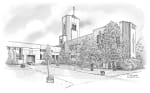
Set on a 30-acre site, the campus is home to one of Windsor’s most noteworthy pieces of architecture, the school’s historic chapel. The site was formerly the site of Holy Redeemer College, a teaching seminary, designed in 1957 by Prairie School architect Francis Barry Byrne. Byrne was an internationally renowned architect who began his architectural career with Frank Lloyd Wright. Wright was recognized as “the greatest American architect of all time” by the American Institute of Architects in 1991.
Using Wright’s teachings as the basis for developing a personal style, Byrne set new precedents in modern ecclesiastical architecture. With its mid-century modernist style, the ASCIS chapel is considered one of Byrne’s greatest works and is his largest built work.
Standing within the chapel, it’s easy to understand why it is a focal point for the school. It’s an uplifting combination of traditional and modernist elements, with several beautifully coloured glass window panels where light streams in. The building is listed on the Canadian Register of Historic Places.
The spacious ASCIS campus includes separate buildings for elementary and secondary classrooms and offices. Also onsite are a daycare, music academy, dance school, performance auditorium, NBA regulation-sized gym, indoor track, weight room, outdoor playground, a soccer field built according to FIFA standards, and residence buildings. Large lawns and leafy trees give the suburban location an almost rural feel.


Leadership
Thérèse H. Gadoury is the school’s founder and remains the Directrice today. Sandy Hamilton, a parent of two alumni, remembers how Gadoury’s ambition came through in the life of the school during the years when her children were students. “She’s feisty, and she had a vision,” says Hamilton. “She wanted the best for students, and you could really get a sense of that.”
Gadoury has an open-door policy and welcomes input from faculty, notes athletic director Pat Hanna, who has worked at the school in various roles for more than 20 years. “In all these years, I’ve never walked into her office and been told ‘I don’t have time to talk to you.’ ” That open-door policy in the directrice’s office sets the tone for the entire school, he adds. The principals are like that too. “I’ve found throughout the years that the people who work here seem to be in a kind of unity,” says Hanna. “They are willing to help each other, and I think that’s a strong point for us.”
Open communication among faculty helps everyone stay in tune with the student body, notes Jennifer Temple, head of the boarding school. For example, if a boarding school staff member notices that a student is struggling in a certain area, they can help the student communicate the need for extra help from a teacher. A collegial and collaborative environment means teachers enjoy working there and give their all, remarks math teacher Samantha Morin, who has worked at the school for 12 years.
Academics
Since 1996, ASCIS has been accredited to offer the International Baccalaureate Diploma Programme for Grades 9 to 12. In more recent years, the school received accreditation for the IB Middle Years Programme for Grades 6, 7, and 8. It’s currently seeking accreditation to offer the IB Primary Years Programme.
The International Baccalaureate (IB) is a non-profit organization that aims to give students the opportunity to be educated for a globalizing world. Schools must meet high standards for IB to authorize them to teach these programmes. IB World Schools are regularly evaluated to ensure the standards are maintained over time. Studies have shown that a higher-than-average percentage of students in the IB Programme attend university to earn a degree, and, then, a higher-than-average percentage of these students persist in earning multiple degrees at prestigious universities around the world.
The IB Diploma is optional at ASCIS, but many students are enrolled in this stream, which is science- and math-focused. ASCIS students who opt out of the IB Diploma Programme for high school still work toward the Ontario Secondary School Diploma. Since the course load in the IB science and math courses is heavier, IB students must sometimes attend extra classes at the end of the school day after 3:30 p.m., when classes normally finish. Students in both streams have the option to prepare to write AP exams, which enable motivated students to earn university credits while in high school.
Regardless of what combination of diplomas they are working toward, students are grouped together in classes by grade level. There is at least one class at each grade level, and there are no split-grade classes. In most cases, the same group of students stays together from year to year, though new students are welcomed.
Preparation for the rigorous IB Programme begins in the early years. The IB philosophy influences elementary teachers at Ste-Cécile, whether in the IB Primary Years Programme for students in Grades 1 to 6 who are between 6 and 11 years old or in the IB Middle Years Programme for students aged 12 and 13 who are enrolled in Grades 7 and 8.
Secondary classes at ASCIS are no larger than 18 to 20 students. Elementary classes aim to have no more than 16 to 18 students each. As a result of these small classes, students have lots of one-on-one interaction with instructors. Teachers, students, and parents interviewed by Our Kids often mentioned the bond between students and their teachers as a foundation for academic success. Whether a child is struggling or excelling in a certain subject at any one time, learning can be readily individualized.
“Something that’s very different from the public boards is that if students excel or need additional practice, we can keep them behind a grade or move them up a grade,” says Diana. This usually helps these students to feel comfortable in groups that are appropriate for their learning needs.
When Rolla Rashid enrolled her two daughters in ASCIS, she was pleased to find that teachers weren’t just looking to assist children who needed help keeping up. When her daughter Talla was in Grade 4, her teachers noticed her math skills were advanced and that she needed more challenging work. Talla’s passion for math has continued now she is in Grade 11. She is working above her grade level, and the ASCIS teachers encourage her to take on new challenges. “Some kids get bored if it’s too easy for them. But the ASCIS teachers really challenge the students who are advanced. They know where the kids are at,” says Rashid.
With so much focus on academic rigour, one might think that there’s a lot of pressure on students. But none of the students with whom Our Kids spoke seemed stressed by the expectations placed on them by their teachers, their parents, or themselves. The work can be intense, but the prevailing attitude is that help is at hand, and there’s no shame in needing it. For instance, when a Grade 11 student was struggling with math at the start of the year, she reached out for extra help and scheduled some one-on-one time with her teacher. They arranged to meet before school the next day to review material that would be on the test.
“There is some sort of pressure about academics, but it’s not necessarily from the people around you,” says Angela Guan, a Grade 10 student. “It’s more like an internal pressure. People aren’t going to shame you for not being smart. It’s more like, a lot of people around you are strong academically, so you want to be, too.”
For a school its size, ASCIS offers a wide variety of courses, well beyond the core science and math courses, notes Cooper. “We offer philosophy, business, economics, and the arts. We get together every year to work out a whole new schedule, and we can make every effort to tailor our program to what fits the needs of the students.”
Faith community
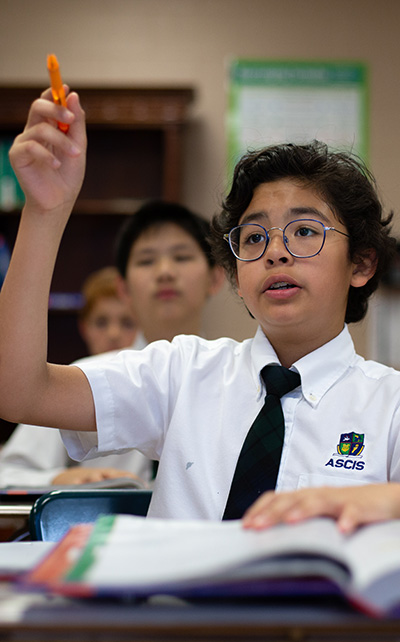
ASCIS is an interfaith school with foundations in Roman Catholicism, but it is not part of the Catholic School Board. ASCIS welcomes children of all faiths and backgrounds. Roman Catholic students attend a weekly mass in the ASCIS chapel on campus; attendance is optional for non-Catholic students who may opt to attend ethics classes instead, where they will discuss a wide range of topics related to the school’s core values, including spirituality, integrity, respect, and self-discipline.
Arts

The performing arts are deeply embedded in the student experience at the elementary and secondary levels. ASCIS offers senior and junior concert bands, jazz band, vocal chorus, string ensemble, percussion ensemble, and liturgy group. Starting in the primary grades, music is introduced through vocal performance and movement. Students acquire basic music concepts that prepare them for instrumental music classes in Grades 5 through 8. Each spring Ste-Cécile mounts a musical featuring elementary drama and music students.
High school students become well-rounded musicians by learning music concepts, theory, and performance skills. They also learn how to interpret, create, and use music in digital formats. The high school program prepares students for post-secondary study of music. The musical year culminates with an all-grades concert.
Students are often enrolled in after-school music and dance lessons at separate but connected private music and dance schools on campus. The Academy of Music and the ASCIS Dance Studio are located in their own spaces on campus and are open to all members of the public whether or not they attend ASCIS.
ASCIS offers visual art classes, and students in senior grades have access to personal studio spaces located beneath the school’s historic chapel. Formerly used as individual prayer spaces by the Redemptorist priests and seminarians, these mini-studios were re-designated to now allow students to create art in a semi-private personal space, which they can access whenever they have a spare period or after school.
Because the arts are deeply embedded in the life of the school, students are able to balance the needs of their creative interests alongside their academic pursuits. For example, Grade 10 student Angela Guan started attending ASCIS in Junior Kindergarten. Though she has a busy academic life and says math is her favourite subject, she has also studied piano and ballet for a decade. In her ballet career, she’s just about to graduate to using pointe shoes. “I finally get to be a real dancer!” she jokes.
For serious students of music and dance, ASCIS offers them an Elite Music and Dance Programme where students will receive nearly 10 hours of instruction per week. While there will be an extra fee added to the regular school tuition in order to be enrolled in this programme, families will benefit from these hours being integrated into the school day of their children.
Athletics
ASCIS offers ample opportunities for students to practice sports while maintaining their focus on high academics. The idea is not to win every competition, but rather to live a balanced life that includes physical activity.
“We really want to see the students be active,” states Pat Hanna, the school’s athletics director. “We like to say that when you’re physically fit, you’re going to be mentally fit as well.” There’s an incredibly high rate of participation in athletics, says Hanna. “I’d say about 80 percent of our student body participates somewhere along the line.”
Students may choose from various competitive sports, including badminton, basketball, golf, swimming, tennis, track and field, running, soccer, and volleyball. Seven intramural sports are also offered, and students have access to state-of-the-art athletics facilities, including an NBA-sized basketball gym, indoor and outdoor running tracks, two tennis courts, and a professional-grade soccer field.
Student teams at ASCIS compete against other public and private schools in the Windsor and Essex County Secondary School Athletic Association (WECSSAA). When they do well, they go on to compete in the South Western Ontario Secondary School Athletic Association (SWOSSAA). High-achieving teams or individuals compete in the Ontario Federation of School Athletic Associations (OFSAA) provincial championships, which includes schools from approximately 20 districts throughout Ontario.
At ASCIS, girls’ and boys’ teams consist of students from both junior and senior grades and they usually play in the senior divisions. The teams are strongly competitive and the ASCIS students live up to the challenge. For example, a pair of students who entered the WECSSAA girls’ tennis competition came home with gold medals in a recent competition. The school has also done well in badminton and swimming as well as in basketball and volleyball, two of its most popular extracurricular sports options.
Taking part in basketball and soccer allowed her children to get to know students in higher grades, notes Sandy Hamilton. “When you’re at a big school, the kids in Grade 11 and Grade 12 don’t get to know the younger kids. But at this small school, the older kids were so great and so encouraging to the younger kids.”
Hanna explains that the school’s capacity in athletics means that students who wouldn’t otherwise play do get involved in school teams. He emphasizes that school sports can be more than just physical training and competition; they can be an opportunity to develop leadership and life skills that spill over into other parts of life. Intramural sports are a less intense option for kids who have less time to devote to sports. And other children find less physical ways to be involved in athletics by being timekeepers, scorekeepers, and managers.
The school’s impressive athletic facilities are also available in the evenings and on weekends as a place for fun and social and physical activities. This is especially important for boarding students.
Elite sports development prep teams
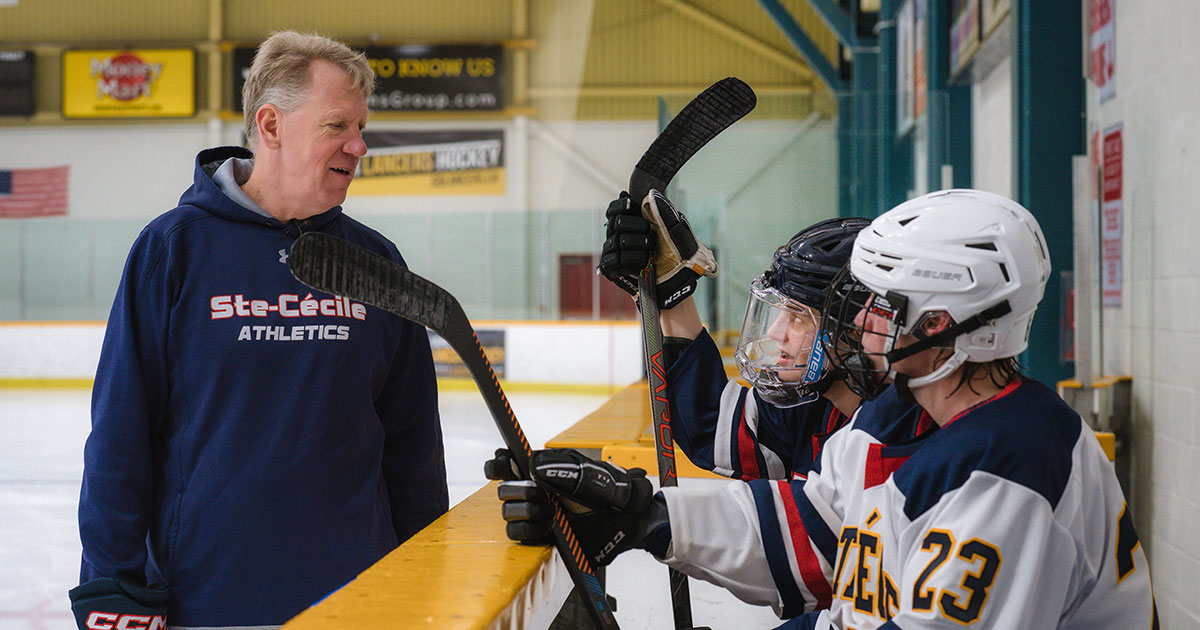
For students in Grades 7 to 12 who are serious student-athletes, ASCIS offers elite sports development programming in hockey and other sports under the guidance of professional coaches (starting in the 2023–24 school year). Throughout the school year, these students will receive over 300 hundred hours of practice and additional hours of sport-specific training (i.e., on the ice, field, court, and in the fitness gym) with the aim to enhance their skills. The prep teams will belong to premier leagues and compete in games and tournaments held throughout Eastern Canada and the U.S. Midwest. Since academics are a priority at ASCIS, these students will receive special schedules. The schedules will accommodate approximately two and half hours of sports training per school day. Games will be mostly scheduled on the weekend. These sports hours will be in addition to a full timetable of courses in the OSSD, IB, and/or AP. To participate in this program, students will be charged an additional fee above their regular yearly school tuition.
Community involvement
Community service opportunities are built into both the OSSD and the IB Programmes, and ASCIS takes this aspect of learning seriously. ASCIS students develop a mindset of service through frequent and varied opportunities for service in the community. Groups of ASCIS students volunteer regularly at the downtown mission. Students also work in the Windsor-based food bank one day each month, helping to prepare and serve lunch.
Secondary principal Cooper notes that since the school intends to build such service opportunities in the community, students fundraise for worthy causes throughout the year. Students are also encouraged to participate in travelling service trips. For example, during a trip to British Columbia, ASCIS students assisted with rebuilding a community that had suffered a mudslide.
In addition to planning outings for students, the school invites community groups and guest speakers to address students on social issues. Ste-Cécile has formed a relationship with Caldwell First Nation, a First Nations band with a land base located about 45 minutes from Ste-Cécile. Leaders from Caldwell visited the school on Canada’s National Day of Truth and Reconciliation to speak with students about the history and significance of Canada’s residential schools, land treaties, and the Indian Act.
Elementary school
School culture is a focus in the ASCIS elementary school. Diana notes that the school year starts with a conversation about how children are expected to treat each other. “Something that’s really important for me, personally, is positive school culture,” says Diana. “In my daily announcements, I often choose a positive quote that can set the tone for the entire day.”
The elementary program occupies a long, spacious building, with three wings leading off from the main foyer. At one end is the junior program. It is self-contained, with students spending the whole day together in a single teaching space, apart from coding, athletics, and recess.
The second wing houses the older primary students, while the third wing houses the higher elementary grades, where students move between classrooms, rotating throughout the day much as they do when they enter middle school and secondary grades. Students also have access to a fully equipped science lab.
With a curriculum based on the International Baccalaureate’s Primary Years Programme and Middle Years Programme, ASCIS introduces some concepts earlier than students would ordinarily experience them. French language instruction, for example, begins in Junior Kindergarten, as does the basics of coding. Since the IB Programmes influence the elementary school, its curriculum exceeds the learning expectations of Ontario’s curriculum.
“We like to do a lot of introductory lessons,” says Diana. She explains that Junior Kindergarten and Senior Kindergarten classes are never combined, so there can be more progression during these two important years. And even at the earliest levels, there’s a balance between play and direct instruction. “It’s not just exploratory, play-based, or free play,” explains Diana. “We try to create a good balance for the younger students.”
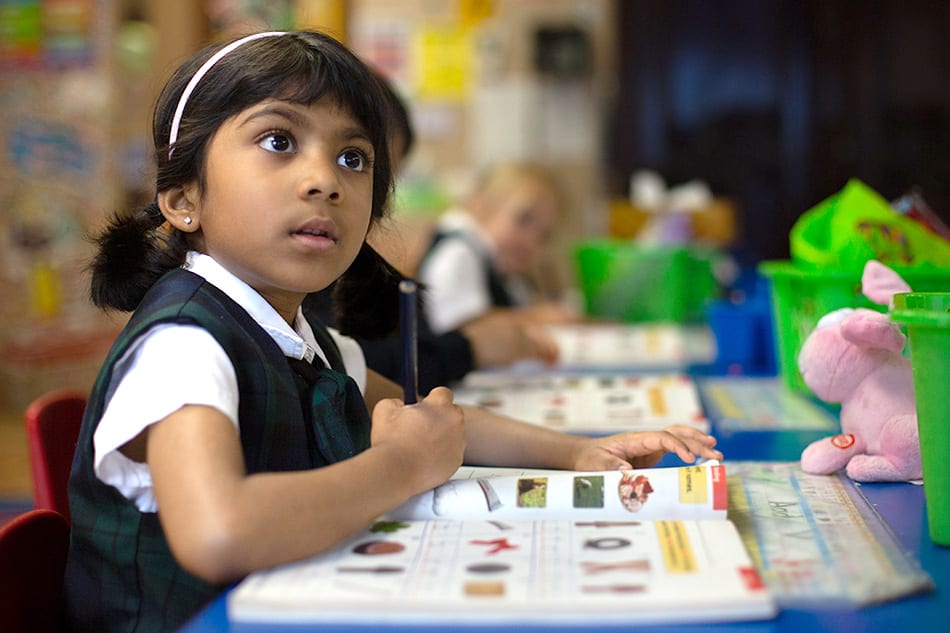
Sight words and letter writing are introduced early and in age-appropriate ways. “A lot of our students will know all of their sight words by the end of Junior Kindergarten, and a lot of them are learning to spell and learning to be able to write as they’re going into Senior Kindergarten.”
On a recent visit, when an Our Kids team member passed by a Kindergarten classroom, it was clear that academic work looked a lot like play for this age group. Children sat in a circle around a teacher who showed cards displaying short words. The children raised their hands to volunteer to speak the words they saw. Then, the whole class repeated the word before the teacher moved to the next card. The children were joyful and proud of their growing skills. They were playing with words.
The elementary school participates in academic contests, such as the North American contest Mathematica Centrum, and Caribou Math, a worldwide online contest held six times throughout the school year across grade levels. Students participate in regional and provincial science fairs starting in Grade 4, preparing their projects over the course of months. “Our students are very engaged, and they have a lot of initiative,” says Diana, “so we run those programs, and they score very, very well.”
In Grades 6, 7, and 8, the preparation for high school begins with children rotating from one class to another to study with teachers who specialize in certain subjects. Middle school students get a modest amount of homework.
Service and leadership opportunities are available to students in the IB Middle Years Programme. Students collaborate with a partner or work independently on a project that benefits the local community.
Grade 8 student Zayn Farhat describes the homework in middle school as rigorous yet manageable. “It’s not an overwhelming amount, and it’s not like the teachers send us home without any explanation or without us knowing what to do, so it’s not too bad,” he says. That leaves plenty of time for participation in extracurricular activities. Options include chess club, math club, student council, choir, concert band, and house league and school team sports.
Diverse course options and extracurricular activities set Ste-Cécile apart from other schools, according to one student. Grade 8 student Aya Tarhuni came to ASCIS in Grade 5. “We have many different classes, with different teachers for each subject. And there’s a lot more variety with the events as well as extracurriculars and things you could do outside of school.” She’s interested in trying volleyball, student council, and the yearbook crew.
When Farhat was on the student council, he said that it helped him get to know students across the elementary school’s grades. It wasn’t even too stressful doing a two-minute speech before his peers during his campaign. He transferred to ASCIS in Grade 5 and credits the school environment for his confidence. “Before I came to this school, I was really shy, not good at public speaking,” he remembers. “Now, I can do it.” He’s been busily involved in other after-school activities. “I’m excited about chess club and soccer.”
The boarding program begins as early as the middle school grades and most boarding students enter when they are in Grades 7, 8, or 9.
Parents are intimately involved with the school and with each other, says Diana. They meet in real life at school events or in the parking lot and stay in touch through text chats and social media groups that allow them to organize get-togethers outside of school or communicate about school initiatives that they’re supporting.
“For example,” remembers Diana, “one year, our Grade 4 parents and class took on an initiative on their own. They wanted to do a drive-through can drive.” The pandemic had prevented families from contributing to their usual food drive events that year, but they found a creative way to get it organized as a parent group, Diana explained. “The families become very familiar with each other. You’ll find a lot of friendships among our community members.”
Elementary faculty
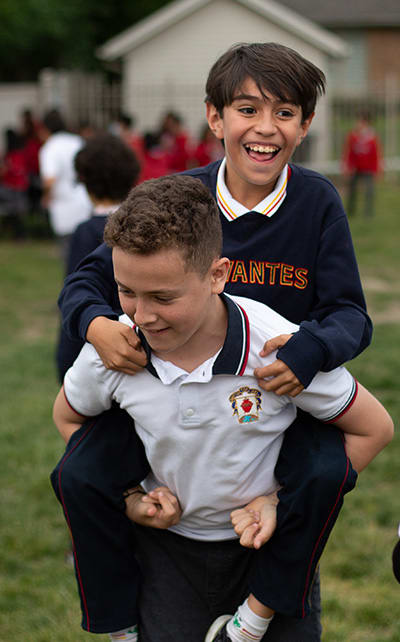
Diana began as a classroom teacher but took the leadership role as principal of the Ste-Cécile elementary school in September of 2021. Diana notes that growing up in Windsor, she was aware of the school but not entirely aware of its capacity. The music program was more visible as it was introduced to the community in 1979; the private school opened in 1993. “My younger sister went to the music program and attended the daycare 20-plus years ago,” says Diana.
ASCIS’ faculty includes highly-experienced Windsor teachers, and it also looks outward for faculty members with international life experience. This helps them bring the world to the classroom.
French teacher Sherry Mena, who worked in Ontario and Quebec, describes the faculty environment at ASCIS as collaborative and communicative. Teachers ensure that their students move from one grade level to the next with complete understanding and without gaps in their learning. For example, explains Mena, when her students move into Grade 6, where they have a different French teacher, she works with their new teacher to ensure their curricula match up.
The ASCIS teachers create a nurturing environment that encourages collaboration rather than competition, says Grade 8 student Emma Persaud. She started attending ASCIS in Grade 5 and immediately noticed that the teachers were kind and considerate. “Teachers are always very supportive,” says Persaud. “They really utilize group work and collaboration in our studies. I think working with other people really helps you learn more about other people and learn new interests which can help you overcome obstacles.”
Secondary school
Academics is the primary focus of the ASCIS secondary school. Students, teachers, and parents see this International Baccalaureate-certified secondary school as a starting point. Students are preparing for an expected post-secondary education. Math teacher Samantha Morin stated: “One thing I always say is that it’s not about getting into university, it’s about staying there. And our program prepares them so well. Our students have the study skills to be successful, and they are much better prepared.”
Students pursuing an IB Diploma have a science- and math-focused academic day. But the program includes a broad range of options that allows students to experiment. For example, when student Ainsley Shanfield was in Grade 11, she took the required math and chemistry courses but didn’t know yet what she wanted to do after high school. So she’s kept all her options open. She especially enjoyed a course in tech design, which involved practical hands-on projects such as installing drywall. Shanfield also loves art and took visual arts class at ASCIS.
The secondary program occupies a spacious building in the centre of campus. Classrooms are fully equipped with technologies that allow teachers to seamlessly include children who may be attending class remotely due to illness. Fully equipped science and technology labs are also available.
An NBA-sized gym was an impressive highlight of a recent tour. Students also have access to a weight room, a fully equipped art classroom, and individual studio spaces for art students. Indoor and outdoor common spaces allow for independent study during spare periods and socializing during after-school events. A healthy rate of participation in extracurricular programs shows that children know that there is life beyond their books.
A performance space for music and drama means that these secondary students have opportunities to organize concerts and plays for the public. Musically-inclined students also have access to private music practice rooms, and parents can arrange music lessons on campus either during or after school hours for their children.
A smaller school population means everyone knows everyone. And special events—like an on-campus haunted house on Halloween—allow teens to socialize across grade levels, reports Shanfield. “I feel like even though we’re in different grades, we still know each other pretty well. At least, we know each other’s names; it’s really cool that way.”
A service mindset
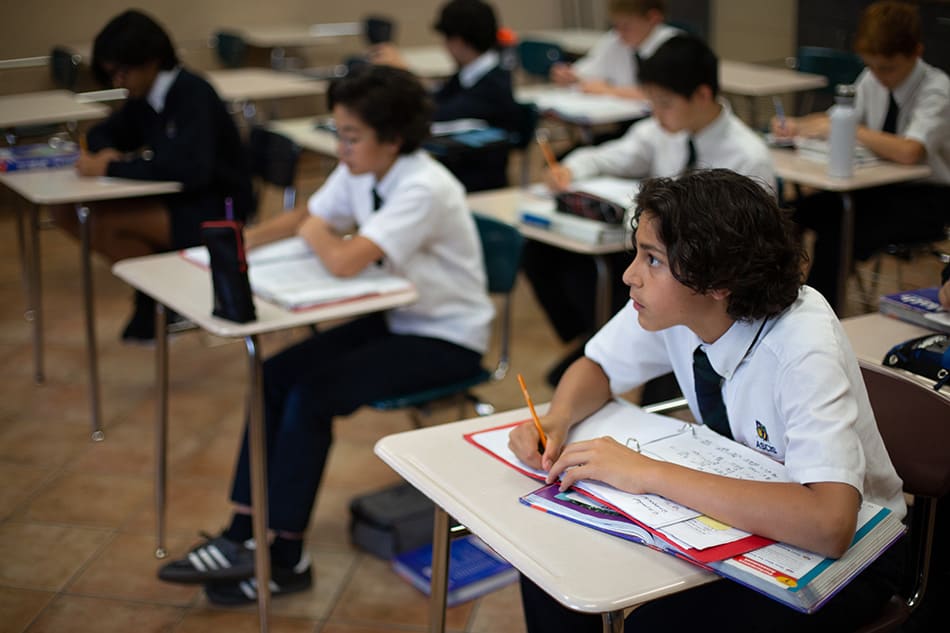
ASCIS’ secondary students do community service trips every year. In addition to earning credit for community service, students boost their university applications and the whole school group bonds through their shared experiences. “Another cool thing was how they formed friendships. I see our students in the hallways who are completely different ages, just hanging out and chatting. It’s so gratifying. They have extracurricular ways of getting to know each other, and students love it,” says Temple.
As they advance through secondary school, the trips become longer and go further away. For example, trips have taken students to British Colombia, Colorado, and elsewhere where they volunteered to do community service.
“I think the students served 718 meals when they were there,” says Temple, who attends trips as head of the boarding school, as do other school staff members. Being of service in the community is a big focus for Cooper, who says he foresees the school’s service opportunities growing to impressive levels in the near future.
Secondary faculty
Benjamin Cooper, who serves as both principal of the secondary school as well as a chemistry teacher, has an open-door policy, inviting students to drop in with problems, ideas, and conversation. In the high school, the principal’s office, with its large glass window, is tucked away, but still visible from the secondary hallway. Students know that the ASCIS open-door policy means that they don’t need an appointment to come in and talk with their principal.
“I think students feel comfortable speaking with me about anything that’s going on,” Cooper told us as he stood in the hallway, nodding hello to everyone who passed by. It’s clear that the ASCIS principal cares about his students. “They’ll often come in with an idea and we’ll talk about how we can make it work.”
The ups and downs of pandemic restrictions showed ASCIS’s resilience: the secondary school maintained stable leadership, with both the elementary and secondary principals at the helm throughout.
Their intimate knowledge of the school’s culture and community allowed the ASCIS heads of the school to steadily manage the academic life of the school before and during the chaotic early days of the pandemic. Under the direction of founder Thérèse H. Gadoury, the school pivoted quickly to remote learning conditions by adding new technology to classrooms that allowed teachers to work from school while students were safe at home.
Several parents interviewed by Our Kids said the school’s approach minimized academic disruption, and the school evolved in positive ways that will continue in the future. For example, Gadoury ensured that each classroom was equipped with technology that allowed teachers to lecture from the classroom while the children participated from home. The setup is still in place so that when students are unwell, they can fully participate from home if they wish.
The school also upgraded its learning management system. That allows for content delivery that’s similar to what students can expect at university. It’s another way that ASCIS helps its students be prepared for post-secondary academic pursuits.
As well, the ASCIS staff adopted the ritual of greeting students at the door when they enter in the morning. They started doing it to connect with students when they first emerged from remote school routines and were learning to wear masks and follow new socially distanced routines at school. Since the ritual was great for morale, it became part of ASCIS’ new norm for staff to greet students as they arrive on campus before the morning bell.
For faculty members, the appeal of ASCIS lies in working with children who love to learn. The school attracts teachers with an interest in science, technology, engineering, and math. When they find a community that welcomes their enthusiasm, they want to stay.
Teacher Samantha Morin learned about the school from a student she had been tutoring. When she saw the students’ love of learning at the school, she was driven to know more about the school the student attended. She immediately knew it was where she wanted to teach math and computer science. She has taken the requisite courses to allow her to assume leadership roles at ASCIS.
“For me, it’s getting to teach students who really want to learn and families who support their learning, and a really good environment to teach in. I have found in the past, when I was in other schools, sometimes it was like 80 percent babysitting, 20 percent teaching. It was not always a great learning environment. So coming here, finding a school full of students who want to learn? And being able to teach them? It’s amazing. It’s amazing what you can do in a class full of children who really want to learn.” The school is an incredible opportunity for Morin’s children, too. She has three in elementary school at ASCIS. That gives her first-hand knowledge of the parent’s experience. She reports that it helps her relate to the parents in the ASCIS school community.
Teachers who are in tune with the needs of their students help create a culture of academic excellence, says Sandy Hamilton, whose two children, Lisa and Kevin, graduated from ASCIS in 2009 and 2011. After earning university degrees in nursing and business, they now hold prominent positions in the community.
“There wasn’t one teacher who wasn’t giving 100 percent,” remembers Hamilton. “My daughter started (at ASCIS) in Grade 6, but she was way behind in French. The teacher came to me and let me know my daughter was at about Grade 2 level in French. I said, ‘What can we do?’ She offered to tutor my daughter a couple of days a week.” It wasn’t long before Lisa was speaking French at the same level as her peers.

Culture
ASCIS is undoubtedly an academic school. Families are attracted to the focus given to academics at ASCIS, and they embrace the opportunity to be in a community where it’s a shared value. All students work toward an OSSD diploma, but they may also choose the IB and/or AP pathways. In most instances, their studies will have a science and math focus. The culture leans toward rigour, and teachers, parents, and students describe an environment that values excellence and hard work.
“When you are around a bunch of people who are succeeding at a very high level, you also want to succeed at a very high level,” says former student Rebecca Parker. But the environment also supports students as individuals, she notes. “Having the opportunity to do the IB and having that interwoven with the one-on-one experience, it helps you work through the heavy course load of the IB diploma. It was really, really important that we had that support system of the teachers.”
The math- and science-focused IB Programme requires students to work hard, notes Parker. “You are going to have to have a strong work ethic to get the grades you want to see.” Her hard work paid off, she says, explaining that her academic focus helped her attract interest from universities when the time came.
A positive school culture is a focus at the elementary school, with such events as Think Positive Thursdays. Diana communicates encouraging and uplifting messages in whole-school announcements and encourages students to do the same in their lives. Several children noted that they develop collaborative relationships with their peers, rather than competitive ones. The school’s small class sizes mean that children get to know each other well. In the senior grades, day students from the Windsor area mix with international students, as well as short-term visiting students who come to study English as a second language. Families describe the social atmosphere as friendly and supportive.
Faculty encourage students to take part in the life of the school even though the focus is on academic rigour. The school estimates that between 70 and 80 percent of children participate in extracurricular activities; diverse options encourage students to try new things. Ample extracurricular opportunities also allow students to socialize across grades.
Boarding options
About 30 percent of the school’s total population are boarding students. Some boarding students hail from other parts of Canada, but a large percentage come to Canada from international locations throughout Latin America, the Caribbean, Asia, and Europe. Students who board at the school live in dormitories on campus. Girls and boys live on separate floors. With guidance from a team of supervisors, most boarding students live in independent private rooms, which are comfortably equipped with a single bed, a desk and chair, a sink, a dresser, a closet, and shelving space. Washrooms are shared.
During their free time, boarding students have access to comfortable indoor and outdoor areas for relaxation such as the games room, gymnasium, weight room, and tennis and basketball courts. Ste-Cécile offers nutritious meals daily to the boarders in the school’s dining hall. It provides basic housekeeping and laundry services weekly.
On a typical day, ASCIS is alive with activity. After school, boarding students may participate in sports or clubs, or visit the local community. They may also choose to remain in the residence, working on their laptops, reading an assignment for the next day’s class, or enjoying friendship with other boarders.
Supervised study hall is scheduled after school. Extra study hall time is scheduled on Saturdays for students requiring additional assistance with their studies. As needed, students have access to teaching staff for extra help with homework. Quiet time starts at 10 p.m. and lights go out at 11 p.m.
Adjusting to a new living situation can be challenging at first, but a staff of caring individuals is available to help, says Jennifer Temple, boarding school head. These staff members spend a great deal of time with students, playing a role similar to Mom or Dad in the student’s life, helping them celebrate successes and navigate challenges.
On holiday weekends, boarding students who live close enough go home to be with their families. Those who are far from their families bond with each other and the boarding staff on school-organized excursions and trips to various parts of Canada. Since ASCIS is located in Windsor, Ontario, a border city of Michigan, ASCIS also accompanies students (who have their U.S. visa) to enjoy activities in the United States.
International boarding students may need a bit of extra support at the beginning of their life at ASCIS when it comes to learning all of their subjects in English. Such support is available for students who need it.
Temple notes that many boarding students stay in Canada after graduating from ASCIS and after receiving the appropriate visa and study permit to continue their post-secondary education in English. However, the school’s guidance department works closely with boarding school students and their families to guide transitions into university in all parts of the world.
International flavour
ASCIS’ boarding program adds cultural and linguistic diversity to the student population and, for day students, it’s a unique and very personal window into the world. Students are welcome from anywhere in the world. For example, the school has established outreach operations in Latin America and Asia.
ASCIS also offers short-term programs to students mostly coming to ASCIS from Colombia and Mexico. They stay for shorter periods of two, four, six, or eight weeks. These students focus on learning the language and experiencing Canada. These ESL learners attend most of their classes separately from the full-year students, although some, whose English skills are more advanced, are integrated into the same classes as the Canadian students. As their comfort in English grows during their stay, they enhance their experience by interacting with the long-term students around campus throughout the school day.
ASCIS’ International Baccalaureate Programmes also bring a global context to the classroom. Children develop intercultural understanding and explore content that’s broad, balanced, and applicable to a globalizing world.
Some ASCIS children already speak a second language, so French is their third or fourth language. Sherry Mena, the French language teacher, helps them understand the connections between their languages and helps them develop a passion for language in general. “I bring the world to the classroom,” says Mena. “When they really understand why the language is important in the world, they want to learn it.”
As well, Mena asks each student in her classes to make a travel book. Throughout the year, the class follows the members of a fictional family as they travel the world. “We learn about where they travel, so we learn about countries around the world that the children may not have realized are French-speaking.” They also keep passports, in which they place stamps that they create. “As the family goes places, we go places.”
ASCIS’ international flavour attracts a diverse range of students and families. That diversity was an important aspect for Hamilton as she considered schools for her two children, who have since graduated. Hamilton wanted to make sure that her children would be exposed to families of varying backgrounds and faiths. And the choice to attend ASCIS was the right one for her family. “At ASCIS, there is a diverse group of children and parents, and my son has so many friends from Ste-Cécile. They’re from all over the world; they’re all from different cultures and races and they’re best friends. For us, it was a great experience and my kids thrived in that environment.”
Extra help
Certain students may need extra support, either in language or the core academic curriculum. Therefore, the Holy Family Achievement School (HFAS) occupies a floor in the school’s main building and helps students who need that extra support, either in language or in other subjects of the core academic curriculum.
Holy Family is a separate school within ASCIS for Grades 6 through 12. It’s managed by designated ASCIS staff. Since it also offers special instruction to students with learning exceptionalities, it tailors how it teaches the core subjects to the specific student’s needs. Students in this school may be integrated with the main school for classes such as music and physical education.
In many cases, instruction at Holy Family is one-on-one, or in groups of two or three. There are opportunities to spend time with teachers to go over homework and address questions that come out of classroom instruction. Some students eventually integrate fully into the main ASCIS programming, while others will graduate from the Holy Family Achievement School.
While all of the course offerings within the core secondary program are academic, some applied stream courses are offered, as needed, to students enrolled in the Holy Family School of Achievement. “This gives us more flexibility,” says Diana, particularly in addressing the needs of students who have unique challenges. That may include adapting a schedule or reducing a student’s course load.
Tuition fees at HFAS are different from those of ASCIS. For more information about the Holy Family Achievement School, please contact the ASCIS Admissions Office.
On the transition to university
ASCIS expects 100 percent of its graduates to be accepted into university should they choose to apply. And most students do.
After graduating from ASCIS more than a decade ago, Lisa and Kevin Hamilton completed their post-secondary studies at the University of Waterloo and the University of Windsor, respectively. After studying the IB Diploma Programme, the transition to university-level expectations was smooth for them, according to their mother, Sandy Hamilton. “My daughter completed a couple of university courses at Ste-Cécile, so that was great. And they really learned how to study, how to succeed at school. So they didn’t have trouble at all when they got to university. They already knew what they were doing.”
The school’s guidance program for secondary students is designed around one-to-one relationships between students and staff, explains Temple. Beyond her duties as head of the ASCIS boarding school, she’s also part of the guidance department. “There’s not a student whom I’ve walked by in the hallway and about whom I don’t know what’s going on in their lives. They feel comfortable coming in and having conversations, just doing life with us.” The bond can be incredibly helpful if and when students face obstacles in their academic life. “They’re able to communicate with us, and we’re able to figure out the root of the problem. And then I can go to the teacher and develop a plan of action.”
A strong relationship with school staff can be especially important for boarding students, Temple notes. “We have a wonderful team of supervisors who are with them at night, and they take on the roles of Mom and Dad who are doing life with them.” The process of helping students envision a post-secondary future begins in Grades 9 and 10 and then more seriously in Grade 11. “We start to ask: What are you interested in? How do you foresee your future? And we then navigate them through the steps, making sure that they will be ready to go where they want to go. If they want to be a doctor, we help them make sure they will study the pre-requisite courses of mathematics and sciences. If they want to be a business person, we’ll make sure they will be enrolled in the business leadership course, etc.”
By the time students are in Grade 12, they start to ask themselves where they want to study. In Canada? In the United States? Or further abroad? And what do they need to get there? “Every student has an action plan,” says Morin.
When we interviewed Temple in September, she was in the midst of meeting with Grade 12 students. “We’re going to go through exactly what they want. What course do they need? Do they need to take the SATs? Sometimes I do practice tests with them, especially if they’re nervous about the test.”
It’s satisfying, she notes, to see graduates go off to various Ivy League universities and other great universities in Canada, the United States, and the United Kingdom.
Summer
During the summer months, ASCIS continues offering short-term programs to students from abroad. Children in Grades 4 and 5 attend four-week sessions as they learn about Canada and do some local sightseeing. In a sense, the program is like an academic camp. “It’s mainly for that ESL support,” says Diana “And we give them a lot of different activities. It’s a wonderful program.”
In terms of more serious academic subjects, regular ASCIS students can take high school credit courses during the summer for students who have catching up to do or who want to reach ahead. primarily in ESL/English and in advanced science courses such as chemistry and physics.

Money matters
ASCIS is a not-for-profit private school. It depends solely on its own revenues and donations. Tuition fees cover instruction and all activities associated with the delivery of the core program. Uniforms, textbooks, supplies, and fees associated with extracurricular activities are not included.
Boarding fees are competitive compared to other boarding schools of ASCIS’ calibre. Students who live close enough to go home on weekends can choose a five-day boarding arrangement and pay less than the seven-day boarder.
All fees are quoted in Canadian dollars. Since fees are adjusted from year to year, please contact ASCIS for a current schedule of fees.