
The 2026 OUR KIDS Private School Expo is coming to cities near you. Get your family pass
Here’s the OUR KIDS guide to Montessori schools in Victoria—your introduction to child-centred learning on Vancouver Island. Montessori programs in Victoria emphasize independence, curiosity, and hands-on exploration, helping children build confidence and a love of learning as they progress at their own pace.
On this page, we feature private Montessori schools in the Victoria area. This includes Montessori schools in downtown Victoria, Victoria West, Oaklands, Fairfield, Rockland, Harris Green, Jubilee, Fernwood, and North Park.
For more than 30 years, OUR KIDS has been Canada’s trusted source for private and independent school information. On OurKids.net, you’ll find verified school profiles, parent reviews, comparison tools, and expert insights to guide your search. For a more complete guide to Montessori education, including preschool and elementary school options, start with our guide to Montessori schools.
There are lots of private Montessori schools in Victoria. These schools vary in terms of their classroom practices, curricular approaches, program offerings, and special needs support. The schools listed below reflect this diversity. They can be filtered for a wide range of features.
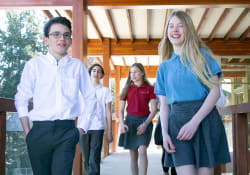 Victoria, British Columbia "We identify experiences that enhance learning, empowering individuals while fostering a community of collaborative contributors. This is achieved through interdisciplinary projects that are seamlessly integrated." —From the school
|
For general advice on how to choose and evaluate private schools, check out our choosing a school guide, as well as advice from top education experts. For advice on choosing Montessori schools, see our main Montessori school guide. You can also read our guides to questions to ask private schools and questions students get asked at school interviews.
Private school expos are a great starting point for finding a school, at any level. We have annual private school expos in Toronto, Montreal, Vancouver, Ottawa, Calgary, and Halton-peel. These expos allow you to speak with lots of private schools in Canada, many of which are Montessori schools, all in one place. Find a Montessori school near you.
Attending open houses is a great way to learn more about schools. For general advice on open house visits, check out our guide on school visits.
The cost of Montessori schools in Victoria tends to be lower than the cost of other private schools in Victoria. In fact, Montessori schools are usually on the lower side of private school tuition in general.
Private school tuition can range from $5,000 to over $30,000 per year for day students. There are no public Montessori schools in Victoria, though some public schools use certain Montessori principles and materials.
Many schools offer needs-based financial aid, such as bursaries or tuition relief. Other schools, though fewer, offer scholarships based on merit—for example, in academics or athletics. You can learn more about need- and merit-based financial aid in our dedicated guide. You can also read specifically about preschool costs and funding.
Below, you’ll find the range of costs for Montessori private schools and preschools in Victoria:
| Tuition (day school) | Students receiving financial aid | Grade eligibility for financial aid | Avg. aid package size (annual) | |
|---|---|---|---|---|
Westmont Montessori School | $13,123 to $32,000 | 1% | K - 12 | $2,500 |
Primary curriculum | Secondary curriculum | Curriculum pace | Academic culture | Average class size | Language immersion | Special needs support | Tech integration |
|
|---|---|---|---|---|---|---|---|---|
Westmont Montessori School | Montessori | Student-paced | Supportive | Withdrawal Assistance | Medium integration |
Legend:
Westmont Montessori School |
Montessori schools, in Victoria and other cities, often have large mixed-age classes with high teacher-to-student ratios. They also tend to have lots of interaction, student-to-student teaching, and group and independent work.
For more comprehensive coverage, see our main Montessori school guide.
The Montessori philosophy of education is unique. Some of the main principles include:
Student-centred: Students are free to move around the class, choose their own work, and determine the pace of their studies. This can make for a dynamic learning environment, where kids often select work that is engaging and stimulating, fostering a love of learning.
Uninterrupted work time: Montessori schools give kids extended periods of uninterrupted work, especially at the elementary level. Many schools provide at least one 3-hour, uninterrupted work period to focus on chosen work. These periods improve concentration, self-discipline, and work habits.
Concrete learning: Learning is hands-on and tangible. At the primary and elementary levels (and sometimes at the secondary level), kids use various concrete materials, including manipulative puzzles, blocks, rods, and spindle boxes. Concrete learning engages multiple senses and can accelerate learning, particularly for younger children and children with special needs.
No external rewards: In primary and elementary school, kids are not graded on their work. Praise is given sparingly and focused on effort rather than outcome. Progress is assessed informally through observation and developmental rubrics rather than formal grades or report cards.
Montessori teachers rarely provide traditional direct instruction. They move around the classroom, guiding students individually or in small groups. Lessons are usually short, interactive, and engaging. Teachers connect students with their work, serving as "guides" or "mentors" rather than traditional lecturers.
Montessori schools in Victoria and other cities have mixed-age classes, typically grouped as 0-3 (toddler), 3-6 (primary), 6-9 (lower-elementary), 9-12 (upper elementary), and so on. This mixed-age environment shapes the teaching approach and learning atmosphere, encouraging collaboration, mentorship, and peer teaching. Older students often mentor younger classmates, reinforcing knowledge and skills for both age groups. See more about the teaching approach and learning environment.
Victoria has several Montessori schools, most of which are private, though some public options exist. These schools have a strong reputation and adhere closely to the Montessori philosophy introduced by Maria Montessori in the early 20th century. Children are given flexibility to choose tasks and work at a pace that suits them.
Many students find this approach very stimulating and rewarding, allowing them to pursue personal interests and projects while working independently or in groups. Teachers provide guidance and mentorship but rarely deliver whole-class lectures. This progressive approach contrasts with traditional schooling methods, though it is increasingly adopted in more schools.


|

|

|

|

|

|

|

|
 |
 |
 |
 |
 |
By logging in or creating an account, you agree to Our Kids' Terms and Conditions. Some information presented on this page may be paid advertising provided by the advertisers and is not warranted or guaranteed by OurKids.net or its associated websites. By using this website, creating or logging into an Our Kids account, you agree to Our Kids' Terms and Conditions. Please also see our Privacy Policy. OUR KIDS ™ © 2026 All rights reserved.