
The 2026 OUR KIDS Private School Expo is coming to cities near you. Get your family pass



Greenwood College School THE OUR KIDS REVIEW
Verified Review
OUR KIDS verifies every review by confirming the reviewer’s identity and their firsthand experience with the school. Learn more
The 50-page review of Greenwood College School, published as a book (in print and online), is part of our series of in-depth accounts of Canada's leading private schools. Insights were garnered by OUR KIDS editor visiting the school and interviewing students, parents, faculty and administrators.
OUR KIDS editor speaks about Greenwood College School
Introduction
Greenwood College School offers a warm, welcoming atmosphere alongside a challenging academic environment tailored to the individual strengths of every student.
It’s no easy feat, requiring the constant, coordinated efforts of administrators, teachers, and advisers dedicated to meeting students where they are and encouraging them to “venture further together” (the name of the school’s current strategic plan) in academics, co-curricular involvement, and character development.
“We’re focused on seeing every child’s potential and helping them grow into that potential,” says Principal Heather Thomas. “We view that potential as vast, not linear, and not entirely about marks. There are some incredibly high-achieving students here who do amazing things, and they do those things because they’ve grown in a holistic way.”
Many schools tout a ‘whole child’ educational approach, yet Greenwood is intentional and concrete about this philosophy. From putting service learning in the weekly schedule and doing formal reporting on students’ character growth to creating space in the timetable for well-being and community connections, there’s a visible commitment to nurturing students’ all-around development. “Everything we do is in support of developing good humans,” says Thomas.
Balance is key in this endeavour, and the scale never tips away from academics. “One misconception about Greenwood I’ve heard is that it’s only for students who can’t achieve academically, and that is not at all the case,” says Thomas. “We set high expectations for learning, and our personalized approach to education enables students to meet those expectations. Our approach is high challenge, high support.”
Greenwood’s signature Adviser Program is at the centre of the school’s comprehensive student support system. Advisers work in collaboration with teachers, social workers, and school leaders to ensure that every student is flourishing in the full range of developmental spheres.
Sheila Allen, a parent of two Greenwood graduates and one current student, as well as the school’s director of athletics, says she took the school’s deep level of commitment to student success for granted until she joined the staff. “I felt like I’d pulled back the curtains. It’s not just by chance. There’s real intentionality and dedication.” When it comes to teachers’ professional development, for example, the quality is high and the quantity is exceptional: the school delivers enriching professional development programming every Wednesday morning throughout the school year.
What can’t be instituted or scheduled, however, is the close-knit, cooperative, and mutually respectful staff found at Greenwood. The hiring process emphasizes the kind of ‘soft skills’ that can’t be captured on a resume–a passion for nurturing students’ growth in all areas, for example, and an enthusiasm for leading them in the wealth of co-curricular activities that Greenwood is known for.
Creating a balance between students’ academic and co-curricular lives is a priority at Greenwood, says Thomas. “We create the space, opportunities, and sense of safety so that everyone can try things out and discover their strengths and interests.”
Making kids feel secure and welcome is the overarching goal, according to every staff member we spoke to. “The first time we visited the school with my child, it was like we kind of walked into a big warm hug, which was wonderful, but wouldn’t have been enough if we didn’t know that the academic program was strong too,” says one parent.
Another parent whose Grade 7 son had started the fall before we met also spoke about the intangible draw of the school. “Greenwood just feels like home for us as parents and for my son,” she says. “It’s resoundingly clear that it’s an environment where students feel supported and cared for.”
At 500 students, the school has a small-school feeling. Several parents we met were attracted to this quality. “We wanted a school that felt down-to-earth and community-oriented,” says one parent of a Grade 9 student.
Similar comments from parents and students alike confirmed that the school is living out its stated mission of creating a safe, inclusive, caring community where children can discover and build on their strengths. “There’s a place for everybody to thrive here,” says Thomas.
Key words for Greenwood College School: Community. Inclusion. Student-Centred (Personalized).
Basics
Located in leafy North Toronto, the aptly named Greenwood College School is a member of the Conference of Independent Schools of Ontario (CIS Ontario) and Canadian Accredited Independent Schools (CAIS).
Viewed from Mount Pleasant Road, the building is impressively modern, especially the section with multi-storey windows where the main staircase resides. This stairwell is somewhat of a work of art, with massive, colourful murals of birds and trees and huge tropical plants, all signalling Greenwood’s nature-themed interior design.
On entering, visitors are met with a cozy, camp-like atmosphere in the expansive common area (the Lodge) where students eat, study, and hang out. There’s a small stage at the front of this high-ceilinged room which, delightfully, features a large climbing wall at the back.
To one side of this common room, there’s another gathering space for students, with couches and a large stone fireplace that students gather around in the winter. All of this is flooded with natural light from the abundant windows.
In 2016, Greenwood doubled its physical space with a renovation and significant addition, yet only grew from about 460 students to the current 500. The aim wasn’t to significantly increase enrolment, says Executive Director of Admissions Tiara Hillis, but rather to enrich the facilities. In 2019, the building expansion received gold certification through the Leadership in Energy and Environmental Design (LEED) program, a green building certification program used around the world.
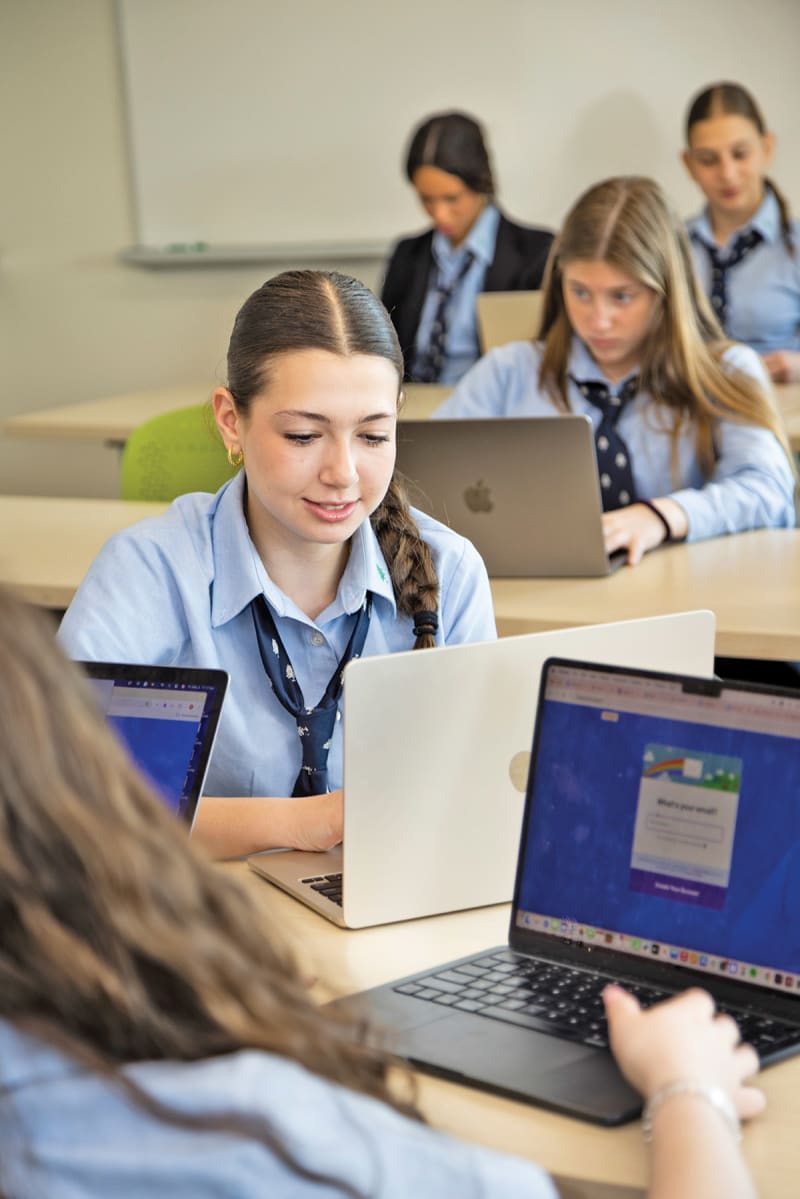
Most of the fresh, spacious classrooms have large banks of windows, and the ones that don’t still have glass walls facing the hallways to let in the light. Class sizes vary from about 15 to 20, with an overall student-to-teacher ratio of seven to one. Some classes are co-taught, with 30-36 students in a class with two teachers. These co-taught classes are held in a Learning Community Classroom–an extra-large room with one or two breakout rooms for small-group learning and quiet work.
One unique feature that highlights Greenwood’s eponymous style is the rooftop terrace (which adjoins a rooftop classroom framed by floor-to-ceiling windows). With patio seating and Muskoka chairs, the terrace has its own green plants and trees and overlooks the canopy below. It’s the ideal spot for real-world environmental education.
Students don’t lack for any of the facilities available at comparable independent schools, with two gyms including bleachers for 600, a fitness room, a performance arts theatre that seats 140, visual arts studios, soundproof music rooms, and a state-of-the-art Innovation Lab.
Indoor athletics are no problem at Greenwood, but until now, the school has had few outdoor facilities and relied on nearby spots such as Leaside Arena, the University of Toronto Athletic Centre, Sunnybrook Park, and Cherry Beach. This will all change when the ambitious Greenspace Project wraps up.
Though the new turf field will not be regulation-sized for formal athletics games, it will be ideal for team practices and gym classes. A fence will enclose the area, and students will have supervised access to it at breaks and lunchtime.
Students purchase lunch and snacks at the popular cafe in the Lodge–Greenwood’s social hub–that sources locally grown produce for its hot and cold menus.
In September 2024, the school declared itself a mobile device-free zone during school hours. That means no phones anywhere at any time. Greenwood supplies special Yondr pouches, which lock up personal devices at school while keeping them safe and in students’ possession.
The school mostly draws students from surrounding neighbourhoods, says Hillis. “We’re definitely a community-based school, but we also have families from pockets all across Toronto.”
One of the many factors that draws families to Greenwood is the fact that it’s co-educational, since there isn’t an abundance of co-ed independent high schools in Toronto. More than a few parents cited co-education as a must-have in their school selection, as did multiple students. “I couldn’t see myself at an all-boys school,” says one Grade 12 student. “This is what the real world’s going to be like, and that’s how I wanted my school to be.”
Background
In 2001, one of Greenwood’s founders, Richard Wernham, a successful wealth manager, lawyer and entrepreneur, realized that the people who made the greatest contributions to society were rarely those who had chosen a narrow, traditional path. Instead, they were those who paired an independent spirit with a deeper sense of character, and were as energized by challenge as they were by success. Greenwood is the result of this belief.
“Greenwood’s founders were looking for something different, even though their children were at some of what were considered the best independent schools in the city,” says Principal Heather Thomas. “They wanted to build a place that wasn’t all-boys or all-girls and exclusively based on achieving high marks, but rather based on the individual student and who that student could become.”
Wernham had noticed that some of his most successful employees were good people who might have been B students, Thomas explains.
“Equally important are a strong academic foundation and the development of interpersonal and intrapersonal skills. Hard work, loyalty, creativity, the ability to work well with others – employers are looking for these skills,” she says. “So, back when schools didn’t talk about character education, it was embedded at Greenwood.”
In terms of who was accepted, the founders shifted the usual metrics. “Twenty years ago, most independent schools put grades as one of the top benchmarks for whether a student got in or not,” says Executive Director of Admissions Tiara Hillis. “For us, it was about looking at the benefits that a range of students can bring to society and to a community, making it a rich environment.”
In 2002, the founders opened the doors to 72 students in a newly renovated building at the site of today’s campus. Founding principal David Thompson stayed until 2008, when he left to become the headmaster at Lakefield College School. Subsequent principals included Allan Hardy and Sarah Bruce. Wernham maintains ties with the school as a director of the Greenwood board.
Leadership
When Principal Heather Thomas was a child, she set up little makeshift desks and a chalkboard in the hallway of her home so she could play school with her friends. “My mom was a teacher, and I knew very early that I wanted to be one too,” she says.
In 2024, Thomas became the fourth principal at Greenwood–the culmination of a 22-year career at the school. After completing a Bachelor of Science and Bachelor of Education at Queen’s University, she briefly taught at the Toronto Montessori Academy before joining the Greenwood staff in 2004 as the instructional leader in mathematics and business. In 2016, Thomas earned a master’s degree in education from the University of Toronto.
“I attended independent schools in elementary and secondary and graduated from Ridley College, so I knew the benefits of the independent system and was naturally drawn to it,” she says, noting that she loved math, athletics, drama, reading, and the outdoors. “These experiences led me to be very well-rounded, and I now appreciate all the opportunities I had at these schools.”
Thomas chose Greenwood for its emphasis on personalized learning and strong community, but also for its extensive experiential learning opportunities and remarkable outdoor education program. She held leadership roles at Camp Wapomeo until her early twenties and is an avid sailor, scuba diver, paddler, and wilderness camper. “To me, one of the elements of camp that is evident at Greenwood is seeing the individual human in each child, considering what they might be going through, and forming strong relationships,” she says. “This is what we try to do with every student, but also with their families.”
Based on our conversations with the internal and external Greenwood community, there’s broad admiration for Thomas, both as a leader and as a person. “She has unbelievable expertise in education and deeply cares about students,” says Vice Principal of Student Learning Elanna Robson. “They are the focus in everything she does. Whenever we’re solving a problem as a school, she considers what’s best for the kids.”
Numerous staff members highlighted the advantages of Thomas’s long history at the school and solid institutional knowledge. “Ever since I started here 15 years ago, I’ve felt very supported by Heather when I have a classroom challenge or question about teaching methods,” says Bill Farbstein, the subject team leader for technology and the coordinator of the Innovation Lab. “It’s great to have someone at the top who has been in so many roles at Greenwood.” Over the years, Thomas has been the director of personalized learning, the vice-principal of student learning and the deputy head of school.
Many staff members cited her extraordinary communication skills, work ethic, and organizational skills. “She has an unbelievable engine,” says Robson. “Her stamina always shocks me.” Thomas acknowledges these traits, jokingly describing her knack for staying organized as “next level.”
Families had positive evaluations of Thomas’s open and caring leadership. “She’s warm and empathetic,” says one member of the parent/guardian association, The Roundtable. “She comes to all the parent meetings and really listens. It’s like she’s trying to work with everybody to keep pushing the school in a good direction.”
Not all principals talk about fun, but making Greenwood an enjoyable place to be every day is a priority for Thomas. “I see my role as being a guide to make sure Greenwood remains a place where people want to be each day,” she says. “I love that the students enjoy being at school. It’s important to have an element of fun at school. Even though I’m a pretty serious person. I like to have some laughs with students and teachers when appropriate.”
Looking ahead, she says she’s excited about the Greenspace Project and other initiatives that will further enhance the student experience, but plans to stay on course and true to the school’s core values of personalized learning and community.
As for why she’s stayed at one school for more than two decades, Thomas has a ready answer. “This is my home,” she says. “I love this school because it’s not too big to be nimble and innovative, but first and foremost, it’s about the people. I care about the people, and I care about the school.”
Academics
While Greenwood prides itself on developing students’ all-around potential, this mission in no way detracts from the school’s commitment to promoting academic excellence.
Several parents and teachers we spoke to made a point of emphasizing the school’s high standards, eager to dispel any notion that there’s a lack of academic rigour. By creating a learning environment that respects and supports learning differences and cultivates rich experiences outside the classroom, they argue, Greenwood in fact enhances student achievement.
“Maybe Greenwood doesn’t have the reputation of a hard-hitting academic school, but it does have a strong focus on academics,” says one parent. “The teachers are very engaged and excited, and the learning is innovative. The other schools that we considered were all about the academics and having kids be a grade ahead in math or whatever, but I don’t see that as a badge of honour. I want my child to have valuable experiences in all aspects of their life at school.”
Geography teacher and student adviser Blair Yungblut puts it like this: “As teachers, we’re always thinking about how to stretch our students and help them rise academically. That’s only possible because of the strong relationships we have with students and their sense of enjoyment and safety here.”
The hallmarks of Greenwood’s academic program are personalized learning, experiential opportunities, student well-being and pluralism.
Personalized learning
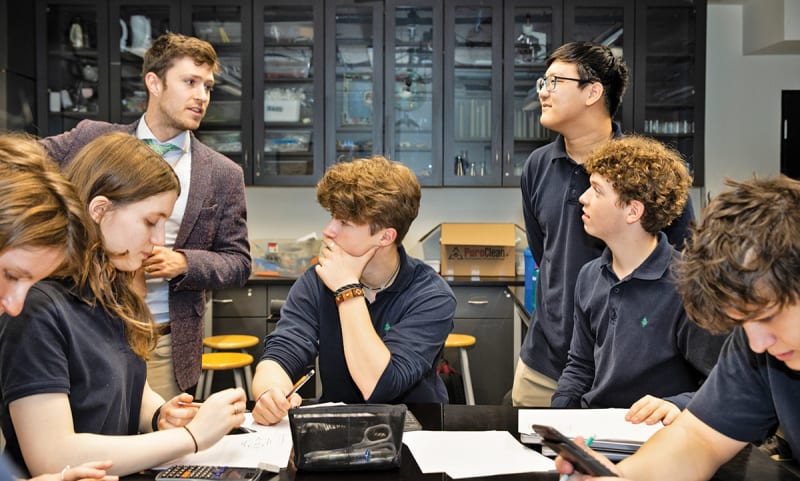
“We take personalized learning very seriously,” says Vice Principal of Student Learning Elanna Robson. “This is not to say that every single student gets a different lesson. Above all, it’s about getting to know our students well so that we can give them appropriate challenge and appropriate support.”
Gaining in-depth knowledge of each student’s learning styles and strengths is an ongoing process, says Sarah Cooper, the subject team leader of History & Social Sciences and research chair of Teaching & Personalized Learning. “We do frequent, thorough, relevant assessments and–based on the results–we work with each student to develop their skills and knowledge.”
Sheila Allen, the director of athletics and parent of two graduates and a current student, says she’s seen personalized learning play out successfully with her children. “All three of my kids are different kinds of learners, and the school took the time to meet them where they were and help them grow.”
Another parent of a Grade 7 student who excels in math says she initially turned down the opportunity for him to accelerate his learning, but soon realized she’d made a mistake. “It was unbelievable to me, but even at a late stage in the year, his teacher arranged for after-school support so that he could tackle the Grade 8 math curriculum. He was so excited about it.”
Students talked to us about how Greenwood’s dedication to personalized learning helped them. A Grade 12 student with ADHD shared how her teachers came to understand how she thrived on active learning, for example, while a Grade 9 student said she often felt bored at her old school, but now she gets to do math problems a step beyond the standard curriculum.
Our meetings with teachers elicited myriad examples of personalized learning in various subjects. They spoke of offering students a wide choice of research topics within a larger theme, varied assessment formats that included everything from traditional essays to short films and podcasts, and customized worksheets based on individual levels of understanding.
As a tech-forward school, Greenwood teachers are also leveraging AI in personalized learning. “We may use tools that translate works of literature into more accessible English, for example,” says Cooper. “I can relevel the reading, and they’re still getting the content and everyone is on the same page for the discussion and analysis, which is where students gain crucial skills.”
Greenwood’s building facilitates personalized learning through the breakout rooms in its Learning Community Classrooms, where there are two teachers. “If a student is a little bit ahead or behind, they can get personal attention in a smaller group during class time, and I love that because my child sometimes needs an extra challenge to keep her engaged,” says one parent.
Amid all this choice and customization, however, teachers ensure that students gain fundamental knowledge and master essential skills. “There’s a balance between allowing them to explore their interests and our focus on preparing them for the next stage, which is ultimately postsecondary education,” says Cooper.
There are multiple paths for ambitious high school students who want to reach ahead in their areas of strength. They could take a Grade 12 course in Grade 11, for example, or access teacher support to prepare for Advanced Placement (AP) exams. The AP coordinator collaborates with subject teachers to ensure students develop the requisite knowledge and skills to succeed, and there are AP exam preparation sessions before and after school with AP-trained teachers.
Personalized learning at Greenwood is also about having a breadth of courses in high school well beyond the expected offerings of a small- or mid-sized school. We were somewhat surprised and definitely impressed at the array of course offerings in fairly niche areas such as entrepreneurship, advertising, green industries, elite athletics, and food and culture. To make room for these classes, Greenwood runs a few electives outside the regular timetable during the mid-morning timeslot called Community Time.
Experiential learning
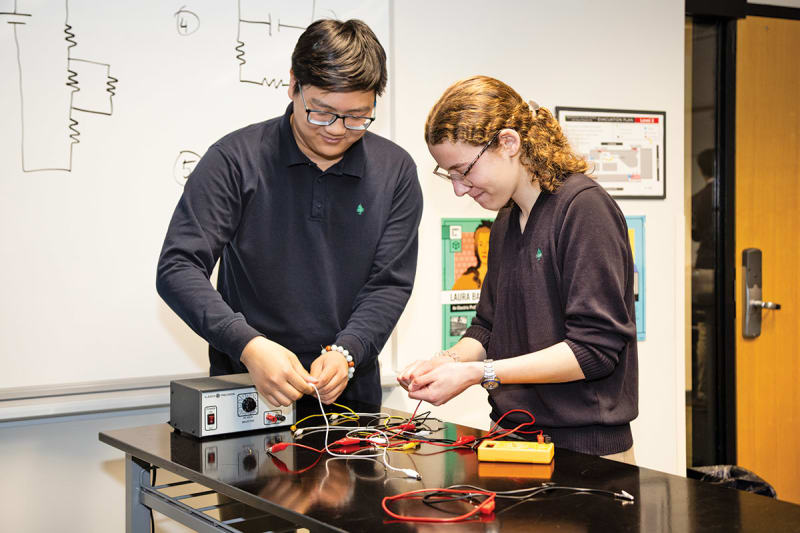
Greenwood expands the conventional definition of experiential learning as occasional field trips to also encompass real-world, curriculum-connected experiences inside the classroom. “This means having professionals in the field working on projects with our students, for example, and having students doing the work of a discipline in concrete ways,” says Principal Heather Thomas.
The idea is that, while field trips are fun, enriching, and part of life at Greenwood, they’re sporadic. On a day-to-day basis, experiential learning happens when students apply their skills and knowledge to practical, hands-on challenges related to the course at hand.
In business classes, this looks like tackling case studies or running an enterprise for a day. In English classes, Greenwood has a writer-in-residence who reviews student writing. In drama, a group from the Stratford Festival watches students perform and provides feedback. Other recent examples have included professional chefs cooking with food and culture students, and a French-speaking musician from Cameroon visiting French classes.
“We have many contacts through parents who work in multiple fields,” says Vice-Principal of Student Learning Elanna Robson. “We also connect with our alumni network to find experiential curriculum opportunities.”
The overriding goal is to ground classroom learning in the real world and make it relevant to students. “We need to answer the question that kids have always asked: ‘Why do we need to know this?’” says Bill Farbstein, the subject team leader for technology and coordinator of the Innovation Lab. “When we have professionals come in, or when we take the kids out into the working world to see and do what the professionals are doing, then they understand the connection between what we’re trying to teach them here to what they will need five or 10 years down the line.”
Greenwood teachers partner with professionals in various fields to develop innovative student projects or to help assess students, ensuring the school keeps pace with developments in various disciplines. Students keen to dip their toes in their fields of interest can take a deep dive into a potential career in Grade 11 with Greenwood’s co-op program.
Pluralism in learning
In line with the school’s culture of inclusion, the academic program is designed to emphasize diversity of thought and ideas. “We want to create classrooms that represent and respect different identities, beliefs, and politics,” says Director of Academics and Pluralism Ryan Vachon. “Our teachers share various viewpoints on curricular topics and create space for an assortment of reasonable, well-intentioned, informed opinions.”
Vachon’s role with respect to pluralism in the classroom is new as of 2024, created partly in response to the increasingly polarized global environment. “Now is a really important time in the world for our students to practice perspective-taking,” says Vice-Principal of Student Learning Elanna Robson. “Empathy and critical thinking often don’t arise of their own accord. We have to give students the opportunities to build their intellectual character.”
To do this, Vachon trains teachers to be aware of potential biases they hold that could colour classroom discussion and be intentional about presenting diversity of thought on curricular topics. “In the process of raising multiple views, we deepen students’ overall understanding of a topic,” he says. “We teach them to think about different ways to solve problems that might not necessarily naturally align with their opinions.”
All schools talk about building critical thinking skills, but Greenwood’s formalized approach to pluralism in the classroom is unique and in line with efforts at postsecondary institutions. “We make sure that students who have different views can see those views represented in the classroom, but can also hear ideas they may not have heard before,” says Robson. “We don’t want them to go to university never having experienced disagreement with a classmate. We want them to be prepared and resilient for a situation where someone can disagree with them and they can generously listen.”
Shortly before we visited, there were school-wide presentations on listening skills and perspective-taking, with future sessions planned on intellectual humility.
Technology in learning
Since its founding, Greenwood has taken a bold yet thoughtful approach to integrating tech in students’ learning experience. “We try to stay in the lead on new educational technologies,” says Lucas Tompkins, coordinator of learning technology and a math and tech teacher. “At the same time, we make sure that we’re using tools that are not just flashy and fun but are actually effective at increasing personalization, experiential learning, and student engagement.”
Tompkins’ role is to help teachers efficiently use existing tools, but also advise them on how to enhance their teaching with emerging technologies. This could mean sourcing trail cameras for the science department or pinpointing which software is best for creating student podcasts. The most salient tool, of course, is AI, and he’s helping Greenwood staff maximize its potential while avoiding its pitfalls.
“We’re working with teachers to help them use AI in safe, creative ways in the classroom,” says Tompkins. “For example, they can use it for brainstorming and idea generation with students at the beginning of a unit or project.”
As for the obvious reality that students are now well-versed in AI Tools, he says the school is taking a pragmatic approach. “I love that Greenwood isn’t trying to cut out these tools and pretend they don’t exist. Students are savvy and will always find a workaround. We’re having some honest conversations in the classroom and getting students to reflect critically on ways to use AI productively and ethically.”
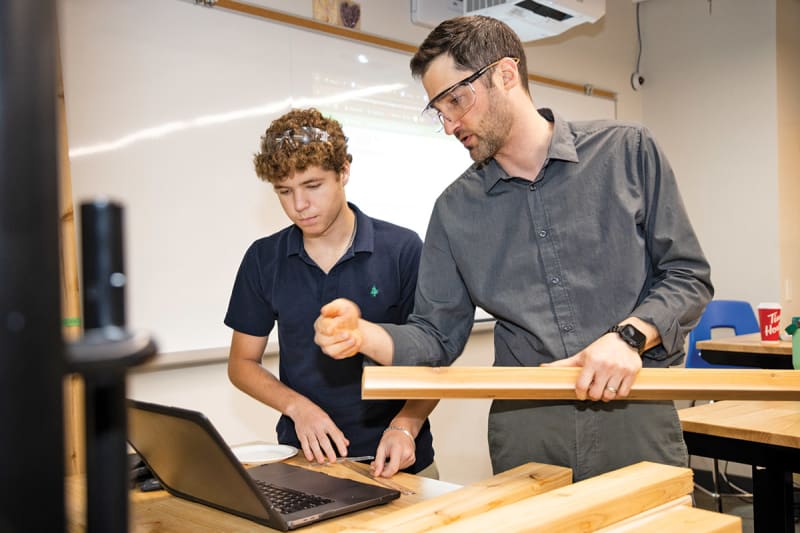
At Greenwood, the Innovation Lab is the hub for both high and low tech, and it’s open for course-based and co-curricular activities. Most independent schools have some kind of tech or maker space, but this one is unique in that students can access the latest digital technology, including a 3D printer and VR equipment, alongside woodworking equipment such as wood lasers. (The school also has a separate Media lab for film editing.)
“Students can come to the lab and express themselves creatively in very different ways,” says Tompkins, who also has woodworking expertise. “It’s great for those who enjoy learning on their feet.” Teachers can give students the option of creating something visual, such as a 3D model, to show their understanding of certain topics.
In addition to a number of longstanding courses in technological design, Greenwood recently launched a new offering in computer technology. Bill Farbstein, coordinator of the Innovation Lab, says there’s a push to give STEM an even stronger presence inside and outside the classroom. “Students don’t just learn real-world, transferable skills in the lab; they gain vital life skills like time management, planning, and organization.”
Pedagogical approach
Greenwood takes a thorough and systematic approach to ensuring students learn from high-quality teachers equipped with the profession’s latest skills and knowledge. At the same time, the school prizes educators who have qualities that are essential for building trust with students.
“When I’m hiring new staff, my number one priority is finding people who are going to connect with and support students,” says Principal Heather Thomas. “Having that human element– that care for students–is so important here. Number two, I’m looking for people who have the desire to keep growing as teachers.”
Most independent schools value teachers’ professional development (PD), but Greenwood’s ongoing investment in this area is striking. The hub for PD is the Greenwood Centre for Teaching, Learning and Research, which runs ongoing programming for seasoned teachers, those just starting out in the profession, and those new to Greenwood. In the first three years after arriving at Greenwood, for example, every teacher, regardless of previous teaching experience, undergoes frequent classroom observation and instructional coaching.
“A teacher in their first year here might receive up to 10 observations over the year,” says Director of Academics and Pluralism Ryan Vachon. “After every one of these, a senior teacher or administrator will sit down and have a conversation about what went well and areas for improvement.”
From years four to seven at Greenwood, the support continues but with reduced intensity. After year seven, there’s flexibility in how teachers choose to continue their learning and growth, but it never stops. Every Wednesday morning throughout the school year, while students engage in a late start for service learning, teachers pursue a wide variety of professional development opportunities.
“There’s always a huge range of PD over the year because the school is committed to us growing in our practice,” says Subject Team Leader of History & Social Sciences and Research Chair of Teaching & Personalized Learning Sarah Cooper. “Sometimes the school brings in outside experts to deliver sessions, but more often it’s developed by our colleagues who have gained expertise through continuing education or their own research.”
Recent examples have included an “AI Fair,” where teachers set up booths to share what they’ve learned about best practices for AI in education, and a seminar on how to nurture resilience in students.
“Our classroom teachers are so much more than content experts,” says Thomas. “We need them to be creative and build strong rapport with students because students learn better when they feel cared for and challenged.”
For students, this translates into strong bonds with their teachers. “I come to school excited to see my teachers just as much as my friends,” says one Grade 12 student. “The relationships that I’ve been able to create with my teachers through my six years are incredible.” In a similar vein, a student in Grade 9 says, “I feel like the teachers here are special because they care about more than just your grades. They care about you as a person, and it genuinely feels like they all want you to succeed.”
Based on our observations and discussions with parents and students, this is a common sentiment. “The teachers and staff have a great energy, which influences the whole community,” says one parent.
Academic support
Greenwood offers students tailored wraparound academic support, whether they’re seeking to extend past the standard expectations or struggling to keep pace. The interventions start small, at the level of the classroom teacher, and evolve in step with each student’s needs to gradually enlist other members of the school’s support team.
“One of the reasons the school was started was to support a broader range of learners,” says Executive Director of Admissions Tiara Hillis. “Up to one-third of our students in any year have an identified learning difference, such as a gifted designation, a learning disability, or ADHD. We don’t modify our academic programs, but we provide a wide range of accommodations to create an equitable learning environment for all students.”
One parent says the school met each of her children’s distinct academic needs. “One of my kids needs academic support and has an Individual Education Plan, and over the years, he’s learned to advocate for himself. My other child didn’t need the subject-specific help, but accessed support with time management and managing her stress.”
Adviser program
The Greenwood Adviser Program is the foundation of academic support at the school, but also provides all-around support for the whole student. Every student is paired with an adviser suited to their age and stage of development, and they stay with that adviser for two years. Advisers are teachers, yet for their 10 to 15 advisees, they act as champions and guides for all aspects of the students’ intellectual, social, and character development.
“The Adviser Program is absolutely core to Greenwood,” says Principal Heather Thomas. “Unlike at most other schools, our small adviser groups have scheduled class time in students’ timetables.” Advisers facilitate personalized academic support by meeting regularly with teachers to assess each advisee’s current strengths and areas of need, and then formulating individualized learning strategies. This could involve designing customized projects for advanced learners or setting up extra-help sessions.
From Grade 7 to Grade 11, the Adviser Program runs through a timetabled course. In Grade 12, when students are looking towards their futures, advisers function as guidance counsellors and meet with students individually to guide them in the postsecondary decision-making process. “Literally the only thing I did for my daughter’s university applications was give her the credit card for application fees,” says one parent. “Her adviser handled every detail and checked in with us, which offered so much peace of mind.”
Advisers play a unique role in students’ lives at school, even beyond the classroom. “As advisers, we are that vital touchpoint with a trusted adult who’s not a child’s teacher,” says Liz Wong, coordinator of the Adviser Program. “It allows us to be the liaison between students, their classroom teachers, and their parents.”
Parents couldn’t say enough about the value of having advisers as the first point of contact for their children. “You can reach out to them for basically anything, and they either obtain the information for you, connect you to the right person if that makes sense, or help facilitate whatever it is you’re seeking,” says one Grade 7 parent.
Student Success Centre (SSC)
The physical hub for Greenwood’s academic support system is the Student Success Centre, a comfortable, inviting space in a prominent location where advisers work with students with learning differences through Learning Strategies courses and one-on-one meetings. Its glass walls signal that this is a place where everyone is welcome and where each student is valued.
Students with an Individual Education Plan often have a timetabled period in the SSC every year, which is staffed with specialized advisers. “We’re trained to work with students of different exceptionalities such as giftedness, dyslexia, or ADHD,” says Allie Gottlieb, an adviser, an SSC adviser, English teacher and literacy coordinator.
The older students we met who had been at Greenwood for multiple years were particularly eager to sing the praises of their advisers and the SSC. “We learn a lot of strategies and it helps you so you are equipped to study on your own at university,” says one Grade 12 student. Another adds, “I would say they’re also good at not giving you too much support to the point where you wouldn’t be able to do it on your own. And they allow you to gradually get better as you get older.”
Prospective families and students who might be concerned that students with Individual Education Plans at Greenwood are frequently removed from the classroom for various types of support will be glad to know that this isn’t the case. “Our SSC advisers do a really good job of designing classroom accommodations with teachers so that students have what they need to be successful on a day-to-day basis with their peers,” says Vice Principal of Student Learning Elana Robson.
It was obvious in our interactions with Greenwood staff, students, and families that academic support is deeply integrated into the school culture. Accessing this assistance, for whatever reason, is considered the norm and seems to carry no stigma. We met students with identified learning differences who spoke of the comfort and relief of this academic culture. “I went to a school that wasn’t very helpful or accommodating,” says one Grade 12 student. “Seeing how well our family and friends with learning differences were treated at Greenwood was what drew us to the school.”
The real test of whether this wraparound support is actually effective comes when students leave the cozy walls of Greenwood. Judging by the stories teachers and advisers shared about graduates coming back to thank them, the proof is there.
Sheila Allen, a parent of two Greenwood graduates and one current Grade 10 student, as well as the director of athletics, says this: “My kids that are in university have said over and over again that the learning strategies and study skills that are formally taught through both the adviser program and the learning strategies courses are game changers. They went into university so well-prepared.”
Character education
In keeping with the school’s founding mission of developing good, well-rounded people, character education pervades every aspect of programming. The school makes this aim explicit through its Four Pillars of Character model, which was often cited in our conversations not just with staff, but with students and families. This is a place that takes character seriously and has instituted the structures to build it intentionally.
Character education can be seen in all aspects of the classroom and co-curriculars, and it’s a key part of the Adviser Program as well.
“We really lean into the four pillars of moral, intellectual, civic, and performance character,” says Principal Heather Thomas. “So much so that we report on students’ progress in all four on their report cards.”
Alongside the academic reports, Adviser Reports detail how students have demonstrated effort and achievement in each of the character pillars and suggest areas for improvement. Students co-create these reports, producing a combination of their self-assessments and teachers’ comments and observations.
“As advisers, we can delve into the soft skills that aren’t always taught in the Ontario curriculum,” says Liz Wong, coordinator of the Adviser Program. “This involves cultivating strong interpersonal skills that underpin character. And we personalize this guidance according to students’ individual needs.”
The Greenwood admissions process (see Getting In) involves the Character Skills Snapshot, which provides insights into incoming students’ character strengths and areas for development. “Based on this information, we can develop programming with our advisers to build certain skills that might be lacking in specific grade cohorts,” says Executive Director of Admissions Tiara Hillis.
Students appeared to be well-versed in the four pillars and keenly aware of the emphasis placed on character development at Greenwood. “Learning how to be a good person is just kind of shaped into the school’s values and how daily life is carried out here,” says one Grade 7 student.
In addition to teachers and advisers discussing and modelling positive values, the school makes character education concrete. One way is by recognizing students’ effort in each character domain through awards handed out at assemblies. Performance character awards, for example, go to students who have sought out a challenge or demonstrated resilience and perseverance in any aspect of their school life, whether in a school performance, on an outdoor education trip, in an athletic or academic competition, or through a classroom-connected experience. Intellectual character encompasses high academic achievement, but also pursuits that demonstrate creativity of thought and a love of learning for its own sake.
The extensive service-learning program is integrated into students’ schedules, cultivating moral and civic character in a deliberate way. The school lays the foundation in Grades 7 and 8, when students spend every Wednesday morning either going out into the local community to provide a service (such as reading to younger students or visiting older age homes) or attending sessions by non-profit organizations to learn about social issues and related volunteer opportunities.
“Service learning at Greenwood is not an afterthought,” says one new parent, who added that it was one of the primary reasons she chose the school for her son. “It’s not a checkbox to get your hours done to graduate. It’s built into their curriculum.”
In high school, the majority of Greenwood students continue their community involvement on Wednesday mornings through the school’s service-learning programs or on their own initiative. One of the more popular Greenwood programs is Hockey HEROS, where students work with younger children from Regent Park on their hockey and life skills, but the school is also partnered with about half a dozen other organizations.
Starting in the fall of 2025, Grade 8 students will work with local organizations and then spend the winter and spring gaining knowledge about global service organizations. “By Grade 9, they’ll have greater breadth of experience and will know what sparks their interest and where they want to give their time,” says Director of Grades 7 and 8 Catherine Wachter.
Director of Grades 9 and 10 Matthew West says it’s not unusual for high school students to far exceed the 40 hours of community service required to graduate. “Because they start in Grade 7, volunteerism is instilled early on. So in high school, they’re volunteering because they like it, not because they need someone to sign their form.”
As expected, the parents we spoke to had nothing but praise for Greenwood’s character-enriching initiatives. “On every level, they’re encouraging students to be good people,” says one. “For my husband and me, that’s why we’re investing in these years. We want to know that the school is adding value to my daughter’s experience beyond academics.”
Recognizing that the adolescent student experience inevitably has some bumps along the way, Greenwood has designed a thoughtful system to respond to lapses in character. The three vice-principals sit at the top of this system, which is based on the concept of restorative justice and learning from mistakes. This approach prioritizes conversation and accountability as early steps towards repairing harm and restoring relationships.
“We’ve been a lot more deliberate about training our staff in restorative practices over the last five years,” says Vice-Principal of Student Support and Well-Being Anthony Costa. “We have a very layered process, which starts with impromptu conversations about discipline issues and moves through steps like making an action plan with teachers and creating contracts with advisers.”
Disciplinary measures, like everything else at Greenwood, are designed to uphold a safe, inclusive learning environment. “Discipline is part of character education, and it’s everyone’s job,” says Costa. “If we as staff members see something, we have to call it out or call it in–meaning have a private conversation about it later–depending on the context.”
Well-being
The research-backed principle guiding all of Greenwood’s programs is that students’ social-emotional, physical, and mental well-being is critical to their ability to learn. “Caring about every student as an individual is a foundation here,” says Principal Heather Thomas. “We’re always asking, ‘What do they need today? Are they bored? Are they struggling? Did something happen at home?’ Really seeing the students in front of us, working hard together, while having some fun along the way—that’s the essence of what we do.”
The support system starts with teachers and advisers, who keep a close eye on the daily health and happiness of their advisees. “Advisers teach much more than learning strategies,” says Vice-Principal of Student Support and Well-Being Anthony Costa. “They teach well-being strategies and offer lower-level social-emotional support such as help with navigating social situations.”
A few parents we spoke to described how their children’s advisers helped them navigate non-academic issues that relate to academic success. “My daughter puts a lot of pressure on herself with school and marks and can get quite stressed,” says one. “Her adviser has been great about helping her develop skills to organize and manage her expectations.”
While advisers are not mental health professionals, most have completed Mental Health First Aid training. For more complex issues, advisers turn to Catherine Wachter, director of Grades 7 and 8, or Matthew West, director of Grades 9 and 10. (Grade 11 and 12 students rely on their adviser/guidance counsellor and the director of the Student Success Centre.) “A major part of our role is to ensure students’ social-emotional health, which includes consulting with our two school social workers about students of concern,” says Wachter.
Wachter and West have an open-door policy for students, who often drop by to chat or seek advice. A number of students did just that during our interview. The school social workers are available for one-time or ongoing counselling, and the school nurse provides walk-in counselling and treatment for minor physical ailments.
When we visited Greenwood, the theme for the year’s well-being efforts was capacity-building. “We want students to understand that discomfort is okay and help them recognize and grow their coping skills,” says Costa. “We want them to know they’re capable.”
There were various workshops and whole-school presentations on related topics throughout the year, including a “Disagreeing Well” workshop and presentations for students, staff, and parents on managing stress, anxiety, and emotions.
Building students’ social connections is a priority at Greenwood, and the school recently took a bold step to nurture more in-person conversations by banning cell phone use throughout the entire school day. “It’s been amazing to see our students engaging with each other on breaks with no technologies around them,” says Sheila Allen, director of athletics and a Greenwood parent.
Another way the school fosters well-being and connection is through careful scheduling of students’ days. “We have a coordinator of student well-being in the classroom who considers the cadence of classes and lessons and the timing of breaks,” says Costa. “It’s highly personalized for each course and the students in the class. For example, our students with ADHD might benefit from a physical activity break.”
Every day other than Wednesday, when students have service learning, there’s a mid-morning Community Time when students attend Assembly, meet with clubs or outside timetable courses, consult with their advisers, or attend special Community Time events. “When I chose Greenwood for my kids, I loved these intentional times for connection and recharging,” says Allen. On our visit, we witnessed the Lodge quickly fill up at Community Time and reach a happy, phone-free din.
Extracurriculars
Greenwood’s inclusive culture extends to its abundant co-curricular options designed to suit a wide range of interests. “Involvement in co-curricular activities plays a huge role in finding out what you’re interested in, finding community, and growing and developing as a person,” says Principal Heather Thomas. “So, we try to have something for everyone.”
Co-curriculars are voluntary for students, unlike the mandatory requirements at some independent schools, yet participation is very high. Advisers occasionally play a role in encouraging engagement by suggesting activities that appeal to their advisees’ individual interests, and students are attentive to the fact that their involvement will be reflected in their Adviser Report.
Still, most students are self-motivated in this regard, says Director of Outdoor Education and Student Life Julie Girvan. “Most Greenwood students are looking for connection and community in opportunities beyond the classroom. They want to figure out what they’re passionate about.”
To promote students’ exploration, the co-curricular schedule accommodates participation in diverse activities, from sports teams and clubs to the annual theatre productions. But it’s more than scheduling, says one parent of a student in his first year at Greenwood. It’s an all-embracing approach. “Greenwood feels like a place where, whatever a student’s spark is, they are looking for ways for that spark to glow brighter. It sets up opportunities for students to try things and fail sometimes, and try again and succeed. My son ended up doing audio-visual production for the school play, which he’d never shown interest in before, and he loved it.”
The students we spoke to confirmed that this approach is working. “At other schools, students might feel the need to define themselves either as an athlete or somebody who’s interested in the arts,” says one Grade 9 student. “Here, there are a lot of intertwinements, where someone who loves musicals can also be on two sports teams.”
The mid-sized school has big-school choices in co-curriculars, from clubs and student leadership (see Student Body below) to arts and athletics. The array of clubs varies from year to year based on students’ interests, as they can propose and run clubs with teacher guidance. During our visit, we met the Grade 7 student who had recently launched a Rubik’s Cube club.
Co-curricular arts are a big draw at Greenwood, with smaller performance options such as open mics and dance competitions and major theatre productions at the middle and senior level, a full-school musical, and annual concerts.
Athletics
Nearly 85% of all Greenwood students are on at least one sports team each year, with 97% participating at the Grade 7 and Grade 8 level. Greenwood is a member of the Conference of Independent Schools Athletic Association (CISAA) and competes with other schools of comparable size, though some teams compete up a division (with larger schools), making them eligible for Ontario Federation of School Athletic Associations (OFSAA) Championships.
The OFSAA teams include basketball, volleyball, rugby, and ultimate frisbee, with track and field athletes also competing at the provincial level. “Essentially, we punch above our weight class in a number of sports,” says Sheila Allen, director of athletics and a Greenwood parent.
As in all programming, the school prioritizes inclusivity in athletics, though not to the detriment of competitiveness. “Especially in Grade 7 and Grade 8, we want to make sure students are in their sport of choice,” says Allen. “We can do this because we have about 70 teams and can create them at different levels in certain sports.” The gym is also open for pick-up play before school, at breaks and at lunch, and it’s never empty.
Several parents we met marvelled at how many sports their children had played at Greenwood over the years. “The girls’ hockey coach found out my daughter played goalie for soccer and asked if she’d be their hockey goalie,” says one parent. “They supported her training and development, and she ended up winning the Performance Character Award for taking on the challenge.” Says another, “My daughter has played flag football, rugby, and I don’t know what else. She’s tried so many sports that we never thought she’d do because she doesn’t have to be the best. She can just have fun.”
While some independent schools use mostly external coaches, Greenwood prides itself on its teacher-coach model. “Outside coaches can be a transient group, and we see the value of attracting and retaining teachers as experienced coaches,” says Allen. “Their interactions with students in the athletics domains further build crucial student-teacher relationships.”
Character education is thoroughly integrated into athletics programming. “At the end of the day, there can only be one team that wins a championship,” says Allen. “Our goal is to be known as a school with high moral character within the athletic context.”
Students travel to partner facilities for practices in certain sports, but the soon-to-be-completed Greenwood Greenspace will soon provide a high-quality turf field. “As a coach or parent, I’ve never heard a student complain about getting on a bus for a game,” says Allen. “And I think it’s an advantage to experience facilities across the city for when they’re recreational athletes down the road.”
Greenwood’s elite athlete course, an example of classroom-connected experiential learning (like the musical theatre and leadership electives) enables serious athletes to gain credit for the outside hours they put into their sport while also completing related academic course content.
Outdoor education
As it does in other areas of priority programming, Greenwood puts outdoor trips on the timetable. Every September and January, the different grades head out to some kind of wilderness, with the settings becoming progressively more rugged over the years. “Students, teachers, and school leaders–we’re all having an adventure at the same time,” says Principal Heather Thomas.
It’s no coincidence that many Greenwood teachers have a camp background, whether as campers, counsellors, or both. “We attract a lot of teachers who are passionate about the outdoors and believe in the value of camp experience because every staff member is expected to participate,” says Director of Outdoor Education and Student Life Julie Girvan, who was a camp director.
The aim is to build and reinforce community ties within and across grades, but also to enhance students’ leadership skills, competence in the outdoors, and ‘gritty’ character traits such as perseverance. Students in Grade 7 start with a stay at an Ontario summer camp, building up skills over the years so they can move from canoeing to kayaking to whitewater rafting, for example. Every outdoor experience is cell phone-free.
“Though my daughter is not an outdoors girl, she’s chosen to do the advanced canoe trip in Grade 10,” says one parent. “She’ll be portaging, which is amazing. The trips have increased her confidence, and she’s tried so much more than I did at her age.”
Other parents voiced similar praise for the character-building nature of Greenwood’s outdoor education program. “They structure every trip so that there are opportunities for success and positive feedback, even if students are trying things for the first time and struggling,” says another parent.
Starting in Grade 10, students have some choice in the setting and rigour of the outdoor trip. For example, in Grade 11, students go to Vancouver Island, where they can opt for sea kayaking or hiking. In Grade 12, they can go to Costa Rica (the only trip that’s not covered by tuition) or stay in the city for an urban service learning program for the Winter OE. In the Fall, Grade 12s can sign up to be leaders/counsellors at the younger students’ camps.
Student body, leadership and diversity
One of the ways Greenwood maintains a small-school community feel is by creating a cohesive student body across grades. It helps that all of the students are in the same building, sharing the same common spaces. Unlike most independent schools, there’s no sharp delineation between the middle school and high school.
Parents spoke of noticing the camaraderie between older and younger students on their first visit to Greenwood. “I remember seeing a Grade 12 student high-fiving and talking to a bunch of Grade 7 students, and it became evident on the admissions tour that the school took these connections seriously,” says one parent.
Our observations of a multi-grade discussion group proved this to be true, with one Grade 12 student who had been at the school since Grade 7 providing the strongest evidence: “I feel like I can have a meaningful conversation with anybody in the whole school,” he says.
According to Director of Outdoor Education and Student Life Julie Girvan, a lot of thought and planning goes into creating this ease among students. “Our House system is made up of groups of students from all the grades to encourage bonding, and our student leadership system’s many committees are mostly open to students from Grade 7 to Grade 12.”
While there are many benefits of whole-school unity, Greenwood is also sensitive to the fact that younger students also need spaces and activities of their own. “We recently started periodic separate middle school assemblies and are building more co-curriculars and leadership roles that are just for them,” says Catherine Wachter, director of Grades 7 and 8.
Parents say they appreciate the quantity and variety of leadership opportunities at Greenwood, especially in the upper grades. “My son never wanted to be the centre of attention, and now in Grade 12, he’s applying for senior leadership positions,” says one. “I think it’s because when he was younger, he looked up to the older kids, and the school does a great job of preparing the younger students with smaller leadership responsibilities.”
In terms of the composition of the student body, there is limited socioeconomic diversity, as is the case at most independent schools. Until recent years, the same was true for racial and ethnic diversity, but there’s been some positive momentum in that area. It’s all consistent with Greenwood’s efforts to promote inclusivity and pluralism across the student experience.
“We’re being intentional about increasing the ethnic and racial diversity here, both among students and staff, and it’s grown steadily, which is fantastic,” says Principal Heather Thomas. Executive Director of Admissions Tiara Hillis says the school has been tracking progress in this area and has seen measurable changes over the last five years. One parent shared how she first looked at Greenwood for her son several years ago and was impressed by every aspect of the school, but the lack of visible diversity was a dealbreaker. A few years later, when her daughter was ready for Grade 7, she returned to see if things had changed. “Before, there were almost no other kids of colour, which was disconcerting,” she says. “When I went back, it was obvious that the school was working very hard on changing this, so I was comfortable enrolling my daughter.”
Among other initiatives, Greenwood launched a parent community group focused on inclusion, which this parent joined. “We’re working on strategies to make the school more appealing to a wider base of families, and the school has listened to our insight as parents,” she says. “We’ve attracted a number of new families, and now we’re focusing on how to make sure they feel included once they get here.”
Getting in
Unlike many independent schools, Greenwood does not rely on external or internal testing in the admissions process. “We believe that report cards offer a better long-term view, rather than a single assessment,” says Executive Director of Admissions Tiara Hillis.
In alignment with its aim of developing students’ all-around potential and focusing on more than high academic achievement, the school considers applicants who are committed to growing and learning, even if their marks aren’t stellar. “Our philosophy is that students who meet the basic academic expectations of the school can thrive with the right support,” she says.
The only formal assessment that all students must complete is the Character Skills Snapshot, a short questionnaire that measures students’ preferences, attitudes, and beliefs. The student interview is the final step in the process. “Based on the results of the questionnaire, our admissions teams might ask follow-up questions to tease out where students’ strengths lie or where growth areas could be.”
Tuition is on par with comparable independent schools, yet parents will be interested to know that Greenwood tuition covers most of the students’ activities, including the extensive outdoor education program. There’s a $10,000 one-time initial enrolment fee for new students, which is discounted for siblings. Limited needs-based financial aid is available and co-ordinated through a third party, and the school has plans to increase this by growing the endowment. There is no merit-based financial aid at this time.
The school offers many opportunities for prospective families to get to know the school. “We try to allow families as many touchpoints as possible,” says Hillis. “Families are not expected to attend everything; it’s up to them to determine what would be helpful to attend.”
Admissions events include a more typical open house, but also a conversation with the principal, sessions on academics, including a panel of students, and a session focused on various aspects of school life (including co-curriculars, service learning, and outdoor education). One parent we spoke to said she attended every single one before her son applied, and this extended access to the school helped sway her decision.
Prospective parents can also reach out directly to current Greenwood parent ambassadors via the website. Hillis says that Greenwood parents work in the usual range of professions, such as law and business, but there seems to be a high number of entrepreneurs. “I think they’re attracted to our spirit of innovation in teaching and learning, and our recognition that young people today will need skill sets that will help them navigate multiple careers.”
Parents
Parents told us that there are plenty of avenues for getting involved in the life of the school, but no pressure. “The first year my child was at Greenwood, I participated in nothing because my impression from parents at other independent schools was that you had to make a huge time commitment,” says one parent of a Grade 10 student. “That’s not feasible for me, because I have a full-time job. My child’s adviser encouraged me to get involved, and I’m glad she did because there’s not much of a demand on your time. You do as much as you can and want to do, and it’s been awesome to be part of the Greenwood community.”
Another parent says the options for socializing with other families are wide and suited to a variety of work schedules. “You can go to one of the dinners in the evening, which have had great culture-specific themes, or do an informal coffee walk in the morning before work.” Volunteer opportunities include being a chaperone for the service-learning program, a grade representative, a helper at special events, or a careers day speaker.
New families can get to know their fellow parents through a welcome dinner in the fall, which is also attended by staff members, or attend a range of events such as graduate panels or parent education sessions. The official parent/guardian organization is called the Greenwood Roundtable, which holds monthly meetings open to all families at any time.
The parents we met agreed that communication with the school is easy and efficient, largely due to the Adviser Program. “I couldn’t ask for anything better than to have a single point of contact who not only knows the school, but knows my child really well,” says one. “It’s an extremely convenient system for parents.”