
The 2026 OUR KIDS Private School Expo is coming to cities near you. Get your family pass



MacLachlan College THE OUR KIDS REVIEW
Verified Review
OUR KIDS verifies every review by confirming the reviewer’s identity and their firsthand experience with the school. Learn more
The 50-page review of MacLachlan College, published as a book (in print and online), is part of our series of in-depth accounts of Canada's leading private schools. Insights were garnered by OUR KIDS editor visiting the school and interviewing students, parents, faculty and administrators.
OUR KIDS editor speaks about MacLachlan College
Introduction
In the heart of Oakville, Ontario, sits MacLachlan College, a co-educational independent school offering a dynamic and transformative education from Pre-Kindergarten through Grade 12. For nearly five decades, MacLachlan, affectionately known as MAC, has inspired generations of students to grow into confident, capable, and compassionate global citizens.
MacLachlan operates across two distinct campuses. The Trafalgar Campus (Pre-K to Grade 6), located in a historic Olde Oakville mansion, reflects the Lower School’s bold and creative vision, grounded in the IB Primary Years Programme. The South Sheridan Way Campus (Grades 7–12) offers a future-focused environment with modern, collaborative learning spaces and an Advanced Placement-focused academic approach, which adds flexibility for students to choose their enrichment focus.
After meeting school founder Audrey Hadfield, it became clear that connecting with students has always been at the core of creating an inclusive, welcoming, and academically rigorous school culture. Established in 1978 by Hadfield, an educator herself, who recognized a gap in reading support within traditional schools, MacLachlan College has grown from a small, home-based program into a vibrant and progressive learning community. In 1983, when the school moved to its current heritage building site, Hadfield created a sign that read, “Through these doors walk the greatest kids on earth.” That spirit remains central to MacLachlan’s identity today.
MAC provides a highly supportive yet academically focused environment that emphasizes small class sizes, personalized learning, and meaningful student-teacher connections. With a progressive curriculum and a balanced focus on academics, arts, an expanded and impressive athletics program in the Upper School, emotional intelligence, and global mindedness, they offer more than just education; they proudly offer preparation for life.
In Spring 2026, MacLachlan announced its partnership with Dukes Education and became a member of their family of schools, the first in Canada. Dukes Education shares a deep commitment to excellence and a belief in the transformative power of education. The partnership positions MacLachlan College for continued growth and innovation while preserving the close-knit, student-centred culture that has defined the school for nearly five decades. Through the Dukes network, MacLachlan students and staff will gain access to expanded international learning opportunities, collaboration with schools and educators around the world, and enhanced academic and co-curricular programming.
As Canadian families increasingly seek globally connected educational experiences that balance academic rigour with wellbeing, leadership development and personalized learning, the partnership reflects MacLachlan College’s continued investment in delivering a future-focused education grounded in strong community values. It is grounded in continuity as much as in possibility, positioning MacLachlan to thrive for the next fifty years and beyond.
“For nearly 50 years, MacLachlan College has focused on creating an environment where students are known, supported and inspired to achieve their full potential,” said Audrey Hadfield, Founder of MacLachlan College. “Joining Dukes Education represents an exciting next chapter that will create new opportunities for our students, staff and families while preserving the personalized learning environment and culture that make MacLachlan special.”
Heather Birnie, Director of Admissions & Communications, says, “Audrey’s entrepreneurial vision and commitment to education built MacLachlan’s phenomenal foundation, and we’ve very much expanded on it. We are a proud International Baccalaureate (IB) school, a Round Square school, with a mindset of educating global learners. We want to ignite the spark in our students.”
Round Square is a global network that pushes the boundaries of traditional education and encourages students to think boldly, act ethically, and approach the future with an entrepreneurial and success-driven mindset. By employing IDEALS: Internationalism, Democracy, Environmentalism, Adventure, Leadership, and Service, students adopt this ethos that’s embedded in every aspect of school life. As Leslie Leys, Assistant Head of the Lower School, Student Life, explains, “We are preparing global learners. The world is so interconnected today; if we want our students to thrive, they must be taught to think globally.”
MacLachlan prioritizes students in every decision. Faculty and staff are committed to creating a learning environment where students feel seen, valued, and empowered to reach their personal best. A former MacLachlan parent with a child in the Upper School writes, “Coming from a school we considered excellent, we weren’t sure what to expect, but our experience at MAC has gone far beyond anything we imagined. Every day, I saw how genuinely happy the students were, how naturally they felt at home, and how much the school truly belongs to them, not the parents. That’s rare. And it’s beautiful.” She went on to say, “In other schools, teachers teach. At MacLachlan, they connect. And that’s what transforms the experience.”
MacLachlan’s informal motto, “Where Tradition and Vision Meet,” complements its official one, Fortis et Fidus (Bravery and Trust), capturing the essence of a school that honours its heritage while preparing students for the future. Whether through community involvement, leadership development, or global learning opportunities, students are encouraged to become bold thinkers and compassionate citizens.
This includes hands-on community service that transcends the usual notion of service, where students tackle problems and devise solutions that they implement. “We nurture students’ agency through service. One of the IB profile attributes is being principled. Doing the right thing when nobody’s looking and doing it for nothing in return, that’s character building. Students need to experience it to learn it,” says Leys, highlighting the school’s focus on purposeful engagement and character development.
At MacLachlan College, the values of connection, curiosity, and courage shape every aspect of school life. The result is a vibrant and inclusive community, one where students are not only prepared for the next step in their education, but for anything the future holds.
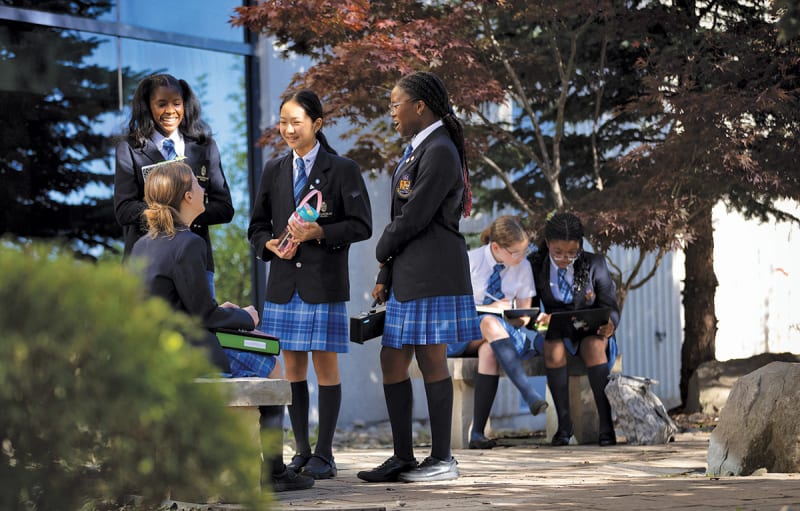
Key words for MacLachlan College: Connection. Innovation. Global-Mindedness.
Basics
MacLachlan College is a non-denominational, day school straddling two campuses in Oakville, Ontario. As the only co-educational school in Oakville for students from Pre-Kindergarten to Grade 12, MAC offers a challenging academic environment within a nurturing community. Every teacher at the school is certified by the Ontario College of Teachers, a requirement that sets MacLachlan apart, especially as some independent schools don’t share this standard. As founder Audrey Hadfield and Assistant Head of Lower School, Student Life, Leslie Leys put it, “It lends to our credibility.”
Currently home to about 450 students, MacLachlan is experiencing an exciting phase of growth. The school recently added a secondary building next to its new Upper School campus on South Sheridan Way, enabling it to accommodate more students as needed. This newer acquisition is a sleek, modern facility that resembles a Silicon Valley headquarters, designed to support the school’s next chapter. The Lower School is in a charming mansion in the Olde Oakville neighbourhood, surrounded by historic homes and an expanded backyard playground.
Students and staff alike appreciate the added space afforded by having two campuses, not just for the increased elbow room, but for what it represents. Historically, MacLachlan has been known for strong academics, but the high school was too small to support competitive athletics programs. Students interested in sports often move on to larger schools after elementary school, explains Mark Hadfield, School Director. “That was one of the pieces that we’ve looked to change and spent the last 10 years trying to figure out how to do it,” he adds.
With plans to continue developing its Upper School, MAC is now proudly poised to support future pro athletes, including those with Olympic ambitions. The school recently welcomed the new Athletics Director to lead the charge in building MAC’s elite programs. Traditional sports like prep hockey will be offered alongside one of the first school-based climbing programs in Canada, led by not one, but two Canadian Olympic athletes starting in fall 2025. Already, the hockey program is drawing standout young talent from across the country, with plans to expand to a full girls’ program as well.
With continued development of the Upper School, MAC is now positioned to support high-performance athletics, including students with aspirations at the collegiate and professional levels. Recent initiatives include expanded hockey programming and the introduction of a school-based climbing program, led by Canadian Olympic athletes.
While the school continues to grow in scale and ambition, one thing remains unchanged: the deep sense of community that defines life at MAC. Faculty and staff often stay for decades, treating the school like an extended family. “At one time, we had four teachers who were also former students,” says Heather Birnie, Director of Admissions and Communications. Head of Lower School, Jacki Bright, has been at the school for thirty-three years and counting. “We’re a family here at MacLachlan. I don’t think I’d be here this long if I didn’t feel like this was my second home,” she says.
That sense of connection is further strengthened through MacLachlan’s house system, a core part of student life. Every member of the school community is assigned to one of four houses, each named after early Oakville pioneers: Colborne, Sumner, Thomas, and Chisholm. The system brings students together across grade levels and fosters belonging through friendly competition in academic, athletic, artistic, and service-based events.
“I’m a proud Sumner Shark,” says Leys. “A lot of the things that we do are grade or age band-based, but our house system is vertical, where students in a house will do activities together through different grades,” she explains. Whether they’re cheering during a rally, leading a service initiative, or competing in a school-wide challenge, students build confidence and create meaningful connections that last.
The school calls this dynamic blend of tradition and innovation “MacLachlan Magic,” an energy that’s hard to define but easy to feel. It’s what everyone we spoke to says makes the school experience so unique. Opal Manhertz, a parent of two current MAC students, sees it firsthand every day. “My daughters go to school, and at the end of the day, they come home, and your mind is blown by the topics they study and the ways they apply them. Their confidence is rising,” she says, adding, “Students know each other, support each other, and so do the parents and teachers. Everyone is working together. Students are thriving, and teachers know their efforts are making a difference.”
There’s a culture of possibility that exists at MacLachlan College that students and parents alike are also drawn to. Students are encouraged to think big, take initiative, and explore their interests, whether through student-led projects, leadership roles, or co-curriculars.
As Birnie explains, the school’s use of the International Baccalaureate (IB) PYP framework in the Lower School and AP in the Upper School, along with its Round Square affiliation, gives students a well-rounded, globally minded foundation. “Whatever topic they’re covering in their IB unit of inquiry can relate to art, to science, to language, and often even music or physical activity. The world does not run in silos; it’s very interconnected. And this is an amazing way of nurturing that perspective in students,” explains Birnie.
Behind the scenes, much of the school’s success is driven by the staff’s willingness to evolve, embrace change, and pivot, something Birnie says is solidly ingrained in MacLachlan’s ethos. “Although we have the tradition of being in operation heading towards 50 years, the learning end has not stagnated in any way with our students or our staff. They’re still hungry to learn more, to learn new strategies, and adapt to the changes of the students.”
Everyone we spoke to at the school agrees that being open to change is essential. The world has changed, and MacLachlan College has adapted to meet the needs of a new generation. Birnie and founder Audrey Hadfield note that in the last 15 years, Oakville itself has changed significantly, becoming more culturally and demographically diverse. “Our global perspective, our inclusiveness of all different types of cultures and religions, is a mosaic that is representative of what Canada is. It enriches our school community and is something the students are proud of,” says Birnie.
The school’s expansion is a testament to that forward-thinking mindset. School Director Hadfield explains, “The fact that we can go from a single campus of 30,000 to 40,000 square feet for 47 years, and then in a matter of two and a half years, go from that to 3 buildings and 100,000 square feet says something. We’ve taken an existing building and turned it into an incredible academic institution in a matter of years.”
The Manhertz family’s journey reflects the strength of that vision. Her daughters say they feel “at home” at MacLachlan and want to continue to the Upper School. Originally planning to return to the U.S. after Grade 8, they decided to stay because of their daughters’ experiences. “Our older daughter asked to stay, telling us, ‘I love my environment, my teachers, my school.’ As a family, we made that decision to continue at MacLachlan because of that,” says Manhertz, adding that even parents feel heard, listened to, and supported.
To maintain that personal level of connection between staff, students, and parents, MAC has implemented an advisor program for Grades 9 through 12. Each student is assigned a dedicated advisor group consisting of one teacher and 8 to 12 students. “Once they enter Grade 9, they get assigned to an advisor, and then that advisor will move with them through their high school years,” says Head of School, Michael Piening. “In that way, the parents have that single personal connection, and staff members will really get to know those families and those students. There’s a family type of connection that we always feel MacLachlan College is known for.”
Background and leadership
Founding an independent school wasn’t top of mind for English-born educator Audrey Hadfield when she was asked to volunteer in her children’s Grade 3 class. At the time, she was on sabbatical, raising her children and helping at the Oakville school near the family’s home. There were four boys in her child’s Grade 3 class who could not read. “I went in once a week, and there was never a proper place to teach, no materials, and so I thought I should start designing a program,” she explains. The program, it turns out, was so effective that Hadfield eventually decided to formalize it.
“I established a small teaching room in our home when we lived on Chartwell Road, and it took off. There was no other facility that was doing what I was doing, and I decided that since I was going into the school and the children were being taken out of class during school hours, that I would do the same,” says Hadfield. The arrangement meant that the parents would pick students up during the school day and deliver them to Hadfield’s classroom, where she successfully taught children to read, before being dropped back at school for the remainder of the day.
Hadfield was notified that her reading students were being marked as truant when they attended her classes, so she took the next logical step and registered as a private school in 1978, not only because she saw a need and had the credentials, but because she has always believed that if you build the right kind of culture, children will thrive. “It expanded from there. We rented a few places before we decided that it was time to make it a permanent school, and that’s when we bought this place here,” says Hadfield.
The place she’s referring to is a black-and-white mansion built in 1856 by business owner Richard Shaw in a 19th-century Victorian style. By 1983, MacLachlan College moved into what is lovingly called “The Grand Old Lady of Trafalgar,” with a painted sign created by Hadfield welcoming children through its front doors.
Although Hadfield remains deeply involved in the MacLachlan community as a guiding light and inspiring presence whose values continue to shape the school’s culture, she has passed the torch to the next capable generation. For the past thirty-three years, that torch has been carried with the highest standards. Since 2009, it has been in the hands of Head of School Michael Piening.
Piening was hired in 1992 as a Grade 4 homeroom teacher by founders Audrey and her husband, Colin Hadfield. He held various roles, including math teacher, before becoming Head of School. “Coming into the role, I wanted to make sure I continued to live up to our motto at the time of ‘Where Tradition and Vision Meet’ by ensuring the continuation of MacLachlan’s traditional values and strong educational foundation, while ensuring we embraced new methods, technology, and resources as they became available.
His leadership brings a sense of purpose and energy to MacLachlan College, where his collaborative style blends strategic focus with a deep commitment to the school’s mission. He describes it as, “I subscribe to servant leadership. It is important for everyone to know I have walked in their shoes and am still willing to do all the small things that allow our school to function. I want everyone to see me doing all the small things (not for recognition but as an example), so that everyone knows every task is important and if I ask them to do something, they also know I have (or will) do it too. I put away chairs after assembly, I will cover a yard duty, coach, and grab a mop from the closet to clean up a spill. When I ask others to do something, they know I’m just as willing to do it myself.”
Under his guidance, MacLachlan advances intentionally as a leader in educational innovation, moving beyond traditional rote learning to focus on curiosity, creativity, and collaboration. Piening states this approach is especially suited for today’s socially engaged and interactive learners. Despite the school’s expansion and changes, Piening is preserving the close-knit, student-centred culture that defines the MacLachlan community. “Maintaining the same type of school culture that we have now, which is very student-centric, very family-oriented, is important to make sure that we’re keeping those connections alive,” he says.
Both Piening and Heather Birnie, Director, Admissions and Communications, believe that as a school, it’s their responsibility to help students reach their dreams. With a new high-performance athletics program, along with other initiatives that are currently being thoughtfully assessed, there’s a constant that remains: no student goes unnoticed at MacLachlan.
Part of that is due to its smaller size, but the most significant aspect is based on choosing people-first educators who purposefully connect with students. “You’re seen here, in class, in the hallways, at events, you’re seen as the person that you are, who is ever evolving,” says Birnie. “Our school is a safe space,” adds Piening, insisting it will always remain so.
His approach reflects a clear belief: a school can grow and innovate without losing the spirit that makes it feel like home.
Academics
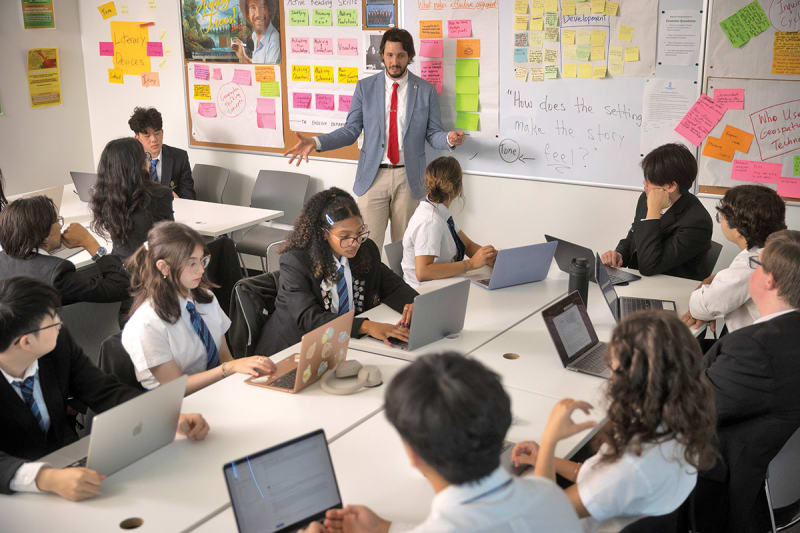
Most independent schools are, by nature, academically challenging, but not all of them are nurturing or believe that students learn best when they understand how ideas connect across multiple disciplines. The academic program at MacLachlan emphasizes interdisciplinary thinking, allowing students to make sense of the world by drawing links between subjects and applying their learning in meaningful ways.
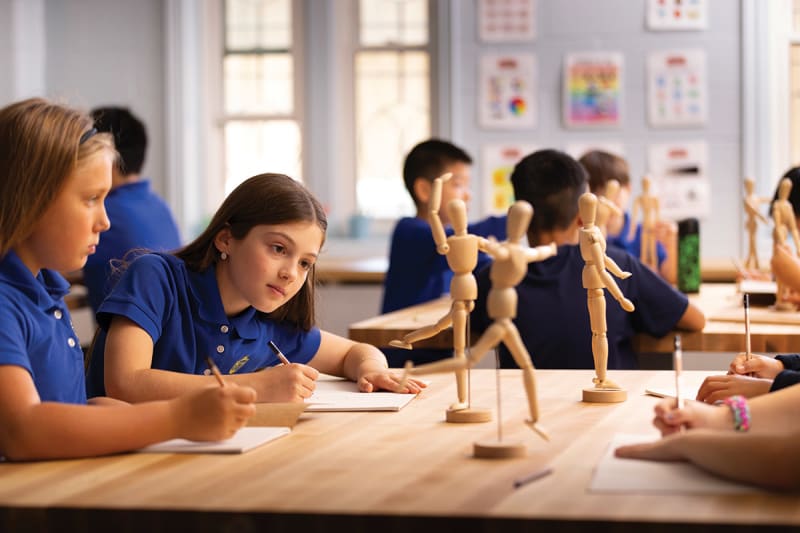
An example of this, explains Leslie Leys, Assistant Head of Lower School, Student Life, is that in the Lower School, “We are very into transdisciplinary learning. Our Grade 4 class might learn a French play, and the way that they exhibited it is that they learned French with their French teacher, the play had a musical score, so they worked with their music teacher, and then brought it to life through stop motion animation.” This interconnectivity is designed to combine traditional, core programs with innovation and technology. Leys adds, “And that’s how you learn. It’s not just in one classroom, at one time. The more you repeat it, the more it sticks.”
Head of School Michael Piening agrees that engaging students, whether through transdisciplinary projects, field trips, or collaborative practices that champion exploration and knowledge-building, will always win out at MAC over rote memorization-style learning. “We’ve always tried to make sure project-based learning is part of the curriculum at every grade level,” says Piening. “We have the space and resources to support students with their projects across all disciplines.”
In line with this vision are the school’s Interdisciplinary Studies (IDS) and global travel programs, which give students the chance to explore different cultures and points of view. Whether through Round Square collaboration and global travel opportunities, or international service trips, these experiences take learning beyond the classroom and into the real world.
Employing an inquiry-based approach, MAC students of every age are encouraged to ask meaningful questions that drive their learning journey. “They’re not just asking—they’re doing the research, and finding the answers themselves,” explains Piening. These habits, he adds, are the foundation of effective leadership. “You want leaders who don’t just sit back and wait for direction. Our students learn to take initiative from a young age, and that mindset continues to grow as they move through the program.”
By the time students reach the upper grades at MacLachlan, they’re actively involved in Round Square, a global network of over 200 schools across 50 countries. Through this partnership, they take part in programs and experiences that broaden their worldview, build character, and develop genuine confidence, all key traits for leading with purpose in any career they pursue.
Sophie Gregg, a MAC 2020 graduate who now holds a Law, Justice & Society undergraduate degree from Dalhousie University and will be attending Osgoode Hall for law school, says the greatest gift she received from MacLachlan College is her confidence. Smaller Upper School class sizes, coupled with the ability to reach out to helpful teachers and staff whenever she needed, gave her “such a supportive environment that allowed me to become way more confident in myself and my intelligence.”
The environment is bolstered by teachers like Head of English, Gregory Dominato, who was also Gregg’s favourite teacher at MAC. He explains that the focus in good education over the last decade has been student-centred, which looks at more than just learning needs. “There are psychological needs, processing needs, and so forth. You become more aware of who’s in front of you.” This is part of what he calls “the traditional triangle of learning,” which includes: students, teachers, and parents. “You can’t do anything useful or dynamic unless all three are working together.”
A big part of Head of Lower School Jacki Bright’s job is ensuring all three are seamlessly working together. She observes that MAC teachers are a special group, all Ontario Certified (many with master’s degrees in their subject specialties), chosen for their willingness to go above and beyond. “This is much more than just a job. At our school, it’s important that you know the children you are teaching and the only way to do that is to develop a relationship with them, and they have to go beyond the classroom.”
Teachers like Upper School Math and Science teacher Meghan Tomasik find ways to get to know students both inside and outside the classroom. “If people are comfortable with you, then they’re more willing to ask for help. In the classroom, I try to connect with them on a different level, and I think things like the house system or sports activities give you a chance to have a back-and-forth,” adding. “So, when you approach me for some extra help in science. Now we have a relationship, and that helps on all levels.”
It might sound obvious, but staff like Ms. Bright know every one of the Lower School students’ names. “That is something that’s important to me because children, as soon as they know you know their name, they feel special,” she says. This is expected of all teachers. As previously stated by Birnie, at MAC, everyone is seen and welcomed.
The other thing that stands out about the teaching at MacLachlan is how teachers tackle traditionally “dry” subjects. In physics or math, for example, Tomasik says, “I want them to learn how to think through something, how to approach something they’re unfamiliar with. The best problems for me to solve in physics are the ones where you don’t know how to solve at first, you think, ‘Wow! I’m not sure.’ And you start solving it, whether that’s with a pencil and paper or making a mousetrap car.”
In Tomasik’s physics class, students use the Upper School’s new Maker Space, equipped with a laser cutter/engraver called an X Tool, drills, and even a Cricut computer-controlled cutting machine to build everything from catapults and marble rollercoasters, to mouse trap cars (Tomasik also teaches a Grade 9 Tech Class in the space and other classes have access to the room and use it for making things like theatre sets in drama, to engraving a quote for English studies with an explanation of the quote on the back). This is a hands-on way for students to see the concepts they’re learning come to life.
As Tomasik explains, the car runs on energy stored in a mousetrap spring. When the trap unwinds, it spins the axle and moves the car forward. Through the project, students analyze motion by creating graphs that track speed, distance, and acceleration, while also breaking down the forces at play and how energy is transferred and transformed. She says it’s a practical way to assess their understanding of physics principles, not just through tests but through application. It also introduces basic building skills since many students have never used a power tool before.
Learning to operate something like a drill safely gives them confidence and a sense of achievement. Projects like this combine theory with creativity and problem-solving, making the learning experience more meaningful. “For them, to see physics in action, to see the energy transferring from something wound up like a mousetrap in the rotational motion of the wheels, I think it brings everything that we talked about in class to life in a way that you can’t with a pencil and paper problem.”
While adding that layer of engagement in physics is always a hit with students, there’s a deeper reason why Tomasik teaches this way: “I am not interested in straight-up knowledge as much as I’m interested in being able to look at something new and apply that knowledge to answer a question or to solve it.” It’s the mental agility and transferable skill sets she seeks to develop in students, for careers or jobs that may not even exist today.
To give graduating students a head start, Piening also points to the Upper School’s AP program. This offers enrichment above and beyond the Ontario curriculum. “Students in Grades 11 and 12 take courses beyond the Ontario curriculum in areas like Computer Science, Math, French, Biology, or English, for example, so that they’re better prepared for 1st year university courses.”
To further support academic growth, MacLachlan offers the IB Middle Years Programme (IB MYP) for Grade 7 and 8 students and Advanced Placement (AP) courses in Grades 11 and 12. These courses extend beyond the Ontario curriculum, providing students with a deeper understanding of subjects such as mathematics, science, languages, and English.
For example, in the Ontario curriculum, Piening says students taking Grade 12 Calculus & Vectors only learn the first half of calculus, differentiation. In an AP course, you get both halves, differentiation and integration. “When you’re sitting in a first-year lecture, it makes more sense as you’ve had exposure to these topics. When they’re coming up for the second time for you, and the first time for the people beside you, you’re at an advantage,” he explains.
Staff are always on hand to help those who need it, but it’s also worth noting that if your child excels beyond their grade in certain areas, MAC teachers are also there to help them track their trajectory. Gregg’s older brother attended the school first because she says the French-immersion public school system wasn’t challenging him enough. Both siblings found their “home” at MAC. Gregg describes it this way: “MacLachlan prepared me so well academically. I built a strong work ethic and, in a lot of ways, found my degree easier than high school.” It’s also worth noting that the school has a 100% post-secondary school acceptance rate.
Technology and AI
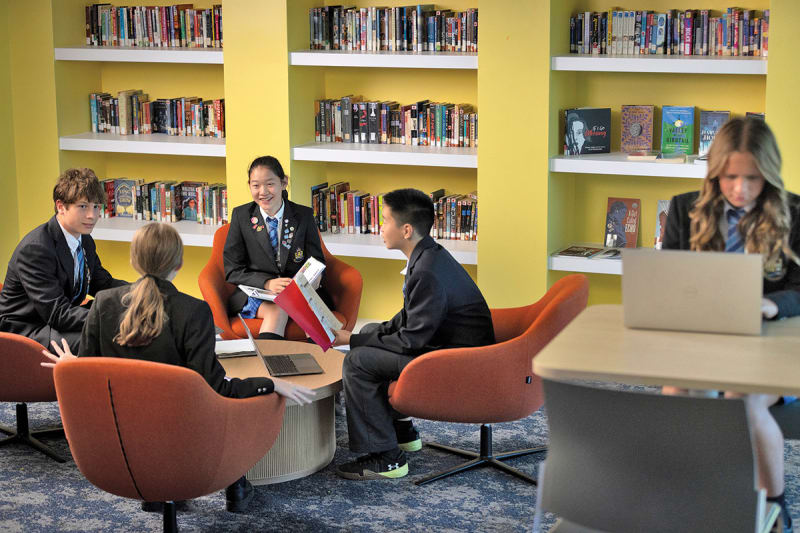
MacLachlan College thoughtfully incorporates technology to enrich and support traditional learning. Starting in Grade 1, Lower School students participate in a one-to-one iPad program, and classrooms are equipped with up-to-date SMARTboards and interactive software. Leslie Leys, Assistant Head of the Lower School, Student Life, says technology is just one of the many tools employed at MAC. “Just like a pencil, we have the iPad as a way of working, but it’s not the be-all and end-all. We’re very cautious of screen time. That’s very important for us.” She adds, “For example, if we have indoor recess because we have some inclement weather, iPads are not brought out, and technology is not brought out. We also have SMARTboards that we use for educational purposes, but not for time-filling. Our technology is very purposeful.”
Heather Birnie, Director, Admissions and Communications, recalls how people once worried about the impact of the Internet when it was first accessible to students. “We’ve gone from having a computer lab to everyone owning their own devices. Technology here is used very intentionally, and we’re constantly changing the rules of how it’s used because the children who are coming into schools growing up in a digital world.”
She adds that at MAC, technology is also used to introduce students to coding, stop-motion animation, and other outlets in which it’s used creatively, as well as for research. In the Upper School, Birnie cites the following example: “The Grade 9 students were given an end-of-year summative for science, and they had to build a space station. They could build it physically, but there was also the opportunity to do it digitally. Some students used Minecraft. We see technology as giving us more options. Though there’s a common project or expectation, you don’t want to see projects all looking the same.” Giving students voice and choice, so that they can express their interests creatively while using technology, is the MAC way, while ensuring they have that sturdy foundation of learning and skill sets.
As an extension of the Innovation class that Lower School attendees receive, Grade 9 students will take Upper School Math and Science Teacher Meghan Tomasik’s Engineering Technology course through the school’s updated Maker Space. Piening says learning to use the laser cutter and other state-of-the-art machinery at this early grade means that when students get into senior years and are doing a project in physics, arts, and beyond, they’re already trained on the tech. The space also gives students “The mindset of developing a plan, having iterations, trying to create something, going back to the drawing board and fixing mistakes, so they receive a real design thinking approach to a project. This isn’t an ‘I’m going to do this and be done in 5 minutes’ kind of thing. It’s the process that’s important,” he says.
All technology at MAC is carefully thought through. Take, for example, the latest advancements in the world of AI (artificial intelligence). “We have to be intentional in how we approach technology, including AI,” says Birnie. “It’s important for students to develop a deeper understanding of both the benefits and challenges it brings.” Head of English, Gregory Dominato, who is also the school’s official “AI Enabler,” is uniquely positioned to explore this new technological horizon given his background in both the arts and Computer Science. His career includes a stint working with IBM and teaching computer programming at the high school level.
Dominato and his team launched an AI Pilot Project at the school, starting with the help of Grades 9 and 10 math, English, science, and geography teachers. “I’ll be working with those teachers 1-on-1 and saying, ‘Okay, here are some things we can try. Let me come into your class and we can get this going with students, using ChatGPT or the AI features built into Microsoft Office,” he explains, adding, “We want our students to use AI, but we want them to understand what authentic voice means. In the simplest terms, that means you’re doing your own work, but the work can be assisted by computer technology.” As part of this project, he has partnered with a professor from MIT who has specific expertise in AI.
With AI, Dominato says, “We want our students to embody critical thinking and have a creative edge to their work. Authentic voice also means that if you’re producing a baseline piece of work, whether it be art or an essay or a science project in a controlled environment, how does that work compare to the work that you’re handing in, where you may have gotten assistance from AI in some way along the path? Is it authentic? How does it measure up against that baseline?”
The working tagline for the MAC AI team is: “Putting the I in AI.” The goal is to retain those independent learning skills, enhanced by AI at certain points in the learning process, such as the planning stage. “Take some of the work you’ve done, give it to ChatGPT, and ask for feedback about the structure. Where are the weaknesses? AI can be extremely good at doing that type of analysis and then take that feedback and run it through your own thinking process and improve it.” Dominato sees AI in some ways as the technological equivalent of a human tutor.
Apart from authentic voice, the other area his team is focusing on is something called “metacognition,” or becoming aware of your learning. “Being able to see your process at the end of a project, point out the areas and where you improved in terms of your use of skills, point out areas where you need to improve further, tuning your work, identifying learning patterns, AI can be extremely good at this,” he explains. It goes back to the Socratic idea of “know thyself” and Dominato says he’s used it for these reasons himself with success.
The third area the team is starting to focus on is the neural networks that artificial intelligence employs as a learning model. “The neural networks that are primarily used in things like ChatGPT are models for how learning occurs. They’ve been mathematically stated and tuned, but it’s the same type of thing that teachers do with students in school,” he explains. Taking some of the machine’s techniques and humanizing them, teaching students how to become more conscious learners, that’s all part of the plan.
The plan also includes bringing parents on the journey to see the progress in their children’s work after perhaps the school’s mid-year testing period. Presenting parents with the work their child completed during the year, and querying AI about their progress, strengths, and development, he feels, will be enlightening for everyone.
Dominato recognizes that AI is, as he puts it, “enormously powerful.” Over the past two years, the team has been working hard to detect where AI did the work, and not the student. “It usually boils down to, ‘You can’t prove that I’ve done that,’ and you’re right. I can’t prove it in the technical sense, but I can prove it when I compare your work to something you wrote in class, under supervised conditions, and there’s no clear way I can account for the difference between this piece of work,” he explains. He’s emphatic when he says that he’s not there to penalize a student, “I’m here to show you that what the world wants from you is your intelligence and your heart. It doesn’t want somebody who’s going to be able to mimic work. That’s not how we’re going to make the breakthroughs that we need. We still need human beings.”
A current Grade 12 student sums up the academic high achievement of so many MAC students this way: “In English, for example, we peer edit each other’s work to make sure we get good grades. And even our teachers, they motivate us to talk to each other, to collaborate, to see what we can learn from each other, and to build off of what others know.” That, says Abouzeid, is not only powerful but also unique.
Athletics and co-curriculars
Big things are in motion for student-athletes at MacLachlan College. Beginning in Grade 7, students can develop their athletic skills and stay active through a wide range of opportunities, from casual student–staff games to competitive teams. Students compete in the Private Schools’ Athletic Association (PSAA) through Grade 8 before moving into the Halton Secondary School Athletic Association (HSSAA) in high school. For those aiming higher, MAC’s High-Performance Athletics Programs offer next-level training and support.
MacLachlan’s Athletics Director previously built successful sports programs at both the private-school and university levels and has been leading the expansion of athletics at MAC. School Director Mark Hadfield explains, “We looked at areas where we could have an impact disproportionate to our school size.”
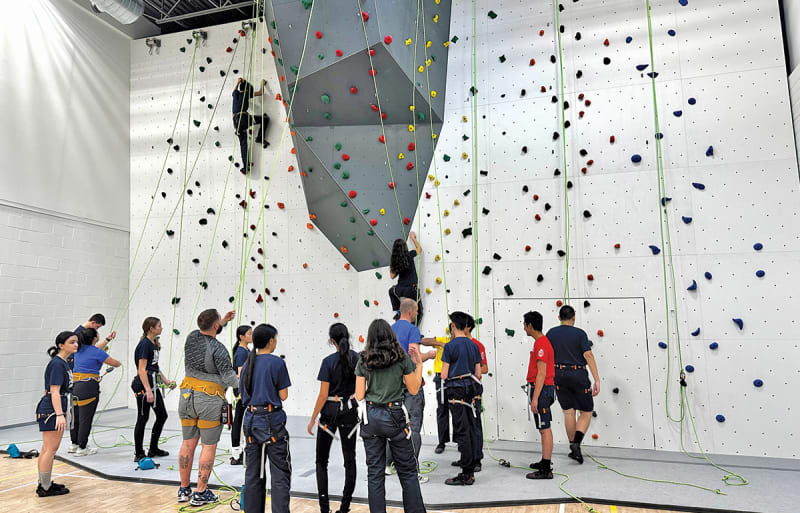
MacLachlan has introduced one of the first Upper School climbing programs in Canada. Hadfield sees strong potential in climbing, particularly given its Olympic status and the relatively limited competition in the field. He also notes its connection to academic skills. “Bouldering is like problem-solving. The routes change all the time, and you’ve got to look at them analytically, which suits our bright student body.”
To support the program, MAC has hired Canadian Olympic hopefuls Zach and Maddie Richardson, who have won a combined nine national championships. They are designing a coaching program grounded in accessibility for all students. Students can experience climbing through gym class, after-school clubs, or a new competitive training stream for those interested in pursuing the sport seriously.
The goal is to train student-athletes to compete at the regional, provincial, and even international levels. The program was developed by asking athletes what they wished they had had access to during their school years and then designing that support system at MAC.
The climbing wall, which now spans the length of the Upper School gymnasium, reflects that investment and ambition. Hadfield and Head of School Michael Piening see it as a unique opportunity for students and a meaningful step towards supporting future high-performance athletes.
Prep hockey launched at MAC in fall 2025 with considerable momentum. After speaking with athletes and families, school leaders identified one of the greatest barriers facing high-performance players: the challenge of balancing elite athletics with academics.
MacLachlan’s solution is an integrated model. Student-athletes begin their day at nearby Canlan Arena, training on the ice four mornings a week. This training also counts towards their physical education credit. Students are then transported back to the Upper School for the remainder of the academic day. After school, they continue with off-ice training, video review, and conditioning.
This structure allows student-athletes to receive high-level hockey training while preserving their evenings for academics, other interests, or rest. Hadfield describes it as a program designed to deliver “the best hockey experience without compromising academics.”
The hockey program is led by experienced coaches and recruiters with a strong track record of helping athletes advance to the OHL, NCAA, and junior leagues across Canada.
Piening believes the program’s success will depend not only on training but also on how well student-athletes are integrated into the broader school culture. “It remains part of the same school culture that we’ve always had, which is that we know everybody and everybody is comfortable being here,” he says.
Girls’ hockey programming is being developed with the same level of planning and integration as the boys’ program. A development program is already underway, and top players from across Canada have begun committing to the school.
Beyond athletics, MacLachlan College is also known for its strong co-curricular offerings. Senior student Tara Abouzeid, a former co-leader of the Debating and Public Speaking Team, reflects on her experience with the program. Initially hesitant to join, she went on to become an award-winning debater and team leader.
MacLachlan students have achieved notable success in debating, including first-place finishes in the Fulford Debating League in winter 2025 and spring 2026. These accomplishments are supported by rigorous preparation, one-on-one coaching, and consistent practice.
Gregory Dominato, who leads the program, emphasizes the transformative impact of debate and public speaking. These activities help students build confidence, think critically, and communicate with strength and clarity. For many, the experience is life-changing.
Students also benefit from DECA, which gives them hands-on experience in marketing, finance, entrepreneurship, and hospitality through business simulations and competitions. Alumni note that DECA helped them build confidence, develop public-speaking skills, and learn to think quickly under pressure.
In keeping with MacLachlan’s student-centred approach, many co-curricular activities are student-led. Clubs cover a wide range of interests, including engineering, photography, chess, Round Square, visual arts, computers, drama, yoga, and journalism. Students are even encouraged to propose and lead their own clubs, beginning as early as Grade 1.
Head of Lower School Jacki Bright notes that students submitted proposals for more than 20 clubs in a single year, all based on their own interests and initiative.
As Piening explains, the school’s goal is to graduate students who are prepared for the next phase of their educational journey. That preparation extends beyond the classroom. Through athletics, debating, clubs, and leadership opportunities, students build the confidence, discipline, and interpersonal skills they will carry with them long after graduation.
“When we go to events and competitions,” Piening says, “our students always represent our school well—behaviourally, academically, and with class and sportsmanship. That comes from a well-rounded program inside and outside the classroom.”
Wellness

At MacLachlan College, mental wellness is woven into the students’ daily school life. From Kindergarten through Grade 12, students are supported in developing the emotional and social tools they need to thrive in and out of the classroom.
A strong sense of community is at the heart of MacLachlan. Students are welcomed into a close-knit environment where teachers foster meaningful relationships and create a culture in which everyone feels safe, valued, and seen. This foundation of trust is supported by lessons that encourage resilience, confidence, and healthy coping strategies.
Central to the school’s wellness efforts is Healthy Minds, a dedicated Social and Emotional Learning (SEL) class taught to Lower School students by MacLachlan’s Guidance Counsellors. Held once every six-day cycle in 40-minute sessions, this program offers students structured time to focus on their personal growth and mental well-being. Wellness Lead Vicki Dawn explains the classes are “Grounded in mindfulness and positive psychology. It provides students with the opportunity to explore, learn, and practice tools and strategies that support their social-emotional development and overall well-being.”
Two full-time guidance counsellors in the Lower School and three in the Upper School tailor their approach to each age group, helping students to build core skills such as self-awareness, self-regulation, and interpersonal skills. Dawn shares examples of this, which can include: “Mindfulness lessons that help students learn to notice and name their emotions, breathing techniques to improve focus, manage anxiety, and take a pause before reacting impulsively; skills that enhance their ability to respond thoughtfully in challenging situations.” These sessions also introduce concepts like character strengths, goal setting, gratitude, and adopting a growth mindset.
Leslie Leys, Assistant Head of Lower School, Student Life, points out that it supports essential one-on-one interactions children will need later in life and that the classes are highly adaptable. “It helps with social-emotional learning and character building, and it also addresses any COVID backlash effects that are residual. This is tackling that head-on, and since it’s a flexible program, the teachers who lead those programs can customize lessons if there’s an issue, or provide support to help with that emotional growth.”
As students move into the Upper School, the program evolves alongside them. With age-appropriate themes like handling exam stress, managing time, resolving conflicts, and making future-ready decisions, the curriculum grows to meet their increasing needs. Dawn notes that timely topics are often explored, including “peer conflict, time management, and transitions.”
A key component of the school’s wellness program is the integration of lessons from The Social Institute, which supports students in navigating the digital world. “These equip students with knowledge and strategies to navigate social media and technology in healthy, balanced ways that support their well-being,” says Dawn. Through role play, group discussions, personal reflection, and mindfulness practice, students are encouraged to engage with these lessons. “Research increasingly shows that fostering positive mental health improves not only emotional well-being, but also academic achievement and the development of effective life skills. When students feel calm, safe, and supported, they are better able to learn, recall information, and thrive both in and out of the classroom.”
Beyond the classroom, MacLachlan encourages mental wellness through various clubs, events, and daily practices. Students participate in Wellness Week, mindfulness workshops, fitness activities, and other events that promote self-care and stress reduction. Clubs such as yoga, run club, and mindfulness groups are available to provide students with additional ways to manage stress and stay active. Even small rituals, like the “mindful minute” at the start of the day, help reinforce the importance of slowing down and checking in with oneself.
Character education and service learning further enrich this culture of care. Through classroom activities, leadership opportunities, and community engagement, students are encouraged to reflect on their values, take initiative, and make positive contributions to the world around them.
MacLachlan’s approach to mental wellness is intentional and responsive, rooted in the belief that students who feel connected, confident, and supported are best prepared to grow, achieve, and lead with compassion.
Student body, parents & alumni
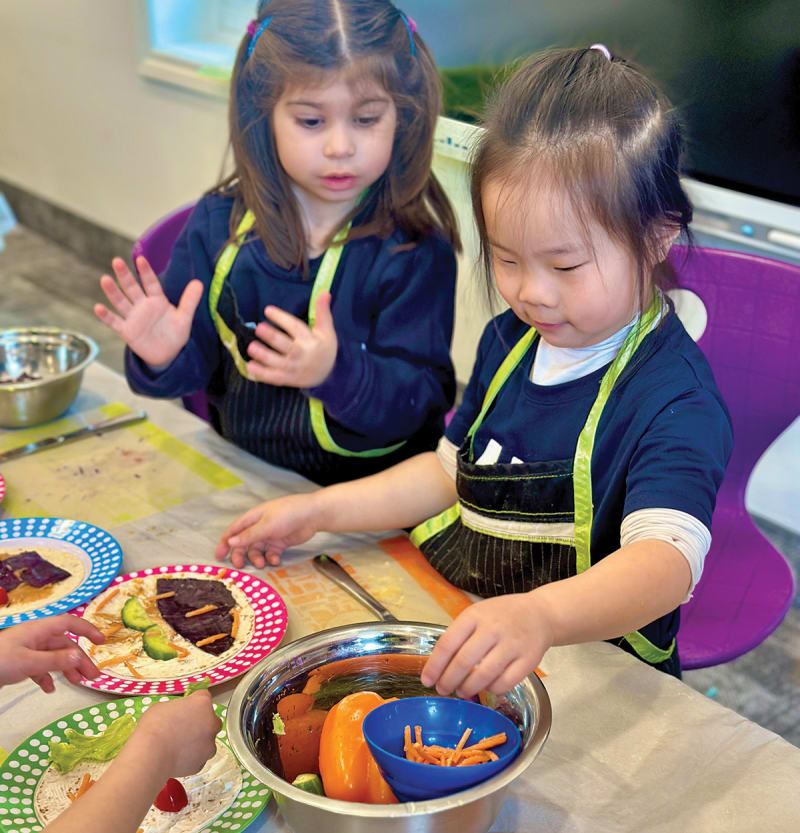
MacLachlan College will welcome about 450 students for the 2026–2027 school year, according to Heather Birnie, Director of Admissions and Communications. Around 10% of those students will be international, coming from countries around the world, including the United States, Asia, South America, the UK, Southeast Asia, and even Australia. “MacLachlan has a culturally inclusive school environment. We have students attending our school with a wide variety of heritage and cultural origins,” explains Birnie.
That cultural diversity is not only welcomed at MAC, it’s celebrated with families being an integral part of school life. Leslie Leys, Assistant Head of Lower School, Student Life, puts it simply: “I know it sounds cliché, but we are a family, and those parents are very important to us; they are part of our fabric. For example, we have a faculty-parent book club that took place last year, and the focus was the Anxious Generation by Jonathan Haidt. We celebrate diversity, we celebrate culture, we embrace it all. I think the parents are surprised that when we talk about being a tight-knit school, a nice community, they are included.”
For Opal Manhertz, a parent of two MAC students, that sense of inclusion is one of the school’s biggest strengths. “They’re very collaborative with parents and very forward-thinking. They’re looking at how they can become a better school and enhance their learning environment for students. They don’t just stick to one way of doing things; they look at tools to always improve, and that I like very much.”
Parental involvement goes far beyond drop-offs and pickups. Parents regularly visit both Lower and Upper Schools to speak about their careers, and MAC hosts vibrant cultural events led by students. The active parents’ association organizes everything from clothing drives and movie nights to pizza lunches and school-wide fun fairs, fostering a strong connection between families and the wider school community.
Even alumni remain closely connected. Every year, former students return to speak with Grade 12s preparing for post-secondary life. They offer mentorship, share university experiences, and give students an honest glimpse into what lies ahead. Many of these relationships last well beyond graduation. Some alumni have even returned to MAC as faculty, bringing valuable insight as both educators and former students.
For students, the school’s small class sizes and supportive teachers make a big difference. A Grade 12 student shares what sets the MAC environment apart: “The thing about our school is that there are no cliques, because everyone’s always talking to each other. I feel like it’s easier to welcome new students because they can go and talk to whoever they want, and we’re all friends.”
That sentiment carries into life beyond MAC. Sophie Gregg, Class of 2020, reflects on her experience: “I think it shapes a well-rounded kind of person with all the experiences and everything you learn. It’s not just academic, it’s life stuff as well, and I think that it shapes you into a good person.”
Getting in
MacLachlan College’s admissions process is designed to provide a well-rounded understanding of each applicant by evaluating both academic achievements and personal background. The school seeks students who are not only strong learners but also thoughtful and engaged individuals who will positively contribute to the school community.
When applying, Heather Birnie, Director, Admissions and Communications, says families are asked to submit a completed application form, recent school report cards, birth date verification, a confidential reference from a current or past teacher, as well as supplementary information, including academic awards, athletic or artistic accomplishments, and any community involvement. These additional details offer valuable insight into a student’s interests and strengths beyond the classroom.
“Good academic standing is a starter, but also qualities that stand out would be exhibiting a growth-mindset with respect to collaboration, critical thinking, and creativity. Independent and self-directed learning skills are also important, and we insist on kindness and respect within our school community,” explains Birnie.
Their school developed various grade-level appropriate assessments for students in Grades 1 through 12. Birnie adds, “Kindergarten student applications are structured to be more observational. Students applying for Senior Kindergarten through Grade 7 will have a class visit and assessment on the same day. Those who are outside the area or out of the province/country will have a virtual interview and assessment. Students applying for Grades 8 through 12 have an interview and assessment.”
Although MacLachlan doesn’t offer formal auditing of classes, the school incorporates classroom visits into the application experience for applicants in Senior Kindergarten through Grade 7. These visits give students a firsthand look at the environment and allow teachers to observe them in a classroom setting.
Families interested in learning more about the school are encouraged to book a tour. This can be done by submitting an online inquiry form through the school’s website or by reaching out directly via phone or email. The admissions team is happy to arrange a time that works best for the family’s schedule.
Takeaways
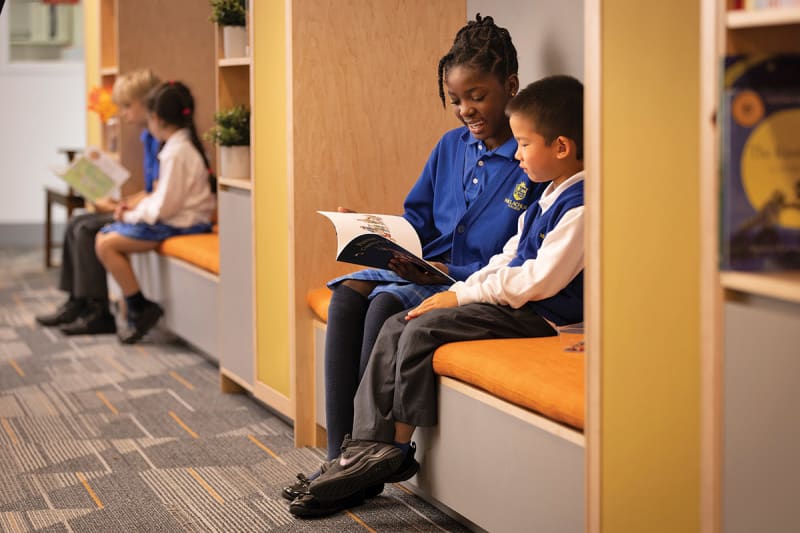
There’s something to be said about MacLachlan College being able to use its modest size to deliver a big-impact experience that resonates with many families wanting a personalized experience rather than a typical public or large private school. One of the biggest takeaways from parents and students alike is the school’s tight-knit community, which provides them with a feeling of “home.” With class sizes remaining smaller, every child is known by name, and not just by their teachers. Senior leadership, staff, and even other students quickly learn who’s who. It’s the kind of place where students aren’t just a number. That personal attention means students feel safe taking risks, asking questions, and growing into confident learners.
A Grade 12 student describes it like this: “At MAC, you can explore your true power and potential. Something that’s unique is that each student has a voice, and you can start clubs with that voice and have the opportunity to feel like we’re in control of something and that we have something of our own.”
Head of School, Michael Piening, adds, “Voice and Choice are new buzzwords, but they live at MacLachlan. If students voice concerns, opinions, or questions, they are encouraged to follow up and see if they can be the change or work with the school on creating change. Sometimes, if students bring forward ideas for certain changes, their ideas have sparked real changes to our school structure, course offerings, or programs.”
Academically, MacLachlan offers a challenging curriculum. In the Lower School, they follow the International Baccalaureate Primary Years Programme (IB PYP), which encourages inquiry-based learning and global awareness. In the Upper School, students begin in the IB Middle Years Programme (MYP) and can take Advanced Placement (AP) courses, allowing them to explore subjects in greater depth and prepare for university-level work. Teachers are often described as engaged, passionate, and responsive. Feedback is timely and detailed, and the support structure is strong, especially for motivated students who are ready to be challenged.
Another highlight is the emphasis on experiential learning. Students regularly go on field trips, attend workshops, and even travel abroad. The school is part of the Round Square network, which promotes values like internationalism, service, and leadership. High School students also work toward the Duke of Edinburgh’s Award, which involves community service, physical challenges, and personal growth. These programs build maturity and global awareness that go far beyond the classroom.
One of the school’s main challenges has historically been the absence of a competitive athletics program. MacLachlan has introduced a newly revamped athletics department that will be offering a one-of-a-kind climbing program and U18 boys prep hockey, a hockey development program, followed by next year’s girls’ U22 hockey. School Director Mark Hadfield says that the school is carefully considering next steps as this is only the beginning.
Communication with families is another major strength. Administration is approachable and transparent, and parents consistently report feeling informed and welcome. From regular updates to organized parent events, there’s a strong effort to make families feel like part of the school’s fabric.
MacLachlan College is best suited for students who thrive in a close-knit, academically focused environment that values leadership, global thinking, and personal growth. It offers a strong balance of academic challenges and a supportive community, making it ideal for families looking for more than just good grades.