The 2026 OUR KIDS Private School Expo is coming to cities near you. Get your family pass
Indirect Support:
Hear directly from Meadow Green Christian Academy community as they share insights into the Academics.
Meadow Green Academy has a Traditional, Montessori approach to Curriculum (as opposed to Liberal Arts, Progressive, Montessori, Reggio Emilia, Waldorf approach).
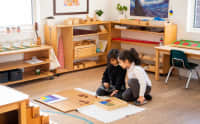
Particularly popular in the younger grades (preschool to elementary), but sometimes available all the way up to high school, Montessori schools offer an alternative vision to the standard lesson format of most classrooms. Instead of listening to whole-class lessons, Montessori classrooms allow students to choose which "tasks" or activities interest them. These tasks centre around special Montessori puzzles - their essential feature being they contain a right answer and allow for selfcorrection. A strong emphasis is therefore placed on lessons being concrete and rooted in practical experience, along with students developing a sense of self-sufficiency, confidence and curiosity.
Meadow Green Academy offers a comprehensive blend of the best in traditional educational practices and modern pedagogy. Extensive use of the latest technology enhances the rich learning experiences of our students.
| Program | Offered |
|---|---|
| Montessori toddler | |
| Casa | |
| Elementary | |
| Middle School | |
| High School |
| Focus | Religious-based |
|---|---|
| Academic | Christian (Non-denominational) |
If you want to learn more about faith-based education, check out our comprehensive guide.
Read our detailed guide to learn all about Christian education.
Meadow Green Academy has a Traditional Math approach to Mathematics (as opposed to Discovery Math, Equal Balance approach).
The mathematics curriculum begins in JK with the use of manipulatives and other hands-on resources. This early exposure to numbers and shapes prepares the way for youngest students to excel in mathematics later on. Meadow Green Christian Academy is a Ministry of Education inspected school with credit granting authority for grade nine mathematics. Students who enter grade eight having completed the grade eight curriculum are able to take a Reach Ahead high school credit in this subject.
This information is not currently available.
Meadow Green Academy has a Phonics-intensive approach to Early Reading (as opposed to Whole Language, Balanced Literacy approach).
Our Language Arts program focuses on oral language skills, listening skills, phonics, word development, spelling, reading comprehension, written language, grammar, and creative writing. Students develop a solid grasp of the English language conventions and the ability to manipulate and use the language in order to be successful in all areas of learning. They gradually learn to develop and express their opinions and to utilize different and appropriate writing styles.
DIBELS Testing: This school does not use DIBELS testing to assess reading progress.
This information is not currently available.
Meadow Green Academy has an Equal balance approach to Writing (as opposed to Systematic approach, Process approach approach).
The focus is on oral communications, vocabulary development, reading comprehension, written language, grammar and creative writing. Students learn how to independently plan, revise and edit their work and they participate in speech and writing competitions. Students are given group and individualized programs based on their strengths and abilities. Ongoing assessments ensure that key concepts and skills are grasped.
Meadow Green Academy has an Equal Balance approach to Science (as opposed to Expository, Inquiry approach).
Grades 1-3 - We teach students the importance of hypotheses and observation by doing hands on science experiments. This multi-sensory approach allows students to master basic scientific knowledge and concepts and practice their skills of inquiry and seeking out information. Science seeks to describe and explain the natural world and our vision is to open the children’s eyes to this world and offer a Christian perspective. Grades 4-8 - Students acquire a broad scientific understanding and technological capacity in all areas of Science. By completing various classroom experiments, investigations, research projects and science fair activities, the students develop a great deal of knowledge which they apply to new situations. Topics in the areas of environmental science, biology, chemistry, physics, and space science are studied at a high level.
| Subject | Offered |
|---|---|
| Evolution as consensus theory | |
| Evolution as one of many equally viable theories | |
| Evolution is not taught |
| Subject | Offered |
|---|---|
| Biology | |
| Chemistry | |
| Ecology | |
| Geology | |
| Meteorology | |
| Physics | |
| Physiology | |
| Zoology |
Meadow Green Academy has an Equal Balance approach to Literature (as opposed to Traditional, Social Justice approach).
This information is not currently available.
| Subject | Offered |
|---|---|
| Canadian lit | |
| American lit | |
| European (continental) lit | |
| World (non-Western) lit | |
| English lit | |
| Ancient lit |
Meadow Green Academy has a Core Knowledge approach to Social Studies (as opposed to Expanding Communities, Thematic approach).
Students will seek to examine and understand communities, from the local to the global, their various heritages, and the nature of citizenship within them. The acquisition of key social science concepts, including change, culture, environment, power and the dynamics of the marketplace are studied. Ancient civilizations, Canadian history, Canadian geography and units related to a study of a country within a continent are studied each year. Different viewpoints are evaluated and information is examined to learn how to make decisions and solve problems.
Meadow Green Academy has an Equal Balance approach to Humanities and Social Sciences (as opposed to Perennialism, Pragmatism approach).
The Geography curriculum allows students to develop a solid foundation of the knowledge and skills that are required for the subject. Students in Grade 7 are introduced to the concepts and methods of geographic inquiry, physical patterns, and how they affect human activity. The use of our natural resources and the environmental implications are studied. In Grade 8, the study of geography focuses on patterns in human geography, economic systems, and migration. Students explain population distribution and characteristics and investigate how human activities are affected by these patterns. They examine economic systems and the economic relationships between Canada and the global community, as well as the major types of migration and factors affecting human mobility. Students are tested after each unit to ensure their understanding of each topic. There are also various presentations and individual and group projects.
Meadow Green Academy has an Equal Balance approach to Foreign Languages (as opposed to Audio-Lingual, Communicative approach).
French - JK - Grade 3 - A rich foundational vocabulary is learned in an exciting and interactive way through the use of conversations, poems, songs and books. Students begin to write simple French sentences and answer comprehension questions. The curriculum aims to assist students to understand key grammatical concepts and to grow in their usage of the language. French Grades 4-8 - MGA students will read a wide variety of materials, appropriate to their age level. They develop strong oral communication skills and explore further aspects of the written language, including grammar. MGA students become h3 French communicators. Parisian French is used throughout the school and a high level of oral communication, reading, grammar, and writing is developed. Students are encouraged to read short stories and novels in French.
| Subject | Offered |
|---|---|
| Chinese-Cantonese | |
| Chinese-Mandarin | |
| French | |
| German | |
| Greek | |
| Italian | |
| Japanese | |
| Hebrew | |
| Latin | |
| Russian | |
| Spanish | |
| ESL |
Meadow Green Academy has an Equal Balance approach to Fine Arts (as opposed to Receptive, Creative approach).
| Subject | Offered |
|---|---|
| Acting | |
| Dance | |
| Drama/Theatre | |
| Graphic Design | |
| Music | |
| Visual Arts |
| Expressive | |
| Disciplined |
Education in the Arts is essential to a student’s intellectual, social, physical and emotional growth. Our Visual Arts program includes the traditional fine arts of drawing, painting and sculpting. Students learn to analyze and appreciate art work from various historical periods and styles. Drama skills are encouraged as each class continues to prepare presentations for varying school assemblies. Two high-level drama productions are performed each year, one at Christmas and one in the Spring. Highly qualified, specialty teachers help the students to develop their acting, singing, dancing, and production skills. The guitar will be studied and students continue to grow in their appreciation of music. They learn musical notation and theory and are given the opportunity to perform at school concerts.
Meadow Green Academy has a Medium integration approach to Computers and Technology (as opposed to Light integration, Heavy integration approach).
Students will become familiar with various programs and functions, equipping them for our technologically advanced and fast-paced society. Wireless access throughout the building allows the students to use their own personal laptops in all classes. SMART Boards are incorporated across all disciplines and enhance learning. Grades 7-8 - In Computer Technology a variety of programs are used to combine education and technology that assist students in becoming better prepared for a technologically advanced society. The students utilize several Techno programs including Techno Web, Internet Explorer, Techno Investor, and Techno CEO, as well as Microsoft Office. Continued emphasis is placed on typing speed using All the Right Type. Students are encouraged to use lap tops at school as the South Campus is fully wireless.
| Subject | Offered |
|---|---|
| Computer science | |
| Robotics | |
| Web design |
A comprehensive Physical Education program rounds out the students' learning experience. Intramural and extra-curricular sports activities and teams are available. Fitness, good sportsmanship, and high-level skills are developed. Involvement in sports and MGA’s Physical Education programs provide the students with an outlet for their energy and physical capabilities. Team sports such as soccer, basketball, volleyball, floor hockey, badminton, and baseball are developed. Individual activities such as track and field, dance, and exercise fitness are also encouraged. Participation in intramural and extra-curricular sporting events provides the students with a lot of fun and broadens their school experiences.
This information is not currently available.
Meadow Green Academy has a Not Ontario curriculum approach to Sex and health education (as opposed to Follows provincial curriculum approach).
This information is not currently available.
Meadow Green Academy has an Academic approach to Preschool/K Curriculum (as opposed to Play-based, Montessori, Waldorf, Reggio Emilia approach).
Our Full Day Senior Kindergarten is a highly academic, nurturing program focused on developing reading, writing, and math skills while fostering a love of learning. Students learn to read and write through sight vocabulary, word families, spelling, and phonics, using engaging materials like phonics readers and storybooks. Math covers place value, operations, fractions, time, geometry, and problem-solving, with hands-on Montessori tools reinforcing concepts. Computers enhance language arts and math learning, while French emphasizes oral skills through conversation, songs, and games. Drama and music build confidence, and science and social studies themes—like the Human Body and Outer Space—stimulate intellectual growth. Physical education promotes fitness, skill development, and teamwork in a fun environment.
Meadow Green Christian Academy's Montessori approach. Learn about this school's class practices and policies as well as its curricular and teaching approach.
| Primary | Lower Elementary | Upper Elementary | Middle | |
|---|---|---|---|---|
| Age groupings How children are grouped by age for each class.' |
2.5 to 5 | n/a | n/a | n/a |
| Uninterrupted work periods The longest uninterrupted work period for each class.' |
1 hours | 2 hours | 2 hours | 2 hours |
| Tests and assignments How often students are given tests or assignments in each class.' |
Occasionally (Moderate Orthodox) | – | – | – |
| Graded work How often students have their work graded in each class.' |
Regularly (Non-Orthodox) | – | – | – |
| Arts and crafts The percentage of a typical student's day that is spent on arts and crafts in each class.' |
25% | – | – | – |
Moderately Non-Orthodox
21% of schools
Schools that are faithful to the original Montessori program and principles, but sometimes supplement it with modern curricular approaches or materials.
Orthodox
Whole-class lectures should never be given. Students learn best through small group lessons, interaction, and independent work.
Moderately orthodox
Whole-class lectures should only be given occasionally (e.g., at the beginning of a term or unit). Students usually learn best through small group lessons, interaction, and independent work.
Moderately non-orthodox
Whole-class lectures should be given semi-regularly (e.g., at the beginning of a lesson or a week). While students often learn best through group and independent work, it's sometimes important for teachers to set the stage for and contextualize learning.
Non-orthodox
Whole-class lectures should be given often (e.g., every day). While group and independent learning is important, teachers need to provide lectures on a regular basis to provide the foundation for learning.
Orthodox
External special education support isn't necessary. Core teachers can deal with all special education needs, by offering the relevant support for each student.
Moderately orthodox
External special education support is only rarely necessary. For instance, a psychologist might be brought in to help out a student with a severe developmental disorder.
Moderately non-orthodox
External special education support is quite important. Outside specialists are needed for a fairly wide range of special needs, such as developmental and learning disabilities.
Non-orthodox
External special education support is very important. Outside specialists are regularly brought in to support students with many different types of special needs, including developmental and learning disabilities, language and speech issues, behavioural issues, and advanced learning abilities.
Orthodox
We don't have any specialist teachers or classes. Core teachers are well-equipped to teach all subjects.
Moderately orthodox
We only use specialist teachers and classes in rare cases (for instance, to teach a second language). Core teachers are well-equipped to teach almost all subjects.
Moderately non-orthodox
We have a fairly wide range of specialist teachers and classes (for instance, in languages, music, and art). Core teachers are well-equipped to teach most subjects.
Non-orthodox
We have many specialist teachers and classes (for instance, in languages, music, art, gym, science, and math). It's important that students receive specialized instruction in many subjects.
Orthodox
Modern-day technology is never used in the classroom. This can interfere with students' social and emotional development and can be a distraction.
Moderately orthodox
Modern-day technology is very rarely used in class, since it can be a distraction and interfere with development. Students at the upper levels, though, might be permitted to use a computer or a tablet to do research for a specific project.
Moderately non-orthodox
Modern-day technology is used in moderation since it can be a distraction. For instance, computers and other digital media might be used for research, writing, and multimedia projects.
Non-orthodox
Modern technology is used fairly regularly. For instance, computers and other digital media might be used for research, writing, multimedia projects, and to learn keyboarding skills. Teachers may sometimes also use digital media, such as interactive whiteboards, to teach lessons or introduce topics.
This school doesn't use teaching assistants.
Learn about Meadow Green Christian Academy's languages of instruction and enrolment.
Meadow Green Academy has an Accelerated approach to Curriculum Pace (as opposed to Standard-enriched, Student-paced approach).
Meadow Green Academy strives to teach each student at their level of readiness. Most students work a grade level above in the core curriculum subjects. A Reach Ahead grade nine high school credit in mathematics is offered to students who have completed the grade eight expectations.
| Type | Offered |
|---|---|
| Subject-streaming (tracking) | |
| Multi-age classrooms as standard | |
| Ability-grouping (in-class) as common | |
| Frequent use of cyber-learning (at-their-own-pace) | |
| Regular guided independent study opportunities | |
| Differentiated assessment |
Our students work in their grade classes but there is ability grouping in language arts and mathematics which best meets their individual learning needs in those subjects.
Meadow Green Academy has a Rigorous approach to Academic Culture (as opposed to Supportive approach).
Meadow Green Academy strives to assist students to reach their academic potential to the best of their ability. This includes providing individual support to students who have special needs. Accommodations and modifications help to set achievable expectations and support students to meet them.
The goal is to cultivate "academically strong, creative and critical thinkers, capable of exercising rationality, apprehending truth, and making aesthetic distinctions."
Equal emphasis is placed on a balance of priorities: intellectual, emotional, social and physical cultivation.
This information is not currently available.
Meadow Green Academy believes that all students can learn and we accept students who learn differently. Additional educational support is provided by trained staff in the form of accommodations or modifications as needed. An admission interview with the Director and initial assessments help us to determine the best approaches that will benefit each child.
Read our guide to special needs schools and special education
| Type | Offered |
|---|---|
| Learning strategy and study counselling; habit formation | |
| Extra support and minor accommodations for children experiencing subclinical difficulties |
| Type | Offered |
|---|---|
| Accommodations | |
| Modifications | |
| Extra support |
| Type | Offered |
|---|---|
| Social skills programs | |
| Occupational therapy | |
| Psychotherapy | |
| Speech-language therapy |
There is an equal emphasis on acceleration and enrichment.
| Program | Offered |
|---|---|
| Full-time gifted program (parallel to rest of school) | |
| Part-time gifted program (pull-out; parallel to rest of class) |
| Program | Offered |
|---|---|
| Custom subject enrichment (special arrangement) | |
| Custom curriculum compacting (special arrangement) | |
| Guided independent study (custom gifted arrangement) | |
| Cyber-learning opportunities (custom gifted arrangement) | |
| Formalized peer coaching opportunities (specifically for gifted learners to coach others) | |
| Custom subject acceleration (special arrangement) | |
| Career exploration (custom gifted arrangement) | |
| Project-based learning (custom gifted arrangement) | |
| Mentorships (custom gifted arrangement) |
This information is not currently available.
OUR KIDS REPORT: Meadow Green Christian Academy