Van Pelt, director of the Fraser Institute’s Barbara Mitchell Centre for Improvement in Education and co-author of A Diverse Landscape: Independent Schools in Canada, helped produce the first comprehensive national portrait of independent schooling in Canada—and it reveals some surprising findings.
What does the research show about independent schools in Canada?
One of the most notable findings is that 6.8% of Canadian K–12 students attend independent schools—a number that continues to rise across all provinces. In British Columbia, the proportion is double the national average. “A greater number of parents,” Van Pelt notes, “are choosing to have their children educated outside of the public school system.”[3]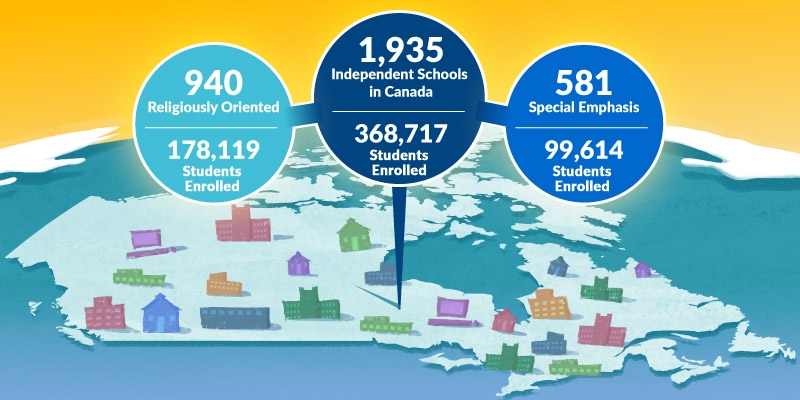 .
.
Yet the report also challenges long-held assumptions about private schools and the families who choose them. “Rigid typecasting of independent schools is more myth than reality,” the authors write. Far from being elite enclaves, Canada’s 1,935 independent schools serve a diverse cross-section of the population.
“The parents of over 368,000 students—one of every fifteen students in Canada—are choosing schools that differ in many ways from one another, the vast majority of which do not conform to the prevailing caricature that private schools are exclusive enclaves serving only the wealthy urban elite.”
Van Pelt argues that persistent stereotypes hinder honest debate about why families make the financial sacrifice to choose independent education. “It’s time Canadians understand the tremendous value and choice provided by independent schools to the education system.”
How does the Canadian public school system fit into this picture?
Canada’s public school system is large and complex, built around provincial and regional boards that adapt curricula, set degree requirements, and manage funding. In addition to a core curriculum, many public boards offer gifted, special needs, athletic, and arts programs, as well as Catholic, First Nations, Francophone, and French immersion tracks.
However, these specialty options are often treated as supplementary rather than essential. Critics of private and specialized education argue that public resources should focus on strengthening the core system. “Everyone needs to be invested in our public schools in order for them to get better,” writes Allison Benedikt in Slate, arguing that reasons like religion or learning challenges aren’t compelling enough for opting out.[5]
Still, many parents disagree—viewing such reasons as valid motivations for seeking alternatives that better meet their child’s needs.
Why is school choice gaining ground?
“The idea of choice is attractive,” write Lynn Bosetti and Dianne Gereluk in Understanding School Choice in Canada. It embodies “equality, freedom, and democracy … reflecting the modern desire for autonomy, control, and self-expression.”[6] Choice isn’t new: Roman Catholic schools have long been part of public education in several provinces.
Even in Ontario—where financial support for private schooling is limited—a significant share of students attend alternative or specialized programs. In 2012–13, over one-third of Ontario students were enrolled outside the English public system, and 170,000 more were in public French immersion programs. As Derek Allison observes, “almost one-half of Ontario students attend schools of choice.”[8]
How can public and private schools complement each other?
Rather than competing, many experts see public and private schools as complementary parts of a healthy education system. Dalton McGuinty Sr., a long-time education reform advocate, emphasized the balance between them:
“With students and teachers of diverse convictions, the public school must attempt neutrality on the great issues of life … The independent-alternative school can assume a clearly defined philosophy in accordance with the values of its students and parents.”[10]
This idea remains central today. Bosetti and Gereluk note that school choice supports diversity, giving space for students whose identities and values might not fit neatly within the common school model.[11]
Canada’s education system benefits from both public stability and private innovation. Public schools ensure universal access and quality standards, while private and independent schools offer diversity, specialization, and alignment with family values.
What kind of education system does Canada need today?
When the Canada’s public system was developed in the 19th century, the goal was social cohesion and moral order. Leaders envisioned free, secular education to reduce poverty and crime and unify a diverse population. The vision emphasized assimilation over individuality.
Today’s Canada is far more diverse. Families expect schools to nurture creativity, critical thinking, and personal identity—not conformity. As Bosetti and Gereluk write:
“Increasing urbanization, immigration, and the shift to a knowledge-based economy have intensified pressure on schools to reform the common schooling model. Marginalized and minority groups seek accommodations for their culture, identity, and values … Parents want schools that reflect their family aspirations.”[13]
Deryn Lavell, head of school at Bishop Strachan in Toronto, expresses the goal well: to give students “a chance to understand who they are, find their voice, and learn leadership in a world of many voices.” Increasingly, families are finding those opportunities in private and independent schools.