Linbrook School THE OUR KIDS REVIEW
The 50-page review of Linbrook School, published as a book (in print and online), is part of our series of in-depth accounts of Canada's leading private schools. Insights were garnered by OUR KIDS editor visiting the school and interviewing students, parents, faculty and administrators.
Introduction
It’s one of the first warm spring days of the season when we visit Linbrook School. The one-storey, red-brick Georgian-style building sits on a picturesque Oakville street that’s sun-drenched and lined with flowering trees. We find the all-boys elementary school nestled among stately homes in the prestigious southeast Oakville / Eastlake neighbourhood, with St. Mildred’s-Lightbourn School—Oakville’s well-known independent K–12 all-girls day school—directly across the street.
Inside Linbrook, it’s quiet upon our arrival as the students are in the middle of an assessment that’s conducted once a year to see where they’re at in a variety of subjects. Classroom doors stand slightly ajar, revealing groups of boys seated at individual desks and shared work tables, absorbed in the task at hand. There’s a hum of concentration in the air, and it’s clear that this is a place where students would easily feel at home.
The first things we notice are the lions. Two stately plush lions stand on either side of the floor‑to‑ceiling glass doors that open onto the school’s expansive yard. They’re here to symbolically greet students when they arrive each morning, and new students, especially the little ones, almost always gravitate toward them. “They help them relax when they’re visiting the school or adjusting to school life,” says Head of School Amber Way.
When Linbrook first opened, Way bought the larger lion for the lobby and later added the smaller companion. Over time, they’ve become part of daily rituals and annual traditions, and they appear in every all-school photo. The lion theme continues throughout the building: an impressive collection in all shapes and sizes adorns the Head of School’s office and appears on posters, murals, and in photographs throughout the hallways and communal spaces. The lions are more than a playful mascot; they’re a visual cue that this is a place with its own rich identity and traditions. “Not only are lions beautiful, majestic leaders, they’re also courageous, protective, and proud members of their pride,” says Way. “When we chose it as our mascot, we knew the boys would admire the strength and bravery of the lion and also feel proud to be part of the Linbrook Lions athletic teams and performance-based groups.”
In the foyer, we are greeted by principal Mike Packowski. He’s very tall and very friendly, and from the way boys seem to gravitate toward him throughout our visit, it’s clear he’s a much-loved principal. As students pass by, they wave and greet him with updates about projects, sports teams, and upcoming events. Packowski responds with ease, calling the boys by name and asking follow-up questions before they move on.
Packowski has been involved with the school since its inception. “I remember thinking how much I would have loved to have gone to a school like this growing up,” he says. “This is an environment I would have thrived in.” Linbrook’s ultimate goal, he explains, is to get boys to genuinely love coming to school. “No matter the subject, they’re engaged, excited, and learning in a way that actually suits how they’re wired.” As he leads us on a tour, the school’s philosophy comes into focus: everything here is designed to make boys feel capable, supported, and eager to return day after day.
The basics
Linbrook School is Oakville’s only independent day school dedicated exclusively to boys from Junior Kindergarten through Grade 8. Small by design, Linbrook creates a safe, nurturing space for boys to explore interests, discover talents, and engage with a challenging but accessible curriculum.
The school offers a full elementary and middle years program, grounded in the simple but well-researched premise that boys learn differently and most academic institutions have not been designed to support their needs. Balancing strong academics with attention to social-emotional development, Linbrook’s physical environment and daily schedule are deliberately set up to support boys. “They need to move. It gives them energy and helps them learn,” says Way, who is also the school’s founder. “Three daily recesses, five gym periods a week, desks and flexible seating designed for movement are just some of the things that differentiate Linbrook.”
With access to ongoing professional development and training by leading experts on boys’ education, Linbrook staff continue to explore new and innovative ways to engage with their students. They leverage research on how boys learn best, be it through movement, humour, clear structure, or meaningful relationships, and apply it to their classrooms. Sometimes that means rethinking how lessons are introduced, incorporating more hands-on learning, or adjusting routines to make time for physical activity and collaboration.
“Oakville has a lot of independent and private schools, some of which require all students to receive instruction a year above their grade level across subjects,” says Way. “That’s not our philosophy. We teach grade-level curriculum, and we delve deeply within content, and enrich or remediate where needed.” In practice, this means that Linbrook’s teachers focus first on ensuring every boy has a solid grasp of the core curriculum expectations for his grade. From there, they stretch learning for students who are ready for a challenge while providing targeted support and extra practice for boys who need more time or reinforcement.
Most importantly, the school creates an environment where boys feel safe taking risks. “In a single-gender space, they’re free to be who they truly are,” Way says. “They’ll sing, dance, and act; they’ll join a visual arts club. They’ll compete in athletics and then thrive in the arts. Because when a place is positive, welcoming, and boy-friendly, it becomes an ideal learning environment for all boys. And before Linbrook, that was missing from the Oakville community.”
While the school’s population is small, its physical footprint is quite large and on the verge of growing again. An upcoming two-phase campus expansion is set to kick off in 2027, further enhancing the school’s ability to offer flexible, purpose-built spaces for learning, collaboration, and play.
Linbrook combines passionate, engaged staff with an extensive roster of athletic and co-curricular offerings and learning opportunities that keep boys actively involved. “Our goal is to set them up for success in high school and beyond,” says Way. “We want them to be able to go to high school wherever they want and to feel academically and socially prepared, armed with all the skills they need to thrive.”
Background
“The seed for Linbrook was planted when I was deep in education leadership, running another program and watching my daughter thrive at St. Mildred’s across the street,” Way explains. “Many of the families I worked with had boys, and they wanted me to look into options for their sons. I quickly realized there was no equivalent to St. Mildred’s for boys in Oakville, yet there was certainly a demand for it. In 2009, I had a son and the research became personal.”
Way, a mom of two, has had an extensive career in education and special education in the private and independent school space. She began as a special education teacher in Vermont and then spent years at T.E.A.M. School in Mississauga, collaborating with educational psychologists and teaching partners to develop and implement individualized programs for students. While teaching, she also founded and co-directed a classroom-based tutorial service for students in Grades 1 through 12. From 2002 to 2010, she was the Director of Wildwood Academy in Oakville, which is where she met Packowski.
With St. Mildred’s being an institution in the Oakville community, it made sense that parents of boys wanted something similar for their sons. After her son was born, Amber decided to get serious about looking for a place to house an all-boys school.
“The town of Oakville owned three schools at the time, and Linbrook was across the street from St. Mildred’s, which made it an ideal location,” she says. “This space had a special energy about it, a lot of property and a beautiful back field surrounded by trees. And having grown up in New Hampshire, it felt like home.”
The building was home to a former French Immersion school, but the town was reluctant to put another school in this mostly residential neighbourhood. Amber attended town council meetings and worked very hard to convince them of the feasibility of her plans. In 2013, Way, along with her husband David, finally won their favour and was granted permission to purchase the property and open a not-for-profit, independent school for boys.
The building needed a lot of work, but Amber was committed to honouring the history of the space. “The eastern part of the school was a one-room schoolhouse dating back to the 1930s, and it was charming,” Way says. “We restored the original wood and maintained the space as it was.” The rest of the building was gutted completely with the help of Bryan Baeumler, a Canadian contractor and television host best known for his home renovation shows on HGTV. “In addition to my husband and myself, the DeGroote family was also involved. They helped us with the mortgage and property and donated funds to help us get started,” Way recalls. “We spent six months removing asbestos and lead, taking out all the walls and rebuilding them to create a bright, modern feel to the historic building.”
Though the first Linbrook families were brought into an office in downtown Oakville and asked to believe in something they couldn’t yet see, the vision for the school caught on quickly. “We showed them our plans and many families stood behind the school,” says Way. Opening in the fall of 2014, while construction was still ongoing, the school welcomed 65 students in its first year. “It’s been very busy ever since,” says Way. Twelve years later, Linbrook is thriving and has been running at capacity for nearly a decade. “We have wait lists in all middle school grades, but the town has set our cap at 180 for 15 years, and that’s where we have to stay right now.”
Since it opened, Linbrook has purchased three more properties: two houses to the east and one to the west. “We have some really exciting plans in the works once all of the rezoning is complete.”
For Packowski, who taught for 10 years in upper and intermediate grades before moving into the role of Athletic Director and Vice Principal at Wildwood, joining Linbrook was a natural fit. “Amber was looking for a principal to help start the school and I loved the idea of it,” he says. “In the spring of 2014, we interviewed potential teachers, realizing we had this unique opportunity to set the culture of the school. We’ve all worked on changing a school’s culture, but to establish one from the ground up, that was intriguing.”
Facilities
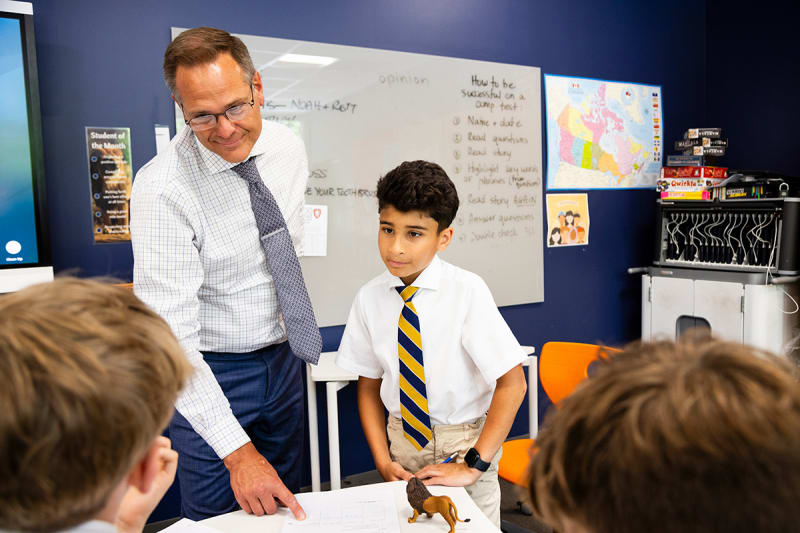
Walk through the halls of Linbrook, and a few things stand out. It’s a bright space filled with natural light, and the classrooms all have flexible furniture that makes it easy for boys to focus and work together. The walls are lined with impressive student art, a clear sign that a lot of creativity comes to life in this building. It’s a warm environment, and it’s obvious that every detail has been thoughtfully planned.
We pop into the Grade 2 classroom that is bright, colourful, and designed for small-group learning. Round and kidney-shaped tables are arranged around the room, each with three to four rolling and flexible student chairs. The furniture comes from Germany and is designed to allow boys to move and wiggle as needed. The walls are lined with bulletin boards featuring student work and themed visuals. Along the windowed wall, low shelves hold bins of books and materials, making resources accessible at students’ height and reinforcing independence.
As a small school, each space is intentionally designed to serve multiple purposes. The recently built Leadership Centre, with its wall of windows overlooking the courtyard and exposed brick, functions as an elevated boardroom for both students and staff, hosting everything from Parents’ Association meetings to student-led initiatives like chess club, House council, and mentorship gatherings.
The Student Success Centre offers a collaborative environment where small groups work with resource teachers on decoding, writing, and math. It is also used for reading assessments and admissions testing. Nearby, the school’s art and music room doubles as a vibrant creative hub, filled with student artwork and used for both visual arts and music instruction, with scheduling designed so the two subjects do not overlap.
In addition, a private music room allows students to take one-on-one lessons during the school day with professional instructors in piano, drums, guitar, violin, and woodwinds, offering families a convenient alternative to after-school programs.
One of the coolest new spaces is the Innovation Studio, set up on the gymnasium stage. “We renovated the space about three years ago and added velvet curtains, upgraded lighting and sound, refurbished the stage and installed a large super-sized LED screen,” says Way. “I believe this is the only screen of this size in a Canadian elementary school, though Sheridan College has one too.” The screen has transformed the school’s production space by bringing assemblies and concerts to life in exciting ways.
The space is used for a variety of purposes. For example, each grade puts on its own assembly for parents and the school community. These range from research-based presentations, like the annual Grade 1 animal research presentation, to creative news broadcasts and days of significance such as Remembrance Day and National Day for Truth and Reconciliation. School concerts, talent shows, and awards recognition ceremonies are also conducted within this space.
“I love to travel and saw these screens for the first time on a cruise ship,” Way explains. “I thought it would be a perfect way to showcase our students’ talents and keep the audience entertained.” After a successful fundraising campaign, the school was able to raise $500,000 for this project. “We have an extremely generous parent community who are eager to support fundraising initiatives designed to improve opportunities for the boys.”
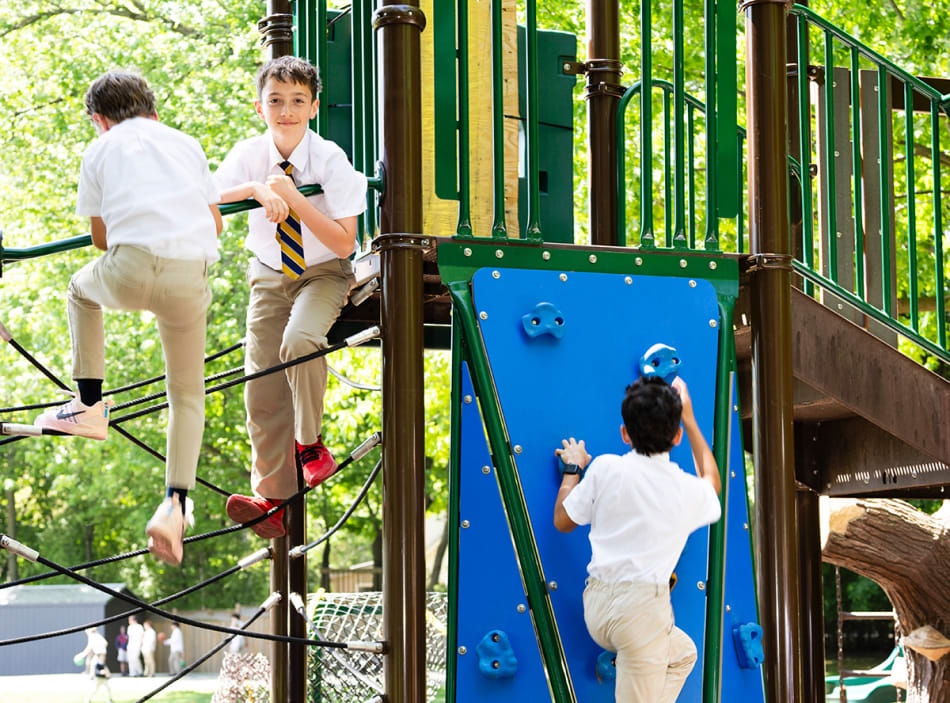
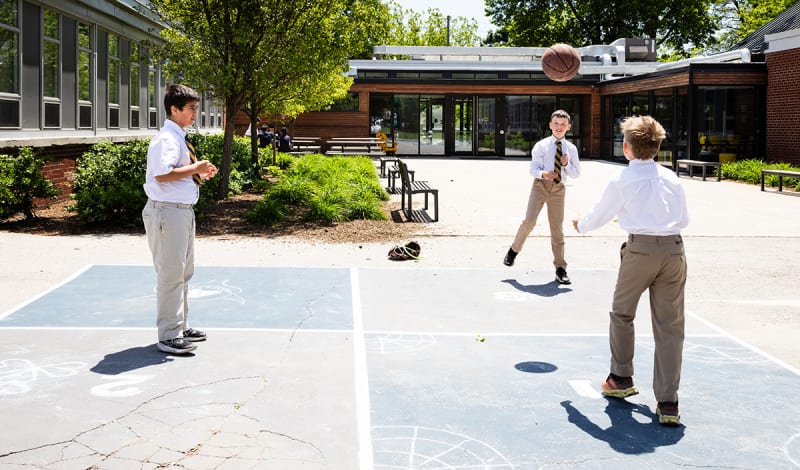
Ask any Linbrook boy where his favourite place in the school is, and he’ll likely tell you it’s the gym or the expansive outdoor fields (although many of the boys actually tell us that art is their favourite subject!). “The boys have five gym periods a week, and they all take place here,” says Way. “It’s also where we host our intramural games for Grades 1 to 8 and where our competitive sports teams practice before they compete within the Private School Athletic Association.”
Growth and expansion
Following a pre-consultation with the Town of Oakville to rezone adjacent properties, Linbrook is moving ahead with a significant campus expansion in the coming years. Parent feedback helped guide the plans, which will include specialized learning environments, shared community spaces, and improved athletic infrastructure.
“To build upon the extraordinary opportunities our students already enjoy, we are expanding our campus to include a beautiful dining hall and inspiring, custom-designed facilities for athletics, STEM, and the arts. These exceptional new learning and social spaces will deeply enrich our programming, giving our students the meaningful experiences and competitive edge they need to confidently excel in their future studies and young adulthood,” explains Way.
We are told that the project will unfold in two phases, eventually adding new classrooms, a central community hub, a full-sized gymnasium, dedicated arts and music spaces, an updated student success centre, and a media centre. It will also include a science and robotics lab, cafeteria and kitchen, and spaces for the Parents’ Association and school store.
“Ultimately, these vibrant new spaces reflect our unwavering commitment to excellence and community, empowering our boys to reach their highest potential while ensuring that connection and brotherhood remain at the very heart of the Linbrook experience,” Way adds.
Student Life
Students walk in the front doors at Linbrook and are greeted by name. While this may seem like a small thing, it has a big impact. “We never miss anyone because we know all of the boys personally,” says Julie Churchill, the school’s Vice Principal. “We know what they need to be successful, how we can support them, and how we can ensure we’re providing them with a well-rounded experience.” When new students join the school, they’re considered based on their academic skills and how they will fit into the existing cohort.
Linbrook has one homeroom class for each grade with 18 students in JK through Grade 3 and 20 students per class in Grades 4 through 8. Each year, a new JK class is added to the school and other students join based on the availability of space. The school is a feeder for other independent high schools in both Toronto and Oakville, including nearby Appleby College.
“We chose Linbrook because it’s a small school and they know every student personally. An environment like that is very supportive for students, especially when they’re young,” says parent Wenfang Li, whose son just completed JK. Because English is not her son’s first language, Li wanted a school where he would be supported socially and academically. “If he had been in a public school, I don’t think his language would have progressed so quickly; he feels very involved, he has a lot of good friends, and he can express himself really well now.”
There are quite a few international students whose families move to the Oakville area for work. And the Linbrook team has experience helping students as they improve their English language skills. New students can join in any grade, if there is space. “We even have some students joining us just for Grades 7 and 8 to get extra support and ensure they’re ready to be successful in high school,” says Nancy Dove, Linbrook’s longtime Manager of Business Administration.
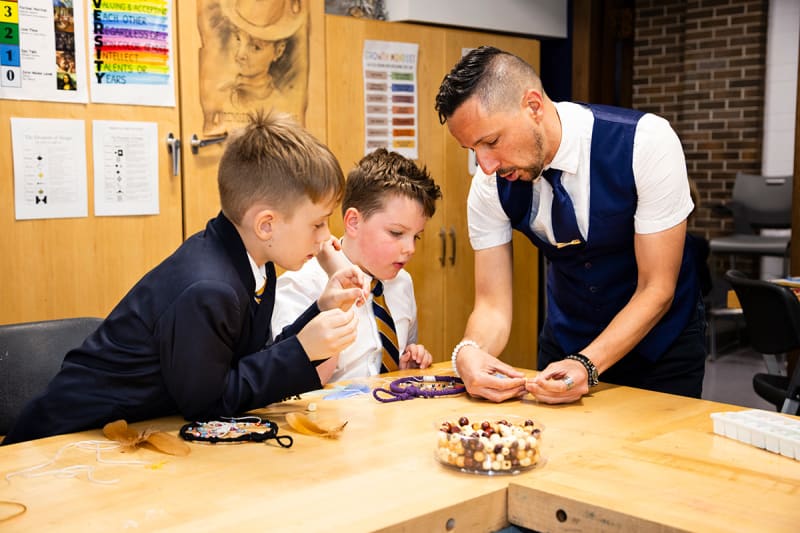
A question Churchill gets quite often is: Why all boys? And it’s one she’s happy to discuss. “When you look at how boys learn, not just how they get by but how they truly thrive and build confidence, well, you want an elementary experience that’s designed to support those things,” she says. That doesn’t mean leaning into stereotypes. In fact, Linbrook prides itself on doing the opposite. Boys are free to express themselves without the weight of gender expectations. “When students asked to start a bracelet club, the answer was ‘absolutely’. The choir, drama program, and art classes are genuinely beloved and all led by male teachers. It broadens their perspective of what’s possible, what they can do,” she says. “We want them to be exactly who they are.”
Especially for the older boys, being in a small environment where they can serve as leaders and have the younger boys look up to them is surprisingly valuable. “Middle school is such an intense time, and I’m so happy my son isn’t at a huge school; I’m glad he has a whole village of adults watching over him to ensure he doesn’t make any mistakes he can’t take back,” says parent Victoria Hughes. Boys at this age deal with a lot of things they’re not really equipped to deal with, and being in a small environment is incredibly powerful. They need help, and they get it at Linbrook.”
Linbrook boys have lots of outdoor time, engaging assemblies, schoolwide performances and concerts, special event days, field trips and overnight trips, all alongside their academic timetable.

The Learning Experience
“I definitely credit Linbrook with helping my sons academically,” says Hughes. “When they joined the school, they were both academically weak. They were unfocused and not engaged in school. That changed quickly.” Hughes says that the environment really worked for her kids, in a way she wasn’t expecting. “It drew them in, and now they’re both in math enrichment, participate in all the co-curriculars, and love going to school.”
Kindergarten
“When you come to Linbrook, you’re not just sending your child to school; you’re joining a community of like-minded parents who have chosen this education for their sons,” says Ashley McNabb, the mom of a JK student. “My daughter is in Grade 2 at St. Mildred’s, so I was eager to get my son into Linbrook. I wanted an all-boys school for him because, to be honest, most traditional Kindergarten classrooms are designed for how girls learn. They are expected to sit quietly in a circle and rarely have enough movement built into the day. While that would have been fine for our daughter, my son is an active 5-year-old and I wanted to send him somewhere where the way he is isn’t a problem to be managed—it’s something to be embraced.”
Two Kindergarten teachers, assisted by two educational assistants, start each day with familiar routines that set a positive tone for the youngest Linbrook boys. The Kindergarten classrooms are lively spaces, with a curriculum intentionally built around movement and hands-on exploration. Activities support early literacy, with the aim of helping students become fluent readers by the end of Senior Kindergarten.
Kindergarten parent, Li, describes learning as differentiated and encouraging. “Teachers carefully match reading materials to each child’s level, rather than giving everyone the same thing,” she says. “At home, my son completes short homework tasks and then the teachers mark them with stickers, smiley faces, and little comments. Each week he eagerly checks for feedback, and he finds that very encouraging.”
Parent Ilana Stoch says one of the things that immediately stood out to her about Linbrook was the use of subject-specialist teachers starting as early as Kindergarten. “My son has dedicated teachers for French, art, physical education, and music, rather than a single classroom teacher trying to cover every subject, and this really elevates the program,” she says. “It means the kids are getting instruction from educators who are genuinely passionate about their disciplines.”
Stoch says she hadn’t initially imagined sending her son to an all-boys school. “My son is a December baby, full of energy, and I worried about him in a large, busy environment. Also, things weren’t coming to him as quickly. We kept him in daycare a bit longer, and while I was looking for a local public option, I couldn’t imagine him in a class with nearly 30 students.”
Stoch and her husband explored several options, but nothing felt quite right. “We came across information about Linbrook and a video featuring principal Mike Packowski,” she says. “I had heard about the school but hadn’t seriously considered it, thinking it might be difficult logistically from our then-home in Milton.” After touring the school and meeting with Packowski, they decided to arrange a trial day for their son. That visit turned out to be pivotal.
“Amber told me that she walked by the classroom a few times and she couldn’t tell that my son was just visiting. He was completely engrossed in what he was doing, connecting with other kids.” This helped them make their decision, and while her son initially took the school bus (a program shared with St. Mildred’s), the family eventually moved, and now they’re just a 10-minute drive away.
Many years later, they’re now looking ahead to high school, and Stoch says she’s confident her son has a strong foundation. “I’m not at all worried about him academically or in terms of connecting with other students; we just have to find a school that will be right for him. But it will be hard to find the same community that Linbrook has provided.”
Grades 1 to 4
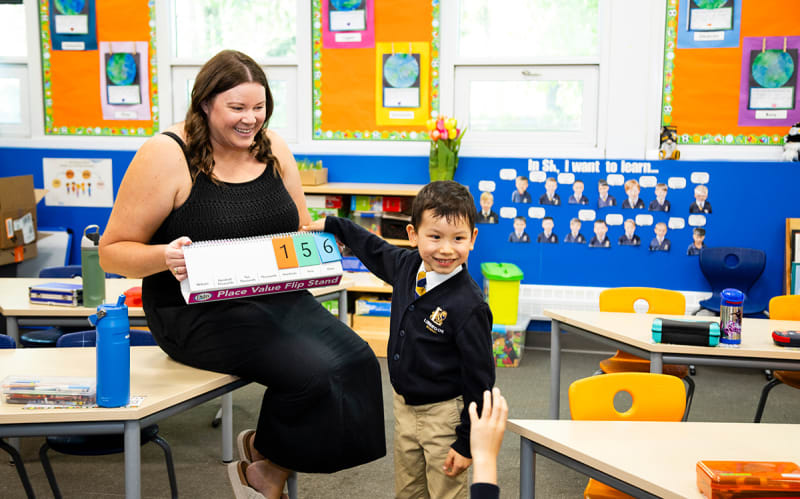
In the primary grades, teachers begin to carefully observe and respond to each student’s individual learning style, tailoring instruction so boys can build strong foundations in a way that feels natural and engaging to them.
Small class sizes make it easy for teachers to break the group into smaller clusters for targeted learning time. In their homerooms, boys work through core subjects and then move to dedicated spaces for music, physical education, and art. Technology is woven into this experience as a core teaching tool. Subjects like math are made more engaging when they’re integrated into educational games that tap into boys’ natural competitiveness and love of movement, turning abstract concepts into active, playful challenges.
In Grade 2, teacher Barbie Vasilakos McRae frames the year as “Jedi Academy,” a playful theme that reinforces the idea that each boy’s strength and potential lies within him. The focus, she explains, is on helping students grow as learners and as humans: if a boy’s “force” is weaker in math, for instance, the classroom becomes a place to build and strengthen that skill. She teaches language and math through a wide range of activities, using tactile materials, visual supports on the SMART Board, interactive tools on iPads, and pencil and paper. Her intention is to have students learn by doing, not just by listening. “Rather than having them write a standard paragraph, we’ll write a recipe, or a letter to an author,” she explains. In her Grade 2 class, there’s also a lot of collaborative work, with students helping one another and taking turns being the ‘teacher.’ “Our classes are designed to be highly inclusive and welcoming,” she says. “We don’t look at limits; instead, when a challenge appears, we ask ‘how can we help?’”
Grades 5 to 8
Grades 5 through 8 at Linbrook are intentionally structured as a bridge to high school, with a clear goal: every boy should feel academically prepared and personally confident when he moves on. Leadership development is woven into these years with opportunities to participate in the Linbrook Leadership Program (LLP), run for House Council, and campaign for house captain or assistant captain. All of these allow them to practise initiative, responsibility, and peer leadership.
Alongside these roles, boys take part in study-skills sessions and targeted lessons that refine essay writing, time management, and organizational habits.
In Grades 7 and 8, preparation becomes even more focused. Teachers design lessons specifically aimed at helping boys transition smoothly to high school, including structured work on organizing binders and calendars, sharpening communication skills, and building independent study routines. Grade 8 students also engage in school-wide leadership activities that ask them to step up as role models, further boosting their confidence as they get ready for the next stage of their education.
After 11 years at the school, Grade 7 and 8 language arts teacher Lindsay Mundy has a deep understanding of what academic life looks and feels like for Linbrook boys. She has taught multiple grades and specialty subjects over the years, and her long-standing work with the middle school cohort now gives her a clear view of how students grow as they move toward high school.
“For some teachers, the prospect of teaching this age group might be daunting,” she says. The boys are at the threshold of adolescence and high school, but that makes it all the more interesting for Mundy. “I love being able to dig deeply into a subject with them.”
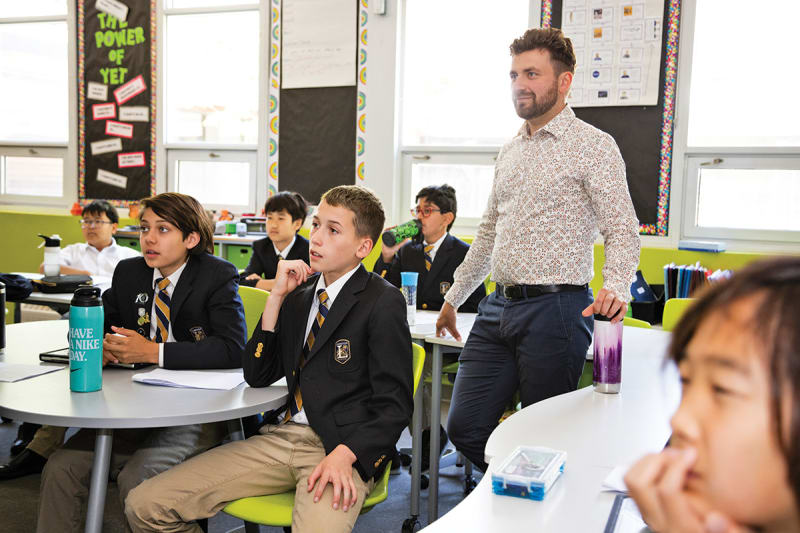
At Linbrook, Grade 7 and 8 students follow a rotary model. Each homeroom serves as a home base for communication with families and day-to-day organization, but subject teachers move between classrooms to teach specific disciplines. In the Grade 8 class, Mundy is the homeroom teacher, the primary contact for parents, the person who keeps families informed about what’s happening in the classroom and beyond, and the one who helps the boys navigate their final year of elementary school. As a specialist teacher, Mundy’s focus centres on language and character education. “Teaching language to the Grade 7s means that when they move into Grade 8, I already understand who they are as readers and writers, their strengths, gaps, habits, and preferences, and I can build on that knowledge rather than starting from scratch.”
The language program is grounded in the standards of the Ontario curriculum, including reading comprehension, writing mechanics and conventions, and visual and oral communication, but it stretches well beyond the basics.
“Over the past few years, one of my major professional goals has been to expand the types of writing my students encounter and practise,” she says. The boys try their hand at report writing, persuasive and opinion pieces, fictional and literary essays, and visual presentations such as commercials and multimedia projects. By the time they leave Linbrook, they should feel genuinely prepared and well-equipped to tackle a wide range of writing tasks in high school.
When it comes to reading, the focus is on enjoyment as much as on content. Rather than forcing boys to read only the classics, Mundy begins by taking stock of where the boys are at and how they like to read. Through an anonymous survey, she gathers data on their personal reading behaviours. Do they read before bed? Do they listen to audiobooks? What genres do they gravitate toward? Overall, how do they feel about reading?
Mundy uses the results to select novels that better match their interests. “The goal isn’t to turn every reluctant reader into a book lover, but to help them experience reading as something other than punishment, and ideally, as something they can enjoy.”
Each year, students develop speeches, write drafts, revise, and then present in front of their class and a teacher audience. The top three are selected for a showcase in the gym, where boys from Grades 5 through 8 attend. The exercise is framed as a life skill rather than just an assignment. No matter what they do in the future, there will be times when they need to speak in front of others, and confidence and poise only come with practice.
Relationships are a priority at Linbrook. “It all starts with connection,” says Mundy. “If you want to have a successful program with middle school-aged boys, you have to connect with them first. At their age, they can often feel like adults aren’t on their side, and if they don’t buy into your class, you’ve lost them.” For Mundy, this often means getting down to their level, getting to know them, and talking with them in a way that feels like a partnership rather than top-down instruction. From that foundation, she says, the balance becomes a bit of a dance. “Connection and enjoyment on one side and clear boundaries and structure on the other. I’m not afraid to laugh with them, but they need that structure. My most successful technique, by far, is ensuring they know that I’m on their team and that I’m there for them.”
In the Grade 8 language classroom, this balance also plays out in how each period is planned. An 80-minute double block isn’t a time to ask boys to sit and tackle one long task from start to finish, Mundy explains. “You have to read the room, understand how much they can handle.” A typical period will open with a mini-lesson, move into stations or group practice, then shift to independent work, with a longer assignment like an essay chunked into manageable pieces. “I circulate, give them space and independence, but they know I’m there if they have a question. Next year, no one will be holding their hand, and so we practise that gradual release of responsibility here, together.”
Academic Support and Enrichment
Some Linbrook students have IEPs and receive extra support in subjects like reading and math, while others are given access to enrichment opportunities. “Our son was diagnosed with a learning disability in Grade 2, and from there the support team at Linbrook really took over,” says parent Kristen Kiernander. “He used to be really down on himself because he struggled to read, but now he carries his diagnosis without shame and has been able to catch up in reading thanks to the support provided. He hasn’t missed a beat grade-wise, and it’s no longer really a thing; he just works with it.”
Churchill, who has been with the school since its inception and whose own two sons went to Linbrook, says the school is more than willing to support students who need accommodations. “Our work is grounded in helping boys understand how they learn best,” she says. As students move through the grades, they are gradually brought into the process so they can begin to advocate for themselves and recognize their strengths. By the time they reach Grade 8, Churchill explains that they are better prepared to explain what works for them, what does not, and how to ask for the support they need.
Mason is a Grade 4 student who participates in a small Friday math enrichment group. “There are 10 of us from Grades 3 and 4, and we get to try advanced math challenges, do math competitions, and make our own questions. I love it because even if math isn’t that challenging in class, then you’re always being pushed a little further through enrichment.”
These enrichment programs purposely combine multiple grades and are designed to get the boys’ brains working in creative ways. “I design the problems as ‘choose-your-own-adventure’ competitions so the boys are constantly pushing themselves,” says Churchill. “When they complain that it’s too hard, I remind them it’s like doing a push-up for your brain.”
“But no matter what they need academically, what parents really want to know,” Churchill says, “is ‘Will we care for your son?’” Her response: “I am passionate about education, and I believe it’s really important to always come from a place of compassion and love when working with boys and families. We form the biggest support team for each boy and, working closely with parents, we ensure every boy has exactly what he needs to be successful.”
Wellness & Character Education
Character education begins in JK and is woven throughout the curriculum. The program begins with teacher Vasilakos McRae. “We plan our teacher assignments based on strengths, and one of those strengths belongs to Barbie, whose mindfulness program is where character education begins for all of our younger students,” says Churchill. Seven years ago, Vasilakos McRae approached the Head of School with an idea to bring mindfulness to Linbrook students. “Amber was immediately on board, and I started teaching informally at first,” she says. “After COVID, we brought in a wellness director to help us develop a written curriculum which teachers are now able to implement.”
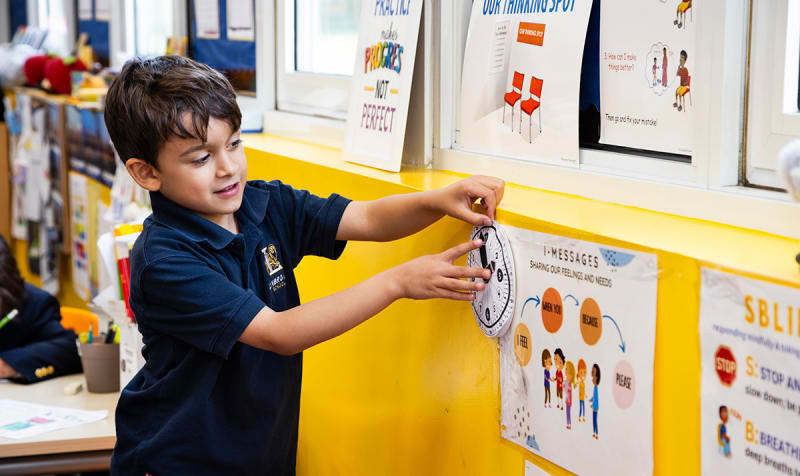
In JK, it begins simply. The use of puppets that embody different emotions and values (think: Tidy Turkey and Buzzy the Bee) helps students learn age-appropriate ways to express their feelings. “We start with things like ‘What are you feeling? What does that look like, sound like, feel like?’” explains Vasilakos McRae. “The goal is to remind boys all the way through their time at Linbrook that academics aren’t everything. We’re here to grow into good humans, and that means developing kindness, courage, and emotional awareness from the start.”
By Grade 4, mindfulness and emotional intelligence are the norm. “Boys who are in Grade 5 have had this type of learning since Kindergarten, and you can really see it,” Vasilakos McRae says. “They have the vocabulary, the self-awareness, and the ability to say, ‘I’m grateful for this’ or ‘I felt this way’ without it feeling forced.”
As the Grade 7 and 8 teachers know, boys at this age are in a fragile stage of development, trying to figure out who they are, where they fit into their peer group, and how they want to show up in the world. Units on diversity, equality, equity and inclusion invite boys to consider what those concepts mean in school and the community, ask questions, and role-play real-life scenarios. They practise how they might respond to challenging situations, why empathy matters, and what it looks like to be respectful and confident young men.
Mundy says that an all-boys environment can, in some ways, remove roadblocks. “Some boys might hold back certain questions or comments for fear of how they will look in front of girls, but while there’s still some pressure when it comes to social dynamics, many boys feel comfortable speaking openly and engaging with sensitive topics without worrying about how they’re being perceived.” The aim is to use that comfort to help them practise the kind of openness, respect, and self-understanding they’ll need in wider, more diverse contexts.
Other school-wide programs, including the Linbrook Buddies program, which helps foster connections between older and younger students, and the Linbrook Leadership Program, which emphasizes service, fitness, curiosity, and adventure among Grades 4 through 8 students, also foster student wellbeing. “Whether in the classroom, on the sports field or within the greater community, our boys proudly display integrity, empathy and respect,” says Way. “Linbrook graduates are confident young men, ready for the challenges that lie ahead in high school.”
School Culture & Values
What Linbrook offers, beyond academics, is something harder to quantify. “They really do form a special bond, a brotherhood, that extends far beyond the end of Grade 8,” says Way. “We have alumni who have all gone on to different high schools and then find themselves reconnecting in university and becoming roommates. Many come back to the school, visit with their former teachers, and volunteer at our events.”
Parent involvement and community engagement are other aspects that define the Linbrook culture. “Our dedicated Parents’ Association and many events—including the Welcome Back Celebration, winter and spring concerts, field trips, regular assemblies, coffee mornings, the speaker series, the Grandparents’ Tea and the Fun Fair—all reflect our belief that boys thrive when their families are also engaged,” says Way. “These events help families form meaningful connections not only with staff, but also with each other, making Linbrook a welcoming place for every family.”
Raising Respectful Young Men
Boys’ schools today have a significant responsibility when it comes to raising the next generation of young men. They have the opportunity not only to create learning environments that better support boys’ success, but also to help them grow into respectful, emotionally aware, and well-rounded individuals. Done well, this kind of education goes beyond academics, encouraging boys to build confidence, develop strong character, and understand the value of empathy, leadership, and responsibility. It also gives them space to be themselves while learning how to relate well to others and contribute positively to their communities.
Linbrook boys form lasting friendships that follow them through university, Churchill explains, and they also have the opportunity to interact with girls from St. Mildred’s-Lightbourn School through co-ed clubs and activities. In Grades 6, 7, and 8, students from both schools take part in Wednesday afternoon co-ed clubs such as chess, volleyball, and social club, which give them a chance to work, play, and socialize together in a relaxed setting.
Athletics & Co-curriculars
“What I love about Linbrook is the sports teams,” says Grade 5 student Charlie. “We usually win the championships...we dominate!”
Athletics are a pretty big deal at Linbrook. And, despite it often being described as a “sports school,” there’s a significant emphasis on balance and participation. As Athletic Director Will Raham explains, “We foster excellence in athletics, but we also have a lot of fun. We focus on the process and developing sportsmanship. Throughout it all, we try to uphold the school’s values.”
In developing the program at Linbrook, Raham drew upon the physical education curriculum he taught at St. George’s School in Vancouver, adapting and refining it to suit the school’s needs. Raham has developed a system of skill-based assessments tailored to different age groups. He tracks performance data year over year, allowing boys to measure progress and stay engaged. Even students who may not initially gravitate toward athletics become invested. “I’m always pushing effort and attitude; hard work pays off no matter what and matters a lot more than talent,” he says.
A cornerstone of Linbrook athletics is its intramural program, which runs from Grade 1 through 8 across the entire school year. Nearly every student participates in some intramural sports, and all athletic abilities are welcome. Sports such as soccer, handball, floor hockey, and basketball are played across multiple indoor and outdoor spaces, with seasons lasting a couple of months each. Standings are tracked and displayed on an athletics wall at the school, becoming a focal point of daily conversation. “It’s the centre of the universe for these kids,” says Raham. “They’re always looking at the board, talking about the metrics; they’re fully engaged.”
When it comes to competitive sports, Linbrook is part of the PSAA (Private Schools’ Athletic Association), which Raham has been president of for several years. A network of 23 schools from Oakville, Mississauga, and Burlington, the PSAA offers structured competition across age divisions. The kids move through cycles of tryouts, practices, exhibition games, and tournaments.
“It’s a bunch of boys; they come to win,” says parent Victoria Hughes. “Even the kids who aren’t sporty tend to get into it. And there are lots of opportunities to participate so my kids tend to try out for everything. They both did cross country, track, swimming, basketball, volleyball, and hockey. It’s a small school, but there are so many opportunities.”
The same is true for co-curricular activities. Linbrook teachers oversee a wide variety of clubs and co-curriculars, and external providers are also brought in to run programming on campus. Some of these programs are included in the school’s annual activity fee, and others are paid for separately. Opportunities include clubs such as biking, computer coding, outdoor art, dance, theatre, Pokémon, and many more.
Outdoor education and leadership extend into overnight field trips the boys participate in during their Grade 5, 6, 7, and 8 years.
“My favourite Linbrook memories include going on the overnight trip to Ottawa and Muskoka Woods Camp,” says Grade 8 student Jaxson. “And athletics, I have probably been on every single sports team so far. Honestly, Linbrook helped me grow as a person. I’ve been here my whole life, and I’m sad to leave.”

Arts Integration
Arts Integration
While an affinity for athletics might be expected at an all-boys school, the enthusiasm students show for the arts—including visual arts, music, and drama—is perhaps more surprising, and certainly noticeable. It is striking just how many students name art as their favourite subject, eagerly describe their experience in the school musical, and speak with joy about the rock band.
Dramatic Arts and Technology
Sitting with a group of Grade 4 to 6 students, we get talking about the most recent musical production of Wonka, staged earlier in the spring. The boys share memories from the production, which saw Linbrook students playing all the roles—including Veruca Salt, Violet Beauregarde, the grandmothers, and every character in between. “They stole the show,” says AJ Fisico, the school’s creative lead for events and productions. “In a co-ed production, girls typically play the boy roles when needed, and that goes largely unnoticed, but watching a room full of boys fully commit to any role, regardless of gender, says something powerful about the environment Linbrook has built. I see it constantly here,” he continues. “The traditional pressure falls away, and the boys genuinely believe in their abilities to sing and dance, and they are celebrated for it.”
Drama comes to life not only through the co-curricular theatre program, but also through student-led assemblies. Every two to three weeks, these high-impact performance opportunities are rooted in public speaking, storytelling, and presentations that often incorporate elements such as news reports, dramatic scenes, and reflections on topics like service or Truth and Reconciliation.
Central to the productions is the 27-by-10-foot LED video wall in the Innovation Studio that enhances performances through dynamic visuals and pre-produced content. Fisico, who also specializes in technology and production, integrates tools such as green screens, video editing, and live effects. In one Grade 6 parody of “Honey, I Shrunk the Kids,” students interacted onstage with pre-recorded footage of themselves, appearing as miniature figures alongside large-scale props like a giant snake puppet. These creative elements help performances extend beyond traditional drama, incorporating multimedia and design elements that elevate the experience.
Using technology creatively, Fisico also has students engage in hands-on tech creation, from video game design using Unreal Engine to robotics projects that simulate real-world challenges. In one example, students programmed small robotic devices to navigate terrain like a Mars rover, connecting coding concepts to scientific applications. Fisico works closely with Sean McCammon (Linbrook’s Director of Technology); together, they emphasize process over product, helping the kids understand how systems work and how digital tools translate into real-world problem-solving.
Music
The music program begins in the early years at Linbrook using Orff instruments. The boys then transition to recorder, followed by ukulele. In addition to covering the required curriculum, boys of all ages use technology to compose and record their own music.
“Grades 5 through 8 are where it all comes together,” says teacher Martin Wigle, who has been with Linbrook since day one. Students cycle through units on every instrument, developing real working knowledge of each, before making an informed choice at the end of Grade 5 about which instrument they’ll commit to.
“We want them to buy into something they’re genuinely interested in, because that choice leads to more practice and more love of music,” he says. “The instruments are also chosen with longevity in mind: guitar, bass, piano, and drums are instruments boys can carry with them for life. These aren’t like the flute, which most people eventually give up—there’s no adult flute band, you’re not pulling one out at a campfire. These are lifelong instruments.”
The school switched to a rock band format during the pandemic when wind instruments were no longer feasible, and they’ve never looked back. All students perform at the winter and spring concerts, and a Band Showcase also takes place in the second half of the year for Grades 6 through 8. This showcase is the culmination of small group work where each band chooses a song they love and works to figure out how to perform it as a group. Beyond this, there are two co-curricular rock bands outside of regular music class that students can join if they want a further challenge in music.
The vocal music program is also robust, with a strong tradition of boys singing. Students in Grades 1 to 3 participate in the Linbrook Choir, and those wishing to continue with singing in Grades 4 and above can join the co-curricular Lions’ Chorus. “This year the choir participated in the Ontario Vocal Festival and advanced to MusicFest Canada nationals, held in Niagara Falls,” Wigle explains.
“There’s a lot you can do here, and you can be whoever you are,” says Tate, who started at Linbrook in Grade 5. He joined because he was looking for a school where he’d feel safe and supported. “There are as many teams as you can possibly join, but there’s also the rock band where I play guitar, and I love to sing, so I’ve joined the choir also.” In the school musical, Tate played Mike Teavee. “We were all so close, and we had so much fun. Even though it’s run by the teachers, we all have a voice. I loved being part of that.”
Parent Ilana Stoch also raves about the music program. “We enrolled my son in private music lessons at Linbrook beginning in Grade 1, and though I wanted him to play guitar, his hands weren’t big enough, so he started with ukulele before moving on to guitar, then electric guitar. Now he plays bass. He definitely would not have had these opportunities had he gone to public school.”
Visual Arts
“The art teacher is also wonderful,” Stoch says. “And the annual art show, where each grade’s work is displayed, has become a highlight for us. Seeing how the art teacher helps boys, even those who don’t see themselves as artists, produce work they never could have imagined, is truly impressive.”
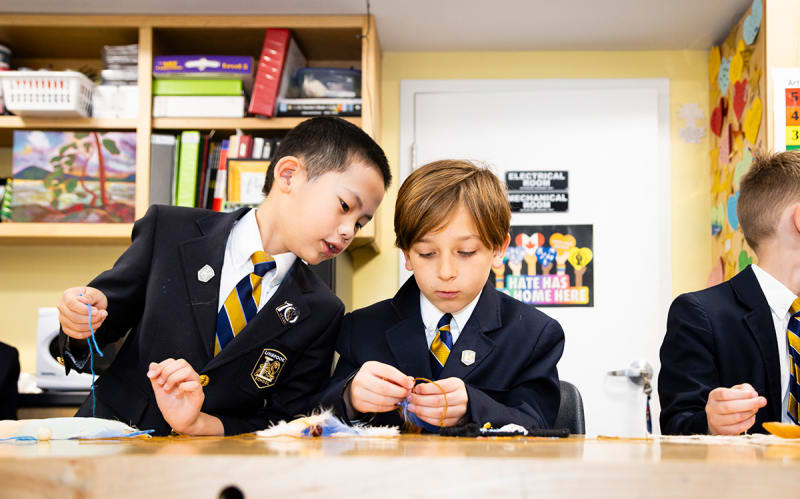
Steven Botelho teaches drama and art at Linbrook. He brings a wealth of experience, including work as a puppeteer. He contributes to both programs significantly and works to create a space where boys feel comfortable expressing themselves creatively, without judgement. “I want them to tell their own stories through their art, to take risks and feel brave doing so,” he says. One recent project saw the Grade 6 students choose a famous painting and replicate it using plasticine. The Grade 5 boys designed remarkably impressive board games based on books they were reading. Grade 8s engaged in a graffiti art project while Grade 7s designed their own album covers. “I always aim to give all the students creative freedom and allow them space to have fun and enjoy what they’re doing.” It shows.
Linbrook Leadership Program
Opportunities for leadership have always been among the defining features of the Grades 4 to 8 program, and the newly implemented Linbrook Leadership Program has taken that a step further.
Developed collaboratively with Linbrook’s leadership team and a dedicated parent group, and now led by Martin Wigle, the program is a student-centred initiative built around the core pillars of adventure, fitness, curiosity, and community. Created in consultation with parents, students, and staff, the optional program takes place outside of school hours, with an emphasis on independence, but is heavily supported by staff mentors.
A central component of the program is the year-long ‘curiosity project’ which allows students to pursue a topic of personal interest and develop their final project over time. Beyond this, students participate in activities for a predetermined number of hours (based on their grade) under each of the other three categories.
At the end of the year, boys who meet the program’s goals are awarded a pin and certificate. “The program builds confidence, showing students what they’re capable of achieving beyond schoolwork,” says Wigle. “We have decided to assign male faculty mentors to each of the boys, because it means something hearing from a male teacher that they understand what it’s like, they’ve been there, and they know you can do hard things and that you’re up for this challenge,” he says.
Admissions & tuition
There are always new families looking to join the Linbrook community, and the school’s strong reputation helps drive enrolment. One new JK class is formed each year with 18 spots for new students. After that, enrolment is based on availability. Grade 1 is a significant entry point for families coming from local Montessori schools. But, as Manager of Business Administration Nancy Dove explains, “This year there were only three Grade 1 spots available. They are now full, and we have a waitlist in place.” Classes grow slightly in size in the older grades, opening up a couple more spots for new students. All interested families are encouraged to call the school to enquire about availability and book a tour.
“Mike will usually lead the tours,” says Dove. “JK applicants attend a one-hour visit independently while parents remain in the school. SK applicants attend a full-day visit independently.” For Grades 1 through 8, there are two visits. The first is a ‘day in the life’ experience where students shadow peers, attend classes, and participate in daily activities. The second is an academic visit involving some standardized testing administered by Churchill. “Mike and Amber review the test results and discuss teacher observations; if space is available, an offer may be extended,” says Dove. “Mike meets with parents throughout the process so there is plenty of opportunity to ask questions and ensure we are the right fit for your family.”
For those interested in attending an Open House, dates are posted on the Linbrook website. The first one is usually held in the fall each year. “Our admissions team operates year-round, including summer, and mid-year entry is possible if space allows,” says Dove.
“The ideal Linbrook student is one who is ready to come to school each day with a kind heart, willing to learn and grow,” says Way. “To get the most out of their experience, it is important for our students to embrace the numerous opportunities we offer outside of academics, including sports, music, visual arts, community service, clubs and leadership roles.”
Tuition fees are in line with other schools in the area, with tuition for JK and SK approximately $5,000 less than tuition for Grades 1 through 8. All prices are explicitly laid out on the Linbrook website. A deposit fee is required to hold the spot of a new student, and there are a number of payment plan options available for annual tuition fees.
Beyond tuition, fees include an annual capital contribution of $1,500, an annual activity fee of $450, and, for Grade 8 students, a graduation fee of $500. Parents can also expect to pay a technology fee, which is $500 per year in Grades 1 through 5 and covers the cost of an iPad rental, and $1,650 per year in Grades 6 through 8 and covers the cost of a MacBook purchase, among other things. Other costs families may incur throughout the year include school supplies, experiential learning opportunities such as camps and overnight trips, instrument rentals, and uniforms.
Extended day programming is available from 7:15 a.m. to 6:00 p.m., and a select number of busing routes are available for a fee and are shared with St. Mildred’s School.
Tuition includes a hot lunch prepared by a catering company that’s also shared with St. Mildred’s and served to the boys daily at the school. The food is kid-friendly and healthy, and the boys seem to love it. Morning snacks are also part of the nutrition program. All textbooks are covered, as are clubs and athletic programs run by Linbrook staff. The school does offer some programs run by external providers that will have an extra fee associated with them.
There are no bursaries currently available for Linbrook students.
The Takeaway
“This is the best school ever. They care so much about us,” says Grade 4 student Josh. “It’s really the best place. We are so lucky our parents can send us here. We shouldn’t take it for granted.”
Josh’s sentiment is echoed by his classmates. They are eager to share stories of clubs and projects, teams and artistic creations. They talk enthusiastically about the musical and the roles they got to play. They boast about their athletic teams and how many new things they’ve had the opportunity to try. They love their rock band and are proud of their choir’s accomplishments. They’re excited about enriched math opportunities and the books they’re reading in language class. They speak openly about how safe they feel at Linbrook and how much they value their teachers.
Life is busy for these boys, but it’s clear they are genuinely happy to be here.
“Research demonstrates that when a school culture is designed to understand and celebrate boys, the outcomes are exceptional,” says Way. “At Linbrook, our boy-centric approach features active, hands-on learning, dedicated arts and science opportunities, three daily recesses, five physical education periods each week, and robust programs in innovative technology and leadership.”
“While Linbrook is academically demanding, your son doesn’t have to be all about academics to do well here,” says parent Ilana Stoch. “Because the teachers are wonderful, they will make sure the kids are getting what they need. Linbrook creates so many opportunities for boys to become well-rounded humans and good people. There is so much within the school community that promotes, inspires, and recognizes positive character traits in the boys. It really is a special place.”