The 2026 OUR KIDS Private School Expo is coming to cities near you. Get your family pass



The Sterling Hall School THE OUR KIDS REVIEW
Verified Review
OUR KIDS verifies every review by confirming the reviewer’s identity and their firsthand experience with the school. Learn more
The 50-page review of The Sterling Hall School, published as a book (in print and online), is part of our series of in-depth accounts of Canada's leading private schools. Insights were garnered by OUR KIDS editor visiting the school and interviewing students, parents, faculty and administrators.
Introduction
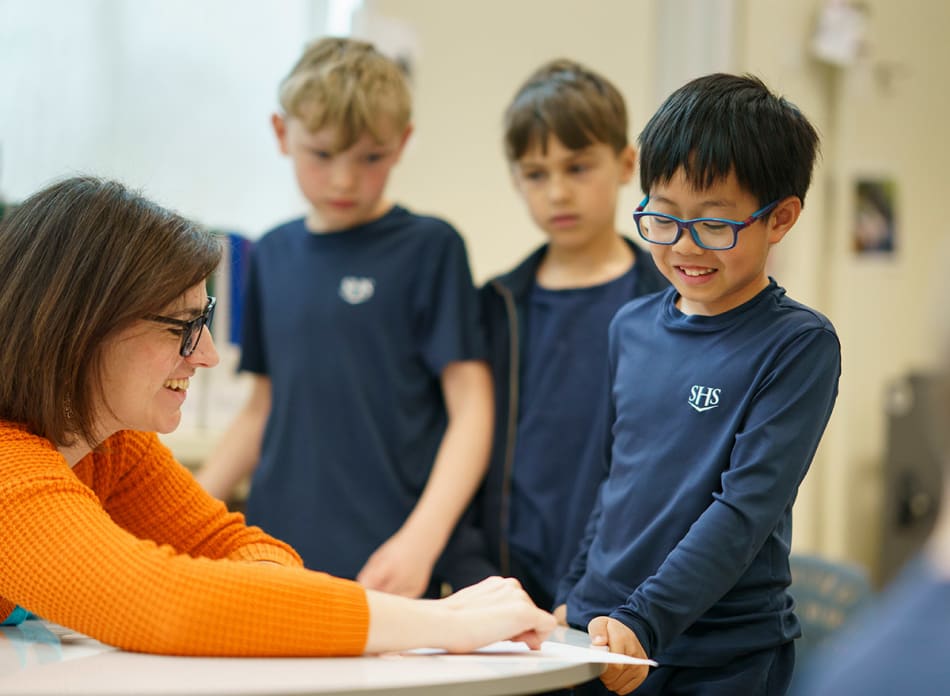
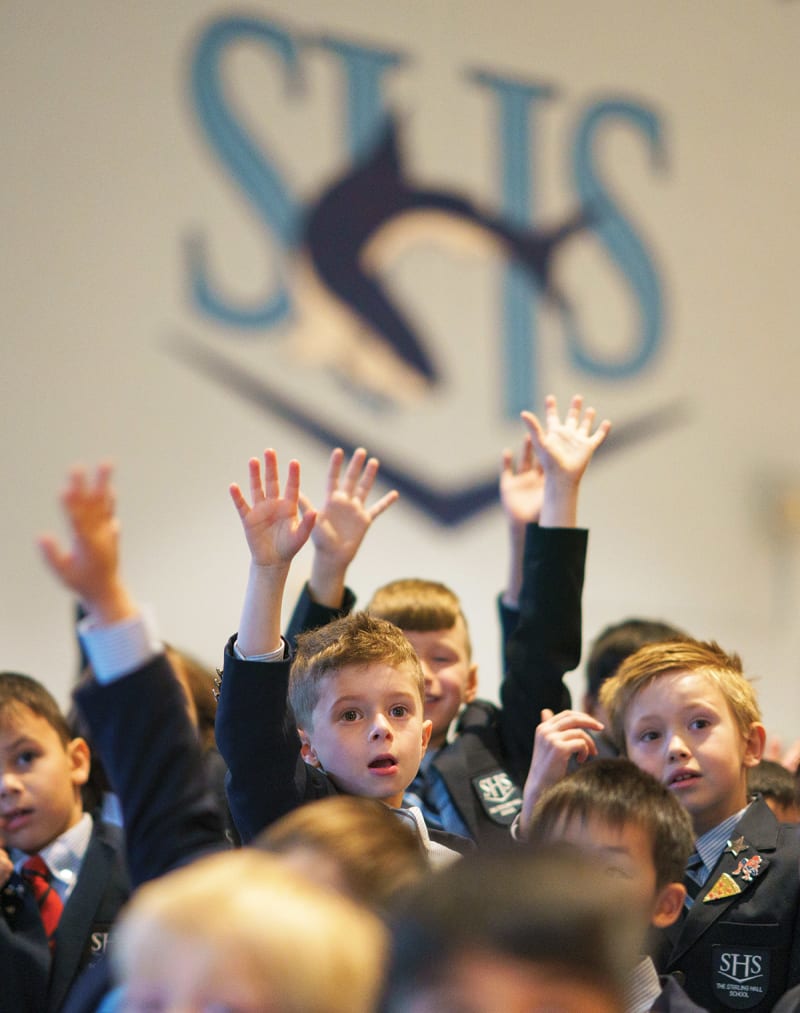
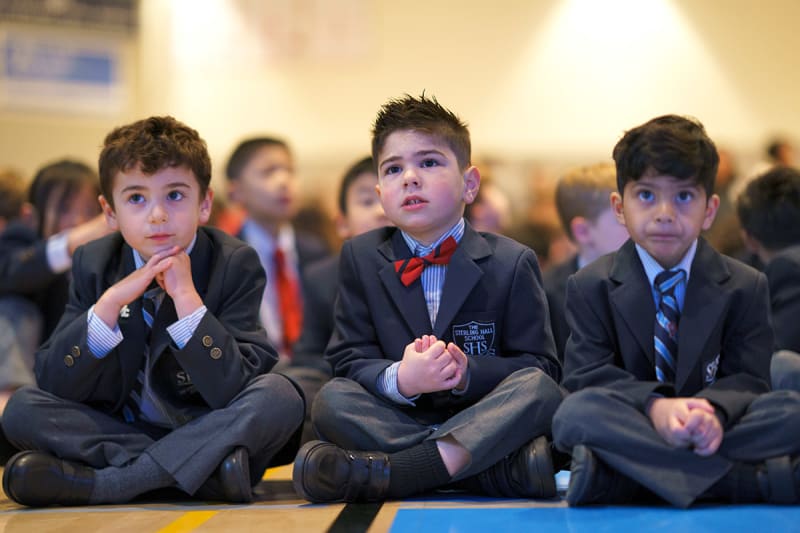
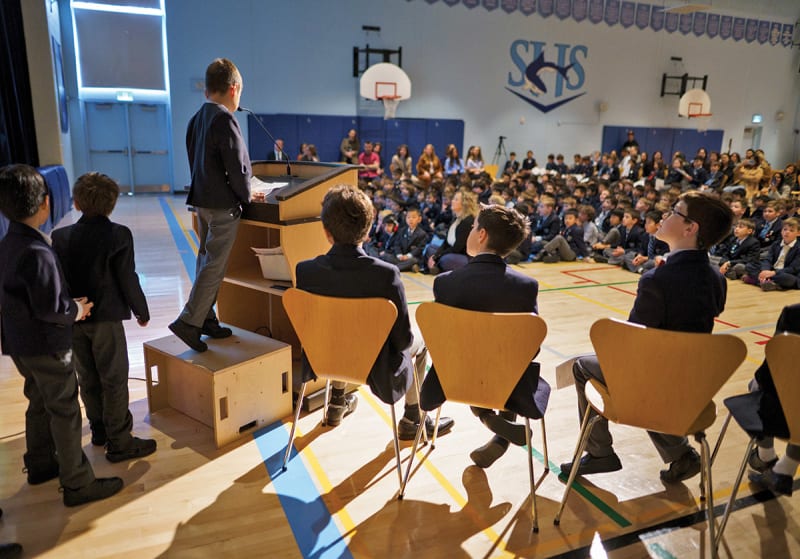
It’s a Friday morning in April, and The Sterling Hall School (SHS) faculty, staff, students, and a group of parents are gathered in the gym for the weekly student-led Friday Assembly. The boys are dressed in their #1 uniform, including blazers and ties, and sit politely on the gym floor (with the Grade 8s on chairs and parents behind them) while various classmates take the podium. To begin, a poised, well‑spoken student Prefect and soon‑to‑be Grade 8 grad delivers a speech on gratitude. The assembly moves quickly but covers a lot: updates on class and club initiatives, athletic awards, and a presentation on Health & Wellness Week.
The Grade 3 class presents a battery-recycling initiative that connects classroom learning with charitable giving. A student-made video trailer kicks off upcoming Earth Week festivities, including the ever-popular “dress as your favourite fungi” spirit day. The assembly is upbeat and supportive, and the confidence of the student presenters is striking.
“The great thing is, the boys think it’s normal to speak in front of 600 people,” says Principal Rick Parsons. “They see the older boys doing it, and they want to do it too. And so we have students of all ages presenting at and leading assemblies. It’s a lovely element of our school where vulnerability and risk-taking are modelled by older boys and embraced by the younger ones.”
Andrei Pop, the parent of an alumnus, has seen this progression firsthand. “The values and traditions that were initially instilled in my son, even from the moment when you start school with the handshake and looking in the eye, are very important to me. I’ve seen him flourish from a shy little kid to a boy who is excited and has no issue talking in front of the entire school at the assembly, which is tremendous to me. Academically, I feel like he’s had the support but also the encouragement to succeed.”
There are always parents at the Friday assemblies. It’s a chance to have morning coffee together, catch up with other parents, and see their boys in action. “The truth is, this is not a kiss-and-drop school. We are always invited into the building with open arms, and the teachers and staff make us feel incredibly welcome,” says Raili Flynn, President of the Parents’ Association.
That same warmth is extended to us as we begin our walking tour of the school with the Director of Enrolment Management, Susie Heinrich. As we leave the bustling gymnasium, students file back to their classrooms and then promptly head outside for recess.
The idea that boys need movement to succeed is a recurring theme at Sterling Hall. After sitting attentively through the assembly, the students are soon outdoors, running around and burning off steam. With two recesses, regular outdoor education, and Health and Physical Education offered daily from JK through Grade 5 and every other day in Grades 6 through 8, the school day is intentionally structured around how boys learn best. “The movement is what enables them to focus in class,” says Heinrich. “The boys know, ‘I’m going to be still now because I’m going to get to move around later.’ The schedule itself helps them self-regulate.”
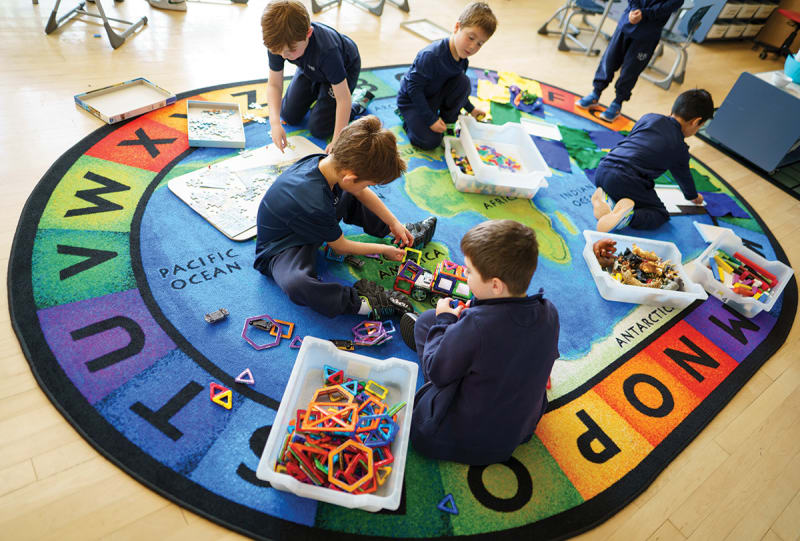
As you walk through the school, it is clear that everything—from the colourful schedules and flexible classroom furniture to the well-lit classes, well‑appointed fitness room, and ample outdoor spaces—is intentionally designed to support an active, visual, and boy-centred approach to learning.
“It is extremely rewarding to work with these boys in their elementary and middle school years,” says David Merrithew, a Grade 8 homeroom teacher, phys-ed teacher, and SHS alumnus. “We get the opportunity to set them up for success and for failure and give them the skills to not only be humble in their success but also resilient in their failure. This school was an amazing and supportive place for me as a student, and now I get to provide that same support to students.”
The basics
The Sterling Hall School (SHS) is Toronto’s only non-denominational, independent, all-boys elementary school. Tucked into a residential pocket across from Yorkdale Mall in the city’s Yorkdale-Glen Park neighbourhood, the school is home to 320 boys from JK through Grade 8. Small by design, SHS provides a tight-knit environment in which every boy is known and has ample opportunities to participate in school life. Its significant roster of intramurals, teams, clubs, and co-curricular activities allows boys to explore their interests, try new things, and contribute to the community.
SHS combines strong academics with a focus on character, leadership, and wellbeing, creating a close-knit community where each student is known and supported. With its thoughtfully designed classrooms, specialist-taught subjects, and emphasis on movement, collaboration, and experiential learning, Sterling Hall provides a dynamic environment that prepares boys with the confidence, skills, and curiosity they need for success in high school and beyond.
SHS recognizes that boys learn differently and uses research on boys’ learning to guide teaching methods and curriculum. The school’s focus is based on the fact that boys often benefit from hands-on exploration, clear structure, and material presented in manageable segments. Classroom routines, lesson formats, and assessment practices are all designed to help boys stay engaged, build confidence, and see themselves as capable learners.
Sterling Hall attracts families from across the city and beyond, with parents commuting from as far as King City in the north and The Beaches in the east, often carpooling or driving their sons to school each day. While families do consider Toronto’s larger all-boys schools, and boys often move on to those institutions after Grade 8, parents repeatedly praise Sterling Hall’s small, close-knit community and its deliberate focus on the foundational JK-8 years, which are among its defining strengths.
Sterling Hall’s Graduate Placement Program supports Grade 8 boys and their families as they prepare for the transition to secondary school. Through individual mentoring, school-selection guidance, interview coaching, application support, and strategic advocacy, the program guides families through each stage of the process. It helps each boy identify schools that suit his goals, interests, and strengths.
“We were looking for small class sizes and a school where my son wouldn’t feel overwhelmed. He was just five at the time, and when we toured the school, I loved how interactive it was,” says mom of three Sterling Hall boys, Sarah Willinsky. “The boys don’t stay in the same classroom all day; they move around a lot, even in Kindergarten. But the biggest factor for me was the focus on character strengths and social-emotional learning. It really aligned with my values.”
SHS creates new classes in JK and Grade 1, while Grades 2, 3, 5, and 7 are also significant intake years. New students are welcomed in other grades based on availability. Intentionally small, SHS prioritizes individualized attention and student support. There is one JK class, one SK class, and two Grade 1 classes, each with approximately 10 to 16 students. “Grade 1 is such a huge year developmentally, and literacy is a primary focus,” says Heinrich. In Grade 2, classes have approximately 16 to 18 students. By Grade 4, they can accommodate 20 students or, on occasion, a few more.
The overall student experience focuses on SHS’s three values: Learning, Character, and Community. “A student should be willing to embrace all of these if they’re going to be successful at the school,” explains Heinrich. “That being said, we don’t have an ‘ideal’ Sterling Hall boy”. As Rick Parsons, Principal, often explains, “we are growing a garden of wildflowers, and we want each boy to be the very best version of himself.”
Background
The Sterling Hall School was established in 1987 by its first principal, Darlene Ferris. Then a teacher at Toronto’s Bishop Strachan School (BSS)—which at the time educated boys and girls up to Grade 2—Ferris saw a need for a boys’ school her students could move on to after BSS. “She had always been focused on educating the whole child and wanted to create a community-based school where her male students would feel at home,” explains Parsons.
Ferris’s ambitious vision quickly gained traction, and SHS grew steadily through its early years. In 1995, Ian Robinson succeeded Ferris as principal, strengthening the school’s focus on community and overseeing its first significant expansion.
Rick Parsons joined the school as its third principal in 2012, having spent eight years as vice-principal of University of Toronto Schools (UTS). He calls SHS his “dream job” and says that after working in high school for most of his career, he was excited to see the impact he could have on younger students. “Working with 16- and 17-year-olds, I kept wondering what would happen if we got to these students earlier, instilling values and focusing on character development when they’re more open to it,” he says. “We have a real opportunity in the younger grades to build formative concepts of masculinity.”
His first action was to organize a senior leadership retreat and work with staff to develop the school’s mission statement: “To inspire and empower each boy through his formative years.”
In 2017, marking its 30th anniversary, SHS purchased its building and land from the TDSB after years of updates and renovations. The school also acquired an additional 1.5 acres to the west, laying the groundwork for a future expansion.
“We pressed pause for a few years,” Parsons explains, “and in summer 2026, we began a $26 million expansion that will create new and enhanced indoor and outdoor learning spaces.”
In 2023, the school celebrated 35 Sterling Years, marking more than three decades of growth, innovation, and community-building. As part of this milestone, Sterling Hall launched a new strategic plan designed to honour its founding vision while setting a clear direction for the next 35 years.

Culture and values
Grounded in a commitment to educating the whole child, Sterling Hall emphasizes character development, empathy, and integrity alongside strong academics. This is a school that lives and breathes its values – Learning, Character, Community – ensuring they’re embedded in everything from report cards and assignments to assemblies and co-curriculars. By focusing on respectful relationships, positive masculinity, and service to others, Sterling Hall nurtures confident, compassionate young men who are prepared to lead thoughtfully in their communities and beyond.
“Through the onboarding process, we are intentional about curating families who are genuinely invested in our values,” explains Parsons. “We are up front and direct from day one. We are a school that believes in human rights and affirming identities. We talk about and celebrate our differences. When families arrive, most of them have already been well-briefed on our values and have had many invitations to participate in the work we’re doing.”
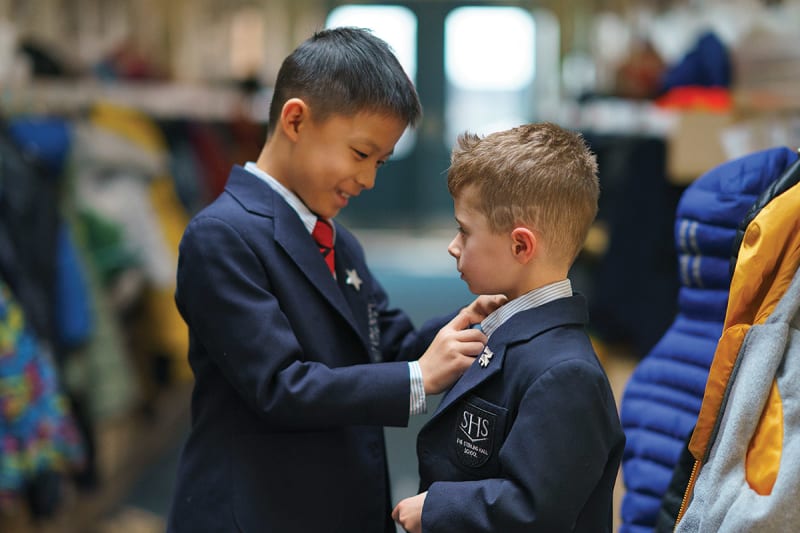
Values are visible throughout the school, including banners at the entrances and posters in every homeroom that present the VIA character traits that form the foundation of the Character Program. Boys wear Sterling Stars on their blazers, and weekly assemblies return consistently to the school’s three values. Posters promoting parent events, including a Parent Association session on positive masculinity, extend these themes across the wider community.
“We begin with the understanding that boys don’t learn in a vacuum,” says Parsons. “Learning is always social, always part of a larger human context. Boys grow through trial and error, by failing and trying again, by navigating friendship conflicts, and by building, sustaining, and repairing relationships.” For Parsons, this “messy” process of human development is not a distraction from learning but the very heart of it. It teaches boys how to work in groups, collaborate, and develop the skills research consistently links to long-term happiness and wellbeing.
“Academics are one important thread in a much bigger fabric,” he says. “The goal is to help boys become resilient, compassionate humans who can overcome challenges, learn from setbacks, and handle social and emotional missteps in healthy, constructive ways.” Parsons frames this approach as “relational learning.” Teachers must first build genuine relationships with boys, meeting them where they are and recognizing that each boy is at a different stage and dealing with different things. The focus is always on the whole child, not just on marks or content coverage.
Character education
Open up any Sterling Hall boy’s report card, and you’ll find the first page dedicated to character strengths. Boys are asked to identify and describe their character strengths (think: perseverance, love of learning, judgment, self-regulation) and reflect on how they have put those strengths into practice at school. The process not only develops self-awareness; it also provides students with a formal space to celebrate growth and set intentions.
“In Grade 7, my son tried out for the U13 basketball team and didn’t make it,” says Willinsky. “He was devastated, especially since the team was heading to a tournament in Winnipeg. But instead of giving up, he committed to improving, joining several basketball programs with the goal of making the Grade 8 team.” By January 2026, he tried out for the U14 team—and made it.
For Willinsky, it was a clear example of the SHS character program in action.
Introduced by Parsons about a decade ago, the VIA (Values in Action) Character Strengths program is one of the school’s most highlighted initiatives. Through the program, students learn from a very young age how to identify these qualities within themselves and how to use them in daily life.
“This is a strengths-based program that looks at 24 different character traits that are broken down into categories,” explains Kate Taylor, the school’s Vice Principal. “Every student has the potential to embody and demonstrate these strengths, and as they get older, they come to understand what their own signature strengths are and which traits they want to practice more.”
The 24 strengths, from bravery and prudence to self-regulation and social intelligence, represent some of the best aspects of an individual’s personality. The program begins in JK with small goals, and then character education is mapped through the SHS curriculum at every level, showing up in the classroom, on the playground, as well as in athletics and co-curriculars.
“In the primary years, character education is story-based and all of us, from teachers to students, have a shared language around these traits,” says long-time Sterling Hall teacher, Aleeza Janmohamed. “Teachers talk about character traits regularly and pair each trait with a story that boys can understand and remember.” This approach is supported through Sterling Stars, a program that makes character education visible and concrete for younger students. In Janmohamed’s SK class, students collect colourful character stickers on their pencil boxes, each image representing a different trait. “At 10 stickers, they receive a certificate and at 15, the Principal comes into the class during community time and presents the boys with a silver star pin they will wear on their blazer.”
Janmohamed shares an example from that morning’s class. “I gave one of the students a sticker for self-regulation,” she explains. The language went something like this: “You were really excited, but you were able to settle yourself, and I noticed that.”
“In JK through Grade 2, external motivation plays a role, but by the time boys reach Grade 3 and beyond, the goal shifts toward intrinsic motivation,” Parsons explains.
“The stars fall away because the expectation is that character work has already been embedded. By then it’s part of who they are.”
That being said, the character traits do still show up in awards and accolades. At the Friday assembly we attend, for example, athletic awards were given out in categories such as ‘Performance Character Award, for perseverance, effort, discipline, and a desire to improve,’ and ‘Civic Character Award for leadership, teamwork, and strengthening our community.’
“My boys have transferred the traits they’re embodying at school to our home life as well,” says Willinsky. “And that’s something that really stands out for me as a parent.”
Facilities
Sterling Hall School’s single-storey campus in midtown Toronto is deceptively large and thoughtfully designed to support how boys learn best. On the cusp of the school’s largest capital improvement project in its 38-year history, there is a palpable sense of excitement across the community. The project will include the addition of eight bright, spacious new homerooms, a second-floor, clearly defined main entrance with a welcoming community gathering place, expanded green spaces to support outdoor education programming, and dedicated on-campus parking with improved traffic flow.
Once complete, the project will grow the campus from 6 to 7.5 acres.
Most significantly, it will create new purpose-built learning spaces for boys to learn, thrive and belong.
Learning spaces for creativity and innovation
But even before these new developments, the school is sunlit, airy and welcoming. Classrooms are bright, flexible, and designed for collaboration, with movable furniture and writable surfaces that allow teachers to quickly reconfigure spaces for group work and hands-on activities.
The school is organized into learning facilities for primary, junior, and intermediate students. In the intermediate wing, just outside the classrooms, a distinctive rock-like structure occupies the centre of a collaborative space. “The boys are growing into their bodies, and they tend to like to flop more in Grade 6,” says Susie Heinrich. “They like to work on their stomachs, on their sides, and standing. We built this rock about 10 years ago as an alternate space for collaborative work. Not everyone is productive sitting in a chair.”
Dedicated spaces for science, art, music, and technology give boys access to discipline-specific tools and resources. The Pryde Science Lab supports hands-on learning where JK to Grade 8 students engage in experiments and innovative STEM projects with expert guidance.
Visual arts, drama, and music each have well-equipped rooms designed to help nurture confidence and self-expression.
The Poile Art Studio offers a wide range of experiences, from pottery (with a full kiln) to 3D construction, puppetry, mask-making, printmaking, large-scale painting projects, and projects with visiting artists. Large, flexible studios support set building and group projects such as murals and castle builds. A dedicated woodworking studio allows students to bring their ideas to life while learning to use tools such as drill presses and mitre saws safely.
The Sullivan Music Centre provides instruments on loan, including woodwind and brass instruments, along with access to guitars, bass, keyboards, and drums for classroom learning. Many boys also take private lessons and showcase their progress at recitals throughout the year.
For computers and robotics, the Cheddie and McFarlane computer labs provide boys with dynamic spaces to explore coding, robotics, digital design, and creative problem-solving. “At SHS, robotics is considered ‘cool,’ and programming begins in JK. Mentorship is built into the program so students in Grades 6 to 8 work together a lot of the time,” says Heinrich. Equipped with tools for 3D printing, robotics, and interactive learning platforms, these labs support everything from early computational thinking to more advanced maker projects. Whether boys are programming robots, building digital prototypes, or collaborating on tech-infused challenges, the labs are designed to make innovation, experimentation, and digital literacy a natural part of everyday learning.
Wander into the Phelan Learning Commons (aka the library), and you’ll find a warm, welcoming hub for reading and research. It’s a book lover’s happy place, with cozy, boy-friendly spots to read and relax, inviting enough that even reluctant readers will likely want to pick up a book. It’s home to a collection of nearly 20,000 titles spanning picture books, early readers, primary and junior/intermediate fiction, non-fiction at all levels, and a wide range of graphic novels.
Ample room for active learning and physical exploration
For the many active boys at Sterling Hall, physical activity spaces are a highlight of campus life. The Eaton Shier Gymnasium features two volleyball courts, three badminton courts, three pickleball courts, tchoukball nets, and six basketball nets, with championship banners lining the walls. It also serves as a performance venue, complete with a stage, lighting, curtain, large drop-down screens for presentations, and a sound system.
The Intermediate wing Fitness Centre includes a bouldering wall and a wide range of age-appropriate equipment—from bikes and weights to ropes, bands, and balance tools—supporting both structured workouts and movement-based play.
Outdoors, Sterling Hall offers expansive and well-equipped grounds spanning 6 acres (expanding to 7.5 acres), including a multi-court sports surface, a soccer field, and the Ian Robinson Quad with tetherball, four-square, a playground, and a sandbox. Set within a treed area, the Community Learning Garden features rock seating, a mud kitchen, and eco play zones. Boys also spend recesses tending the learning gardens and, in season, eating what they have grown.
A space for fueling busy minds with healthy meal options
The cafeteria is bright and welcoming, set each day with student name cards and place settings for the optional hot lunch program. Meals focus on fresh, healthy food, with careful attention to allergies and dietary needs. Boys can purchase items à la carte with a prepaid card, and JK-to-Grade 2 students receive two daily on-site snacks.
“The lunches are really good,” Cristiano, a Grade 5 student, tells us. “My personal favourite is the salmon; it’s really yummy. I also love the grilled cheese with tomato soup and the butter chicken.”
Students arriving early for athletics or before-school care can also purchase healthy breakfast options.
Student support and leadership
“Sterling Hall is truly a warm, loving, and supportive environment,” says Stephanie Orleans. “The school is genuinely invested in the success and growth of each individual child. They recognize that each boy has his own personality and tailor their approach to ensure every child feels safe, supported, and confident.” This thoughtful, curated student experience seems to make SHS so special. It’s why parents choose this school for their boys in their foundational years, and why they stay through to the end of Grade 8. It’s why graduates miss the school when they leave, and why they keep coming back to visit and participate in events.
A culture of support
Jacob Ische, a 2021 SHS graduate, returned in spring 2026 as one of SHS’s alumni interns, working with the Advancement team to strengthen the school’s alumni community. Jacob was thrilled to return to the school that had such a big impact on his life. Having just finished his first year at Western University, he says he continues to draw on the skills he developed at Sterling Hall.
“I remember struggling with test anxiety in Grade 6,” Jacob says. “My teachers helped me build strategies for managing my work and test-taking, and they kept checking in to see what was working. Over time, things improved.” By Grades 7 and 8, he felt much more confident. “I’ve carried that with me, being able to recognize when I’m struggling and find solutions that actually work.”
That support helped prepare him for high school at Upper Canada College (UCC). “Grade 9 and the International Baccalaureate (IB) Programme were a big step up, but I felt completely prepared. The transition was very smooth.”
When we sit down with a couple of Grade 8 students, they’re eager to talk about their upcoming transition to high school. This year, 90% of Sterling Hall graduates accepted offers from their first-choice schools, with students heading to 15 different institutions across the GTA and abroad. Just a few months until graduation, they’re feeling nostalgic: excited for the next adventure but also really sad to be leaving Sterling Hall. “I’ve been here for so long, I don’t know anything else,” says Cory Mecklinger. “Because it’s a small school, we’ve had so many opportunities to shine. We’ve had the chance to work toward creating a legacy and figuring out what we want to be remembered for.” As he prepares to attend TanenbaumCHAT for Grade 9, he looks forward to bringing the confidence and leadership skills he developed at Sterling Hall to a new and larger school community.
Thomas Zhang agrees. He’s moving on to UCC and will take with him the leadership skills and confidence he’s amassed at SHS. “I’ve learned how to ask for help and advice when I need it,” he says. “I don’t think I was a great student in Grade 6, but I really wanted to get on the honour roll. I went to my math, science, and English teachers for help, and with their support plus a lot of hard work, I was able to make the honour roll in Grade 7.”
Cory says one of his challenges was overnight trips, which are a big part of Sterling’s culture but something he avoided until Grade 7. “School trips were never for me,” he recalls. “But last year the basketball team was going to Winnipeg, and I didn’t want to miss it. Luckily I had a teacher I felt comfortable talking to and letting out all my emotions, and that really helped.” Not only did he go on that trip and love it, but he also decided he’d be going on the Quebec City and Montreal trip at the end of his Grade 8 year. “Now that I know I can do it, it’ll be a great way to sign off,” he says.
Welcoming new students with open arms
For Yasmine Battiston, Sterling Hall quickly became “our school.” After a disappointing experience in a public program, she and her husband visited on a friend’s recommendation and were immediately struck by the school’s diversity and warmth. Their eldest son settled easily into Grade 1, and a decade later—with one son now thriving as a boarder at St. Andrew’s College and two still at Sterling Hall—she calls it the best decision she could have made for her kids.
“The transition to Sterling Hall was a saving grace during a hectic time when we were just welcoming our third child,” she recalls. The parent‑buddy program paired her with a more experienced SHS parent who checked in regularly, organized playdates, and helped ensure her son had friends before his first day. That early sense of connection carried into the classroom. “His homeroom teacher took him under her wing, and the boys even made a keepsake book and gift to celebrate his new baby brother.”
For Yasmine, these gestures reflect what SHS has become for her family: a place where her children are deeply known and genuinely cared for. “They spend more time at school than at home,” she says, “and we’ve always felt they were in good hands.”
This sense of connection is intentionally built through a buddy program for all incoming families, coordinated by the Parents’ Association. As Heinrich explains, the program works alongside orientation events and classroom‑level community activities throughout the year. From new-family orientation days, new-boy playdates, and pizza nights to “New Boys Day,” parent coffee get-togethers, and parent cocktail parties, the goal is to ensure that all families feel welcome, supported, and integrated into the school.
For Lee P., a Grade 5 student new to Sterling Hall this year, it was the fall overnight trip that made the difference. “It was kind of scary at first because I didn’t know many people at the school,” he says. “The first day was hard. But we went to Camp Wahonowin for two nights, and I made a lot of friends and got much closer with people.” His advice to new students: “Come in with an open mind. Sterling Hall is a small school, and you can get to know everyone pretty quickly.”
Raising young leaders
Something parents, teachers, and students all talk about with pride and enthusiasm is the SHS leadership program. Leadership development is intentionally scaffolded from Grades 2 through 8, beginning with opportunities to serve as a class representative on Student Council and expanding to roles as a student ambassador, club mentor, or member of an Advisory Group. Through these experiences, boys build communication, collaboration, and leadership skills, preparing for the school-wide leadership positions held by every Grade 8 student.
At the Intermediate level, Advisory Groups bring together students in Grades 6 through 8, giving them further opportunities to listen, collaborate, and support one another across grades.
By Grade 8, this foundation culminates in meaningful leadership roles, with every student taking on a senior position across teams focused on areas such as Citizenship, Academics, the Arts, Eco, Athletics, House Leadership, and School Life. Student leadership at Sterling Hall is rooted in meaningful responsibility, character formation, and the lived experience of challenge and support.
Both Cory and Thomas are Prefects, a central leadership role that oversees Student Life and is responsible for running the Student Council. Meeting once or twice a month, the Council takes on projects that directly shape the student experience. “We’re working on building a gaga ball pit, introducing new clubs like drone club, and creating more athletics opportunities for younger students, like flag football,” Thomas shares. “It’s a lot, but it feels good to know you’re making a difference.” For the boys, becoming a Prefect is the realization of a goal they’ve worked toward for years and a chance to model what it means to be attentive, caring, and forward-thinking leaders within the school community.
“Our goal is to give every boy a voice and a role,” says James Burns, Director of Student Life. Grade 8 students share responsibility across a range of school-wide leadership teams, working with faculty advisors on initiatives and events that shape student life.
Student leadership also shows up in the House program. The four Houses—Morrison, Howard, McClintock, and Plumb—are represented by the Knights, Hounds, Mustangs, and Pirates, respectively. Together, they create a vertical community, with boys and staff staying in the same House throughout their time at SHS and connecting across grades. House spirit runs year-round, with friendly competition at events like the Terry Fox Run, Spirit Days, and the spring SHS Olympics. In Grade 8, some boys are chosen as House Captains; they help build spirit, make announcements, coordinate events, and motivate their peers.
Drawing on his experiences as an SHS alumnus, semi-professional rugby player, pilot, infantry officer, and now a homeroom and HPE teacher, David Merrithew sees the Grade 8 leadership stage as uniquely powerful. “There is no better place in the city to prepare for responsible leadership,” he says. “We thrust responsibility into their laps—they’re the oldest boys, and we expect a lot of them—but we also give them the tools, bandwidth, and space to discover the type of leadership style they want to cultivate.”
Grade 8s are prepared for their year of leadership with a week-long camping trip in Temagami. With days spent paddling, sometimes in rough, cold waters, they’re nudged into conditions that demand collaboration, humility, and care for one another. For Merrithew, these shared challenges cut through the noise of toxic online messages about masculinity and replace them with genuine, compassionate leadership. “Your friend is crying, and you help him out, because it will be you one day. Experiences like that can’t just be talked about; they have to be lived,” he says.
For younger boys, leadership opportunities begin early, with students looking up to the Grade 8s and aspiring to these larger roles and responsibilities. Henry T. is a Grade 5 student who is a class rep on the Student Council. “We have an election at the start of the year, and you have to give a speech about how you’ll help the school and represent your class,” he says. Henry was also elected as a class rep in Grade 2, and while he says the election process this year was exciting, he remembers being more nervous when he was younger.
“Above all, we want our students to be kind, compassionate people who care about others,” says Parsons. At his first assembly as principal more than a decade ago, he introduced a message that has since become part of the everyday language at SHS: “Big boys look out for themselves. Bigger boys look out for others.” Parsons continues to share the phrase regularly, and the boys understand it as a guiding principle—one that frames leadership as service, responsibility, and contribution to the SHS community and that they aspire to live by every day.
Parsons believes every boy can lead, starting as early as JK, where even helping a classmate with snowpants is an act of leadership. “The sooner you help your buddy, the sooner you both get outside,” he says. A Grade 2 student, Raphael, describes what this looks like: “When I’m with my friends, I always show kindness. I show this strength when I help kids when they fall or need help.”
Many Sterling boys, Parsons notes, go on to take on leadership roles and become active members of their high school communities. “At SHS, we believe in them before they believe in themselves, and that sets them up to pursue leadership roles in high school and beyond.”
Academics
Academic life at Sterling Hall is grounded in a robust program that builds strong foundations while giving educators the flexibility to extend learning in a variety of directions. Throughout the program, educators draw on research and best practices concerning how boys learn. “Rather than following an International Baccalaureate (IB) or inquiry-based model, we work from the Ontario curriculum and expand upon that,” says Vice-Principal Kate Taylor.
In math, students from Kindergarten through Grade 7 are taught using the Singapore Math approach, known for its emphasis on deep conceptual understanding and problem‑solving. By Grade 8, the boys are doing Grade 9 math, so when they transition to high school, they’re more than prepared to excel in mathematics. The same philosophy applies to science: while the Ontario curriculum provides the framework, classes include far more hands-on learning and experimentation. By Grade 8, students are engaging with Grade 9-level content.
“My favourite subject is science,” says Grade 5 student Cristiano. “I love the experiments. We probably do them up to three times a month. In the most recent one, we were learning about potential and kinetic energy, and we used a basketball to make hypotheses about how high it would bounce in different situations.”
Across subjects, educators regularly draw on high‑quality external programs—such as The University of Florida Literacy Institute (UFLI), Writing Revolution for writing instruction, and elements of British Columbia’s revised arts curriculum that incorporate Indigenous knowledge and perspectives—and integrate them into Sterling Hall’s own scope and sequence. “We are always looking for ways to challenge and inspire our students. We want them to be engaged in their learning with the ultimate goal of having them all more than ready for high school success,” says Vice Principal Taylor.
“What I love most is having different teachers for subjects like science and art,” Cristiano says. “We leave our classroom and go to specific rooms for these classes.”
In addition to homeroom teachers, Sterling Hall has specialist teachers in drama, music, art, Information & Communication Technology (ICT), science, French, outdoor education, and health and physical education, providing expert instruction across both core and co-curricular areas.
Yasmine Battiston, a parent, says the school’s academics are equal parts demanding and supportive. Her eldest son, a recent SHS graduate, arrived at St. Andrew’s College and felt as though he was a year ahead, particularly in math. “He was so comfortable with the work in Grade 9,” she explains, “that he was able to help his classmates.” Battiston credits SHS with setting a high bar while also offering consistent scaffolding for boys who need extra help.
“Our Academic Success Team is really about whole-child success,” explains Cat Gallienne, Director of Student Success. “We look after social-emotional learning and character, and we also provide academic support and extension. Between classroom teachers and a team of specialists who push into classes, pull boys out for small-group work, and run morning and lunchtime programs, we make sure every boy is getting what he needs to feel confident and successful.”
What Battiston values most is how deliberately SHS tailors the experience to each boy. Her sons are very different: one is athletic and naturally drawn to leadership, another deeply empathetic, and the youngest highly analytical and mathematical. She feels the school sees and honours these differences, creating pathways for each child to thrive. When a son needed speech support, there was a specialist working with him on site from JK onward. Another son benefits from extra academic help through the morning support program, where teachers are available to address specific needs in math or literacy. She contrasts this with her own schooling, where memorable teachers were rare. “At Sterling Hall,” she says, “it’s unusual not to have a strong, positive connection with every teacher.”
The Primary Years: JK – Grade 2
The Sterling Hall School’s primary program is designed around the needs of boys, with a focus on knowing each child, building strong relationships, and creating a genuine sense of belonging. Academic and social development are closely aligned, especially in the early years.
“One of SHS’s greatest strengths is its willingness to embrace research-informed teaching practices, and to do so thoughtfully and collaboratively,” says SK teacher Aleeza Janmohamed. “We were early adopters of the science of reading.” She notes that the school approached structured literacy much as it had character education. “It’s not just about understanding why change is needed. Teachers are involved in deciding what program we’re going to use and how we’re going to implement it.” Once the school selected a structured literacy program, teachers didn’t wait for the next school year to begin. “We chose a program and started implementing it after March Break. We jumped in with both feet,” she recalls.
Today, every student participates in universal literacy screening three times a year, giving teachers a clear picture of each boy’s progress. The data informs classroom instruction, identifies students who may benefit from small-group or one-to-one support, and helps determine when additional diagnostic assessments are needed. The Academic Success team, a group of dedicated educators, works closely with classroom teachers to provide targeted instruction both in the classroom and in small-group or one-to-one settings.
The school’s research-based approach extends to mathematics as well. In the primary years, teachers regularly use hands-on materials and visual models while encouraging students to discuss their thinking, build mathematical vocabulary, and solve problems collaboratively. Through games, conversation, and purposeful math talk, students develop not only procedural fluency but also a deeper conceptual understanding of mathematics.
The Junior Years: Grades 3 – 5
With a strong early foundation in place, students in Grades 3 to 5 advance their reading to support critical thinking, as well as oral and visual communication. They begin developing their public-speaking skills, including presenting in front of the entire school community at Friday assembly, while continuing to refine their writing and analytical abilities.
“Junior boys are given genuine voice and agency in their learning,” explains Niki Van Haarlem, Grade 5 homeroom teacher and Junior Division Coordinator. Grade 5 students, for example, undertake Passion Projects—research-based inquiry projects on topics of their choice. These culminate in “Dreams on Display,” an exciting science-fair-style event where the boys share their interests and passions with family members, students from other grades, and the wider school community.
Speech writing and public speaking are also part of the Junior program. One student explains that his speech was about how sleepover camp helps you step out of your comfort zone, while another chose to explore why Michael Jordan is the greatest basketball player. In Grade 6 and beyond, students are encouraged to enter a public speaking competition, having already been given the opportunity to develop and refine their skills.
“In social studies, Grade 5 boys study government and civic responsibility, then deepen their understanding through visits from a local MP and MPPs as well as a trip to Queen’s Park,” says Van Haarlem. “They are encouraged to follow their curiosity, creating projects and presentations on political issues in the news, which helps connect classroom learning to current events.”
The Intermediate Years: Grades 6 – 8
During the Intermediate Years, Grades 6 through 8, students build on the foundations that have been laid in earlier years while pushing into new and more in-depth areas of interest. More critical thinking, greater personal responsibility for learning, and an increased leadership role all take shape during these middle school years. There is also a clear focus on developing learning skills and habits needed for success in secondary school.
“In the Intermediate division, executive functioning is taught explicitly and reinforced consistently,” says Heinrich. “In Grade 6, for example, teachers start walking the boys through study strategies and time management for exams. Students begin with shorter, 45-minute assessments and are given structured review packages so they can practice planning their study time.” By the time they reach high school, many SHS graduates report feeling significantly more prepared than their peers, confident in their ability to organize materials, follow a study plan, and manage exam expectations.
Elective courses give Intermediate students a taste of independent learning. “In the second half of the year, students in Grades 6, 7, and 8 choose from about 10 to 12 electives,” says Burns. Options might include golf, woodworking, introduction to film, and more. Small, mixed-grade groups allow older boys to model leadership and younger students to benefit from mentoring.
Academically, core subjects such as mathematics and the humanities are taught in ways that connect them closely with social science and science, helping boys see links across disciplines rather than treating each subject in isolation. Specialized teaching continues in areas like art, French, music, and physical education, while students also study Geography in Grades 7 and 8. Experiential learning plays a major role in shaping leadership and character at the Intermediate level through camping trips, overnight city excursions, and day trips.
Transition to high school
“The school is extremely helpful when it comes to navigating the transition to high school,” says Willinsky. “Because they know our children so well, they help determine which schools will be a good fit and prepare the boys extensively for the application process. The most important thing is to let them guide you, because they have relationships with all the private schools and they go into those schools to talk about the boys and advocate for them. They really are there 100% of the way.”
At SHS, the transition to high school is treated as a thoughtful, step-by-step process. It begins in Grade 7 when families meet with SHS staff to discuss goals, interests, and what kind of school might be a good fit. Families are encouraged to explore a wide range of options, then narrow the list based on where their child will be most successful and happy. In Grade 8, the school hosts a high school application panel and a high school fair, bringing in alumni and parents from a range of schools so families can hear about their experiences and ask practical questions. Each boy is also paired with a faculty or staff mentor at the start of the year to discuss his feelings and concerns, practise interviewing, and prepare for the admissions process. Weekly entrance-exam preparation and ongoing consultations with students and parents provide further support at every stage.
A dedicated “How to High School” course in Grade 8 comes after high school decisions have been made. “We cover all the things students need to make the transition easier,” says Tyler Meakin, Director of Graduate Placement. “We focus on things like executive functioning skills, course selection, Ontario diploma requirements, pathways through high school, as well as how to use a Google calendar, write a proper email, and take effective notes.”
Art, athletics, co-curriculars and outdoor education
The breadth of Sterling Hall’s schedule reflects its extensive co-curricular program. Although small by design, the school gives students opportunities to explore new activities and pursue established interests in greater depth. “The extracurricular program at SHS is one of the school’s biggest strengths,” says Aly Tsourounis, whose two sons attend the school. “They honestly offer everything. Right now, my boys are doing baking club, slimes and potions, softball and track and field, climbing club, art club, and French club. There are several clubs every single day, including early morning clubs.” Study Hall and the after-school care program (“After Four”) also provide families with supervised options beyond the regular school day.
Tsourounis says that despite her sons’ different interests, both have found meaningful opportunities to participate and grow at Sterling Hall. “My older son is really athletic and passionate about politics and social studies and plays on every single sports team. Sterling Hall has embraced and encouraged his interests. My younger son is just starting to get into sports, but he’s very artistic, and the arts program at Sterling Hall has been fantastic since JK. So it’s been really wonderful to see their interests flourish and be fostered at the school.”
Athletics play an important role at this all-boys school, but inclusivity and access are priorities. The phys-ed and athletics program offers a wide range of teams and activities, running from early morning drop-off around 7:30 am to after-school programming until 5:00 pm, so boys have many opportunities to participate and stay active. As David Merrithew, HPE teacher, explains, “In the primary years (U8/U10), the focus is on healthy play, games that involve competition but are not competition-based, so boys can experience teamwork, camaraderie, and grow competence in a low-pressure environment.” As the boys get older, the school will sometimes create two or three teams to ensure everyone can play U12 soccer, for example. While there are some cuts made, they’ll often keep a practice squad so as many boys as possible can be involved.
As students get older, competition increases. The U14 hockey team recently took home a CAIS division win, which was widely celebrated. But the team did maintain a roster of nearly 20 students who showed up to practice even when it was at 6:50 am. “We have high passion and high engagement, win or lose,” says Merrithew. “We recognize that many boys also play rep sports outside of school, and we intentionally offer school-based teams as a friendly, community experience that fosters camaraderie across CAIS schools.”
Character education is woven into all athletic programming, helping boys develop respect, teamwork, leadership, perseverance, and healthy relationships through sport. Teachers and student coaches model these values and integrate VIA character strengths into practices, encouraging boys to build confidence, resilience, and a strong sense of community as they play.
The arts, including visual and performing arts, are highly valued at SHS. Many clubs focus on creative disciplines, including medieval makers, photography, comic book making, choir, Jazzology, improv, and fibre arts. The large, bright art studio serves students from JK through Grade 8 and supports work in pottery, printmaking, photography, cardboard construction, and large-scale projects such as sets for school plays.
Students can take private music lessons at school on nearly any instrument and perform in concerts, recitals, talent shows, and regional or national competitions. Opportunities range from primary and intermediate music clubs to inquiry-based electives, accommodating both beginners and experienced musicians. The program is based in a modern music centre with soundproof practice rooms, a small ensemble studio, a bright main classroom, and current tools such as AI-supported practice software and music-production technology.
As Kate Taylor explains, the school is working to dismantle narrow ideas of masculinity by emphasizing that boys can be nurturing and caring and by supporting activities such as the arts and music, as well as clubs like knitting and baking, among other things. “What’s most important to us is that the boys feel safe to be themselves and not constrained by stereotypical masculine norms,” she says.
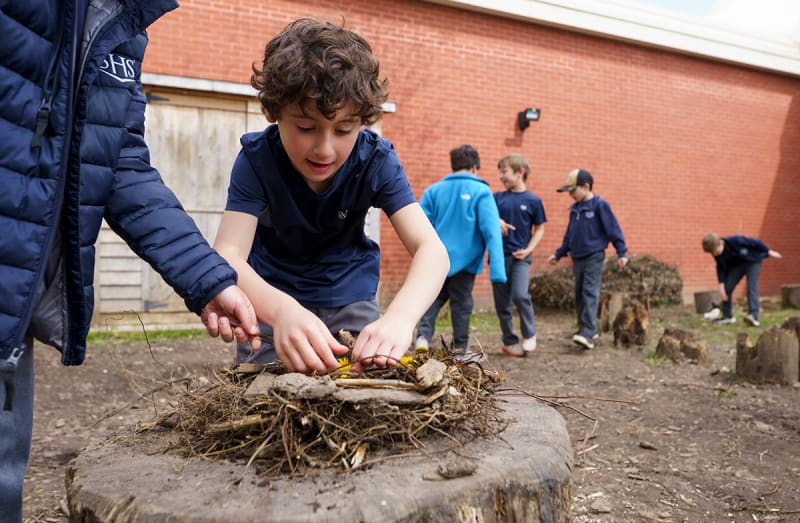
Finally, it’s worth pointing to the robust outdoor education program the school has developed. Supported by a professional educator with a background in gardening and camp programming, it gives boys structured opportunities to explore and learn outdoors. The program includes the school’s Community Learning Garden, where boys plant, nurture, and harvest food while developing a deeper connection to the natural world.
Outdoor education is closely connected to the science curriculum and has become one of the school’s most popular offerings. “Instead of just teaching the scary parts of climate change and environmental issues, we focus on helping boys really love the environment, being engaged, immersed and curious, because when kids love a place, they’re much more likely to take care of it,” says Parsons.
Student wellbeing
There’s an acronym at SHS that links the school’s mascot—the shark—with a well-developed health and wellbeing program that’s integrated into everyday life. SHARKS stands for S—Sleep, rest & recharge; H—Healthy eating; A—Active bodies; R—Relationships; K—Knowledge & experience; and S—Service & citizenship. “The SHARKS framework provides a shared language that helps the boys understand how to care for themselves and others,” says Niki Van Haarlem, the Junior Division Coordinator and member of Sterling Hall’s Health and Wellbeing committee. “Our morning Health and Community time is rooted in the SHARKS program and filters into everything we do.”
The SHARKS framework comes alive through signature experiences like Discovering Your SHARKS Day, a whole-school event that brings in guide dogs, nutritionists, Indigenous Elders, musicians, yoga instructors, and drum circles. Student voice is central to this work. This year, Grade 5 boys organized their own SHARKS morning, brainstorming ideas, sending emails, and creating groups that included every boy in the Junior Division. They designed seven activities, from outdoor football and cookie decorating to board games and staff-versus-students dodgeball, reinforcing the concept that boys are active participants in their own wellbeing.
Daily Health and Community time is built into the schedule for every class from JK through Grade 8 and regularly includes community circles. This dedicated time helps boys develop social-emotional skills and character while engaging with leadership, health, and safety topics. “These circles are essential because while we know the boys will readily talk about bravery, they need dedicated, consistent time and space to open up about moments when they don’t feel brave, when they don’t fit in, and how they can handle those feelings,” says Susie Heinrich. “When this space is given regularly, boys share, empathy builds, and the group becomes genuinely grounded and connected.”
Parsons says he sees these community circles as an essential way to practice naming feelings, communicating them, and strengthening relationships. “In the safety of a small, all-boys school, starting this work early and doing it regularly, we are giving the boys tools many men never got: the courage and capacity to handle emotions and relationships in healthier ways as they grow up.”
There’s an overall emphasis at SHS on breaking down gender stereotypes and raising boys into young men who embrace strength as well as vulnerability, speak openly about their feelings, and value community wellbeing as much as their own. The goal is to impart lasting habits and skills that these boys will carry into the world and, hopefully, teach to others.
Getting in
Boys can join SHS from JK through Grade 7, with the largest intake in JK and Grade 1 when new classes are created. Most students stay through Grade 8, but some move earlier to K–12 independent schools, and when they do, that opens up spots for new boys to come in.
The admissions process is built around small, personal experiences. Families usually start by submitting an online inquiry and registering for an open house. Open houses are held on Fridays during regular assemblies, and visiting boys are paired with trained student ambassadors who help show them around the school. The goal is for incoming families to see the school in action, experience the assembly, sit in on a regular school day, and meet with current families.
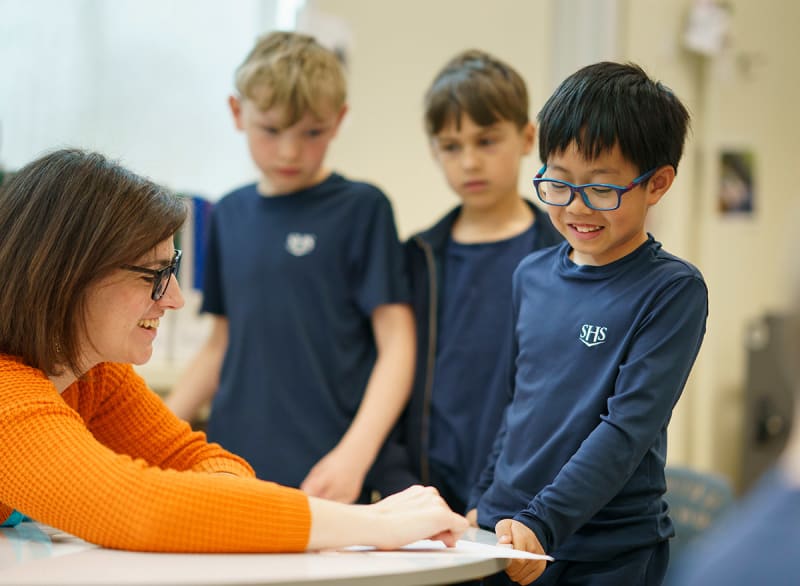
Assessment is designed as a “learning snapshot,” not a formal test. Applicants come for about three hours, in small groups, and take part in math tasks (some easy, some challenging), reading and writing activities, collaborative work, games, PE, and critical thinking. Teachers observe how boys respond when work feels easy or hard, and how they solve problems and work in teams. Afterwards, the team meets with parents online to share observations, ask follow-up questions, and check that values align. JK through Grade 2 follow an early common offer date, while Grades 3 through 8 follow a later common offer date; after each date, offers are made on a rolling basis as space permits.
Money matters
Tuition at SHS includes all clubs and sports, books and supplies, and most field trips that take place during the school day. Experiential learning trips are charged separately. Families pay an admission fee and can choose to pay tuition in a lump sum with a discount or in multiple instalments. Instrument rental for Grades 5–8 is also included in tuition.
Additional costs include uniforms, which families can purchase through the Shark Shop or at pre-loved uniform sales organized by the Parents Association, as well as private music lessons and overnight trips. A hot lunch program can be purchased on a per-term basis, and participation is very high in the younger years. The carefully prepared lunches typically include protein, vegetables, hot and sandwich options, and can accommodate allergies. Older boys can also buy small items like yogurt and fruit if they aren’t on the lunch plan.
Financial assistance is available, primarily for families with boys in Grades 6 through 8. The school uses an external assessment service to review applications and offers both full and partial assistance, with a preference for partial awards to support more students. The Robinson Family Fund helps provide financial support, and each aid package is outlined in a specific agreement detailing what is and isn’t covered. Families can indicate interest in financial assistance on the inquiry form, and application fees for both admissions and financial assessment may be waived.
Takeaway
Students come from across Toronto to attend Sterling Hall, a school designed just for boys. While it may be one of the only schools of its kind in the city, Parsons says urban centres around the United States are filled with K–8 single-sex preparatory schools. “There’s a reason for that,” he explains. “Boys change so much over the years, and the kind of school they want to go to when they’re 16 may not be the school they want when they’re 6. That’s our niche proposition. We aren’t focused on high school or post-secondary; all of our resources, all of our energy, all of our attention goes into 4- to 14-year-old boys. And when you do that properly, no one can really compete.”
Plus, it’s not that they aren’t thinking about what comes next. “We had 36 Grade 8 grads this past year, and they went to 17 different schools. Our Grade 8s have agency and a clear idea of what they want when they leave here for high school.”
But what’s striking is that many SHS boys form such strong connections that, despite attending different high schools, they meet up again at university. Many even become roommates. “My son went to U of T and lived with a friend from Sterling Hall who he hadn’t seen since Grade 8,” says Parsons. “These are the formative years, and strong bonds and lifelong friendships are made within the walls of our school.”
Families also experience this type of connection. On Friday, parents gather for coffee, catching up with one another before heading into weekly assembly, where they watch with pride as their boys speak in front of a full gym. On Friday evenings, they check their email and look forward to the SHS Memo, a detailed newsletter with updates and photos that brings the energy of the school week into their homes. Parents are a defining part of the SHS community: 70% volunteer in some capacity, from joining committees and planning events to helping in classrooms.
Educators and administrators are deeply invested in the school and the meaningful relationships they build with students and families. SHS supports postgraduate education for faculty and staff, reflecting the school’s culture of lifelong learning. Many teachers hold master’s degrees or other advanced qualifications, specialize in their fields, and are committed to applying their expertise to provide the best possible education for their students.
Parsons sees the results of this work in the wide range of boys who thrive at SHS. “This model is just beautiful,” he says. “We have artists and athletes, kids who love drama and coding. They find their passion, they find their interests. And they do it in a safe environment that fosters learning and growth. They’re looked up to as leaders during those messy middle school years, when they need it most. And they undergo massive change. Most importantly, they love coming to school. You can see it on their faces when they walk into the building every morning. They want to be here.” Each morning, faculty and staff welcome students as they enter the building, a daily expression of the school’s commitment to knowing every student.