Fairview Glen Montessori School KEY INSIGHTS
Each school is different. Fairview Glen Montessori School's Feature Review excerpts disclose its unique character. Based on discussions with the school's alumni, parents, students, and administrators, they reveal the school’s distinctive culture, community, and identity.
What we know
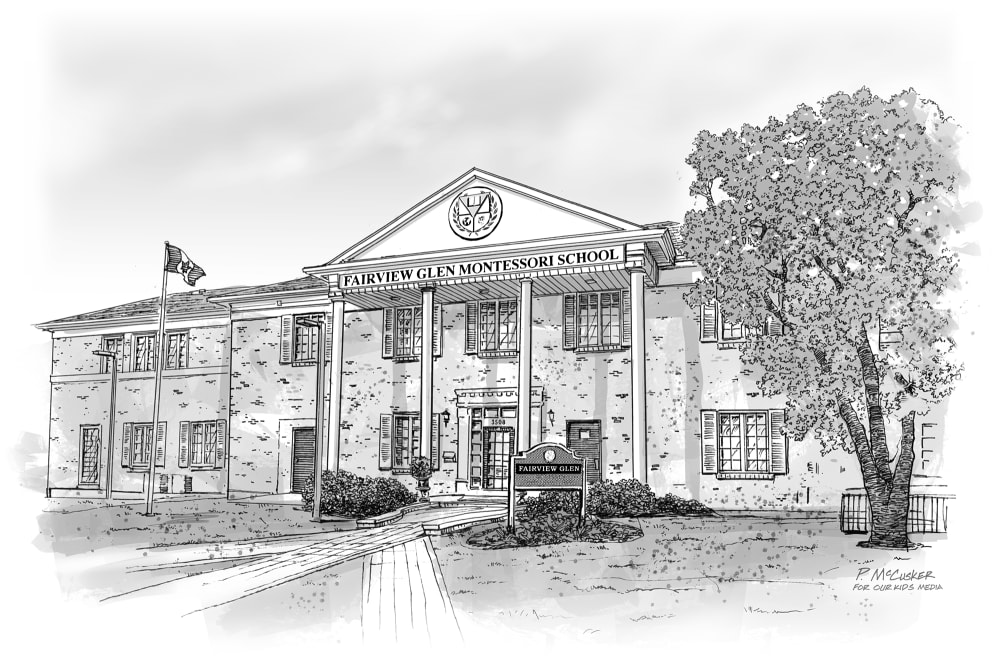
- Fairview Glen offers a rigorous Montessori program that also emphasizes the development of independence, responsibility, self-regulation, and individualized learning.
- The school’s culture emphasizes strong relationships among students, teachers, and families, treating social-emotional development as central to education.
- From Casa through Junior High, students gradually prepare for greater autonomy through mixed-age classrooms, hands-on learning, leadership opportunities, outdoor education, public speaking, arts, and thoughtful use of technology.
Handpicked excerpts
Fairview Glen Montessori School is a community built around a particular vision of childhood education. The recurring theme in our conversations with parents and staff is the importance of a strong academic foundation. The foundation goes beyond academic learning and includes responsibility, self-regulation, curiosity, and the gradual movement from dependence toward autonomy. “The mission of Fairview Glen Montessori has always been to create a place for the whole family,” says Head of School Tammy-Leigh Sage. “It’s really done out of respect for childhood, and of respect for the family as a unit.”
Many families describe the school as a place where the relationship between home and school is integral to the educational experience. Sage says the school has “always applied that individual approach and worked on building relationships that are authentic.” For her, Montessori education extends beyond classroom materials and multi-age grouping into the way adults relate to children, parents, and one another. “It’s really about learning to be a good human, and learning to make those connections,” she says. “Those connections aren’t limited to student-to-student. Those connections have to be between principal and teachers, family and teachers, family and the principal.”
THE LEARNING ENVIRONMENT
That relational quality comes through strongly in parent comments. Melissa Fialho, current parent, recalls being drawn to the school by the confidence and composure of its students. “The kids displayed such confidence, too, with the hello and goodbye”, says Fialho. “The kids are confident and respectful. That really drew us in.” Kelly Hassall, another current parent, remembers a similar first impression. “We noticed how quiet it was because the kids were all engaged in doing something,” she says. Coming from a more traditional model, where students often do the same thing at the same time, she was struck by seeing “kids doing different things.”
That observation captures one of the central distinctions of Fairview Glen’s Montessori approach. The classrooms are not organized around uniformity within the classroom. Students work with materials, pursue lessons at different points of readiness, and gradually learn to manage time, work, and responsibility. Deepa Ganatra, parent to an alum, remembers being surprised by the level of mathematics being studied even in Casa. “The golden beads, for example. This is how they were actually doing multiplication with the beads and the bead board at a Casa level. It was multiplication, but they didn’t even know that it was multiplication. They were using the materials to solve the mathematical problem.”
Abstract concepts are introduced through physical concrete exercises. Casa teacher Shehla Munawwar describes the early-years program as deliberately consistent in its Montessori practice. “We are still teaching the same way,” she says. “We are still following 100% Montessori philosophy, the curriculum.” That includes a low-technology environment for the youngest students and a classroom built around careful observation. “The basic rule is we teach one-on-one,” she explains. “We have a weekly plan for each child.”
EARLY YEARS
Danielle Lapointe, also a Casa teacher, explains that “follow the child” begins with disciplined observation rather than vague permissiveness. “The child, through their actions, almost speaks to us in what they’re ready for,” she says. “The biggest part of our job is observation.” The three-year Casa cycle gives teachers time to understand the child’s temperament, family context, readiness, and pace. “You’re with the same teacher for three years,” Lapointe says, “so we can deeply understand you as a person, but we can also become almost like an extension of your family.”
Anne Tindale, the school’s registrar, describes trust as the first condition of the school-family relationship. “It’s a big step when you drop off your one-and-a-half- or two-year-old,” she says. In her role, she often sees families form an impression of Fairview Glen early—through a phone call, a visit, or the consistency between what they have heard from other parents and what they encounter in person. “People come here, or even in that initial phone call, they’re getting a sense of whether we are the right fit very early on,” she says.
In the early years program, children begin contributing to the life of their environment. In various practical ways, children care for the orderliness and cleanliness of their classroom. Lapointe calls practical life “the most important area of the classroom” at that level. “It’s care of environment, care of self, care of others. We form a community.” Munawwar frames the same idea in terms of belonging: “It’s not like we say, ‘This is our classroom.’ We teach them, ‘This is your classroom.’”
LOWER ELEMENTARY
As students move into Lower Elementary, those habits extend to academic learning, managing the pace of learning, peer collaboration and support, and problem-solving. Samantha Cliff, a Lower Elementary teacher for Grades 1 to 3, describes a classroom where cooperation and conflict resolution are part of daily work. “How do we talk to each other? How do we listen to others’ ideas and be open to those ideas?” she asks. When problems arise, children may use peer mediation or a peace corner to “talk it out.” The goal is not to remove all friction but to help students learn how to handle it.
Tammy-Leigh Sage makes the same point at the school-wide level. “Our students do experience friction, but friction is necessary, and conflict is necessary for children to learn creative ways of solving those problems,” she says. “Problems are a source of learning, and they shouldn’t be avoided.”
MIXED-AGE LEARNING AND INDIVIDUAL PACE
The mixed-age structure supports the gradual taking up of responsibility. Cliff explains that Grade 3 students help younger classmates, which gives them leadership while reinforcing their own learning. “If the Grade 1 is not sure how to do a certain concept, we’ll ask a Grade 3 to help,” she says. “It gives them that repetition, and it takes on a little bit of a teaching role.” For younger students, the older children become models. For older students, competence is tied to service.
Parents see that structure working organically. Rana AlDabagh, a current parent, says her son in Grade 4 has “his own agenda and schedules his work.” For her, this reflects real life more than a rigid subject-by-subject schedule. “In Montessori, if you’re in the zone, you can get the week’s work done in three hours,” she says. “I felt this was mimicking real life, so this was a big factor.” Fialho describes a similar progression: “In Lower Elementary, Grades 1 to 3, they have an agenda. Moving to Upper Elementary, Grades 4 to 6, there’s more independence, with tasks and goals they set for themselves in their agendas in preparation for a test. Independent learning is phased in.”
Fairview Glen’s teachers regard differences between students as a built-in feature of the classroom. Cliff gives a concrete example in math: “Right now, I have one child who is just beginning to understand long division, and I’ve got another Grade 3 who’s doing decimals, adding, multiplying, and dividing by decimals.” In that environment, she says, the teacher can “gear it toward the child.” The goal is to build what she calls a “tool belt” for students, which includes strategies for persistence, independence, and learning at their own pace.
UPPER ELEMENTARY
Upper Elementary teacher Steve Sage, who is a founding and leading figure at the school, describes Fairview Glen’s “unwritten curriculum,” which complements the academic work. In the upper years, students are also learning to work with others, participate actively in groups, take responsibility for their shared community, and use technology without letting it replace direct, effortful learning. “Montessori is a preparation for life, and life is going to be using technology,” Steve Sage says. The goal, however, is to give students “a firm foundation” first, with technology used to enhance learning rather than short-circuit it. “Taking away the challenge is not a good thing for developing perseverance,” he says. “There has to be that time with the Montessori materials, working through things concretely, before they get to do the easier way.”
JUNIOR HIGH
The Junior High program is a relatively more recent addition at Fairview Glen, with its own set of priorities. Junior High teacher Lara Dremos says, “Integrity is a huge part of the program in junior high because we’re really helping them explore who they’re becoming as adults.” She describes adolescence as a “messy” period, but one that requires room for reflection. Students need “a safe place to feel like, ‘I really messed that up,’ and giving them the grace to reflect on those experiences.”
The Junior High program also extends the school’s mixed-age and peer-learning approach. “I really have 14 teachers,” Dremos says, referring to the way students teach and support one another. “I definitely don’t claim to be the keeper of all knowledge. I actually love seeing them learn from each other as well.” Some Grade 8 students are working toward Grade 9 math credit, while others may be reviewing Grade 8 topics or encountering Grade 9 material in preparation for high school. Rather than every student moving at the same speed, the common thread is that students learn to make priorities and manage their work. “Their executive functioning skills, I find, leaving here are incredible,” Dremos says.
EXPERIENTIAL LEARNING, ARTS, AND GLOBAL AWARENESS
Aside from academics, Fairview Glen places notable emphasis on public speaking, music, outdoor education, and global awareness. Parents repeatedly mention presentations, concerts, International Day, Model UN, and the school’s outdoor education facility. Hassall describes Nature’s Edge as “a game changer” because students go away, pack, spend time outdoors, and build independence with trusted adults and classmates. “They bond with their classmates and make memories,” she says. “They always come back so happy and tired.”
Physical education teacher Matt Taylor frames athletics and movement in similarly developmental terms. “One of my goals as a coach here is not to make Olympians,” he says. “It’s to help them grow and be healthy throughout their whole lives.” Movement may include sports, dance, yoga, or activities designed to move students out of their comfort zones.
The arts, too, appear to serve more than performance. Fialho describes music, concerts, plays, and band as opportunities for students to develop confidence. “The arts are so supported at Fairview Glen,” she says. “It brings out this confidence in the kids.” They also point to Model UN as an example of how public speaking develops from early practice into more demanding experiences. “Even at the Casa levels, the kids are speaking with cue cards, making eye contact with the audience, and that plays all the way into the Junior High classes, where they go to Model UN in New York City,” says Fialho.
SUPPORTING WHOLE-CHILD DEVELOPMENT
For many families, the school’s strongest impact lies in the combination of academic independence and emotional confidence. Ganatra says one of the most important skills her children learned was the ability to ask for help. “It is a critical skill to recognize when they’re struggling and ask for help,” she says. “It sets them up to be lifelong learners.”
The emphasis on such skills differentiates Fairview Glen from a purely achievement-oriented school. At Fairview Glen, academic growth matters, but it is not isolated from character education. Tammy-Leigh Sage says families who choose the school often want “a learning environment that extends beyond academics, that extends towards moral development for compassion, and for developing how their child is going to be as an adult.” She is also careful to say that the school requires effort: “It doesn’t come without hard work, dedication, initiative.”