Pickering College KEY INSIGHTS
Each school is different. Pickering College's Feature Review excerpts disclose its unique character. Based on discussions with the school's alumni, parents, students, and administrators, they reveal the school’s distinctive culture, community, and identity.
What we know
- Learning at Pickering College is organized around Connections, Academics, and Purpose (CAP), a framework that links rigorous academics with authentic challenges and community engagement.
- The school’s approach is innovative and forward-thinking, tying its rich history and traditions with future-readiness.
- The school’s warm and welcoming environment is both intimate in size and global in perspective.
- Strong relationships are central to the Pickering College mission, shaping every aspect of the experience. A warm, home-away-from-home boarding program welcomes students from across Canada and around the world.
Handpicked excerpts
Pickering College is a JK to Grade 12 coeducational day and boarding school where real-world challenges, emerging technologies, and partnerships with organizations in the wider community add depth to a strong foundation of academic rigour. The school is located on a 35-acre campus in Newmarket, Ontario, and includes Blue & Silver Farm, a 77-acre living laboratory and innovation hub located 10 minutes from the main campus.
While much has evolved since its founding in 1842, Pickering College continues to be shaped by the principles that have defined the school for generations: simplicity, peace, integrity, community, equality, and stewardship. These values are evident in the school’s culture, relationships, and approach to learning, as well as in the warm and welcoming community feeling that is evident from the moment you step on campus.
Academically, the school’s educational framework, Connections, Academics, and Purpose (CAP), begins with authentic questions and real-world contexts. Students work alongside community organizations, businesses, and experts to explore complex challenges and develop practical solutions. “We start with understanding a real context,” says Dr. Cinde Lock, Head of School, “and then embed deep academics into it.”
Students present ideas to municipal leaders, design solutions to complex problems, build prototypes, conduct field research, and launch entrepreneurial ventures. The goal is not simply to acquire knowledge but to apply it in meaningful ways beyond the classroom so that students can develop their passions, discover their purpose and find their place in the world.
By connecting academic learning with experience, Pickering College helps students develop the curiosity, adaptability, and confidence to navigate an increasingly complex world.
THE SCHOOL ENVIRONMENT
The culture of Pickering College is reflected in the character of its campus, where historic architecture sits alongside contemporary learning spaces and a strong connection to the outdoors. The physical environment is designed to support the school’s emphasis on curiosity, collaboration, and hands-on learning.
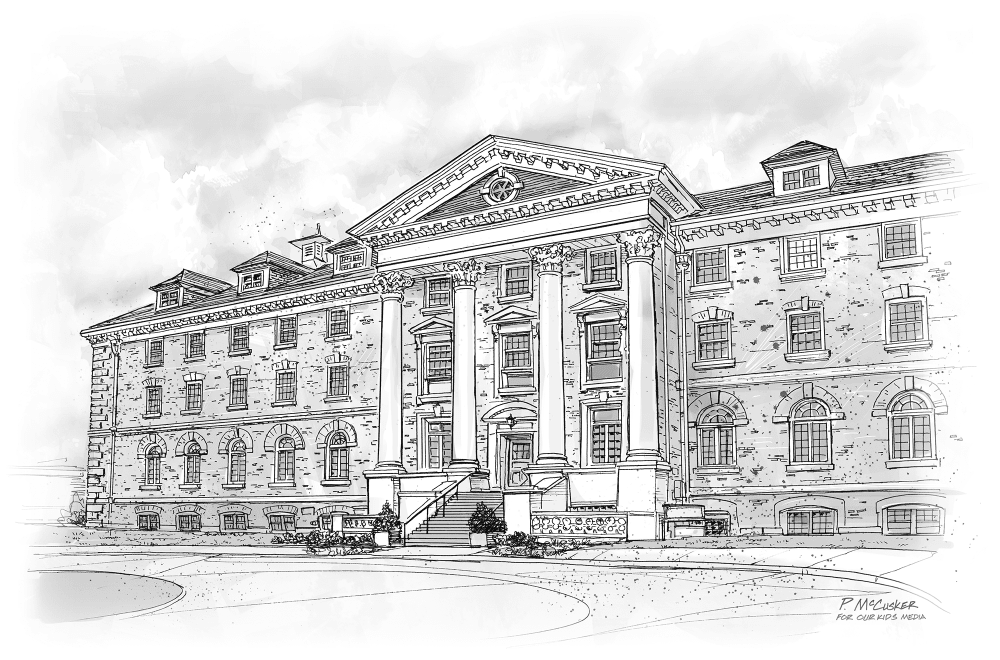
Rogers House, the school’s most historic building with its iconic four-pillar facade, is home to the Middle and Senior School and includes spaces such as the Innovation Centre, where students explore design, robotics, and emerging technologies, and the Puma Den, a hub for fitness, wellness, and student life.
West Lake House, the school’s newest academic building, offers a contemporary expression of learning. Filled with natural light and designed to support collaboration and creativity, it houses specialized spaces for art, music, science, and performance and is home to the Junior School.
“We’ve used design principles that include lots of natural light, high ceilings, exposed beams and piping,” says Dr. Lock, “to create a true community hub and gathering space.”
The school’s 77-acre Blue & Silver Farm extends experiential learning beyond the main campus. This living laboratory includes forest trails, camping platforms, gardens, a greenhouse, an apiary, a pollinator garden, and outdoor learning spaces that support sustainability, scientific research, entrepreneurship, and smart farming technology.
CONNECTIONS, ACADEMICS, AND PURPOSE
At Pickering College, learning often begins with a question, a challenge, or a community need. Through the school’s Connections, Academics, and Purpose (CAP) framework and Global Leadership Program, students engage with real-world issues that give academic work greater relevance and context.
For example, Middle School students were tasked with supporting a non-profit organization. They conducted research, gathered stories from impacted individuals, and produced materials to support the creation of a new low-income housing development. When the town council voted against the project, the students then engaged with local politicians to understand the issue further. By addressing the stigma around the issue of homelessness, the students had a profound impact in helping to change perceptions. Throughout the project, they used feedback from the non-profit organization to revise and refine their writing and gained insight into how meaningful change is often achieved through collaboration and iteration.
For students, understanding context can change their relationship with learning. “If we connect learning to something meaningful and help students build a strong academic base in context, their work is real,” says Dr. Lock, “and their learning becomes both urgent and exciting.”
Julia Hunt, Assistant Head, Strategic Initiatives, points to the school’s Sphere Program as another example. In Grades 4 and 5, students explore environmental stewardship and technology through projects like designing robotic fruit pickers, developing irrigation systems, and using drones and advanced technology to create solutions to real-world problems.
As Hunt explains, “Students master the curriculum at a much deeper level because they are applying their learning to authentic projects. They develop a genuine sense of purpose, knowing that their work matters and that community partners are counting on the outcomes they co-create with students.”
Beyond academic content, students develop practical skills that are often learned only through experience: writing professional emails, scheduling meetings, asking questions, incorporating feedback, and presenting ideas to audiences outside the school. As Hunt notes, “The interpersonal skills needed to execute a project are very important, and students develop these here in a supportive environment.”
THE ACADEMIC ENVIRONMENT
Pickering College’s academic culture is rigorous, and the students earn entry and scholarships to the world’s top universities and programs. Interestingly, the definition of rigour at the school extends beyond grades, test scores, and advanced course offerings. The emphasis on critical thinking, problem-solving, and the ability to transfer knowledge across disciplines and contexts is embedded throughout the curriculum and in all grades and subjects.
Joshua Armstrong, Director of Teaching and Learning, sees this as an essential part of preparing students for life after graduation. “Students need strong writing, critical thinking, and academic preparation,” he says, “they also need experience in applying their knowledge to difficult, open-ended problems.” The school’s robotics program illustrates that approach. Students design and build robots from scratch before competing alongside alliance partners in regional competitions. While the engineering challenge is significant, Armstrong notes that success also depends on teamwork, adaptability, communication, and strategic thinking.
“Students have to determine how their robot can work in alliance with others, how to compete, how to adapt, and how to improve,” he says.
The program has become a notable area of strength for the school, with students advancing to championship-level competition with their sights set on the FIRST Robotics World Championships.
Supporting that work is the Innovation Centre, which provides students with access to laser cutters, 3D printers, CNC routers, and a wood and metal engineering design suite. The goal is to make prototyping and iteration a routine part of the learning process, allowing students to move from concept to creation within the school environment.
STUDENT SUPPORT AND CULTURE
The emphasis on relationships and connection extends beyond the classroom. Students describe Pickering College as a place where teachers know them well and take an active interest in their success.
“Teachers here care about you, and they help you if you’re struggling. They all want to see you succeed,” says Bilal, a Grade 12 student.
Bonnie, a Grade 11 student, describes close relationships with teachers as an important part of school life. “I can talk to them about stress, about schoolwork, about anything,” she says.
That accessibility is supported through structures such as flex time, extra-help sessions, and regular opportunities for students to connect with teachers outside of class. The result is a learning environment where academic challenge is paired with individualized support.
ARTS, CO-CURRICULARS, AND STUDENT LIFE
The co-curricular programming at Pickering College is student-centred. “When we organize a program, it’s based on what the students want,” says Dave Fiscaletti, Co-curricular Director. “That could mean adding a student club, a recreational activity, or a competitive team from one year to the next. We also try to provide variety and lots of choice for students.”
That range includes long-standing offerings such as equestrian, as well as newer activities such as team-based esports. Students can participate in cooking clubs, debate, pickleball, DECA, concert band, athletics, and student-led clubs.
The school has seen notable athletic success, especially with soccer, hockey, and volleyball teams, all of which have won multiple championships over the last several years. The Senior Badminton Team has also seen top placement at the CISAA finals. Pickering College also offers a High Performance Student Athlete Program to provide support and greater flexibility for students involved in an elite-level sport outside of school.
Fiscaletti describes the transformative power of pursuing a passion for students. “They work hard and sometimes all their work, their efforts throughout the year, culminate in one final achievement.” One student became actively involved in DECA at the start of the year, advanced through regionals, nationals, and internationals, and competed in the U.S. against a wide competitive field of students.
The school’s rich arts focus extends to music, visual arts, and drama, and takes student work beyond campus, giving artistic expression a real audience. High-quality student artwork adorns the halls, and the arts are supported through dedicated spaces including a kiln room, dance studio, auditorium, radio station, and purpose-built music, drama, and art classrooms.
BOARDING
Pickering College’s domestic and international boarding program has undergone a significant shift in staffing philosophy. According to Laura Mason, Executive Director of Boarding and Health Services, the school has built a dedicated residential-life team focused exclusively on the boarding experience, allowing staff to develop deep relationships with students and provide consistent support throughout the year.
Each residence has a full-time House Director, House Parents who live on campus, and a full team of Boarding Dons. Staff dine with students in the evenings, helping foster a connected residential community and creating continuity in students’ daily lives.
In the boarding program, students build independence, self-advocacy, and life skills. The university preparatory program helps them prepare for university by explicitly teaching financial literacy, cooking, laundry, practical decision-making, and how to navigate university systems.
Mental health and well-being are supported through relationship-building and early recognition. Mason’s view is that adults can only notice subtle changes when they know students well. “If you don’t get to know the students and who they are as individuals,” she says, “you will miss those subtle changes in the beginning, and you won’t address an issue until there’s a crisis.” Boarding staff receive annual mental health first aid training, and support is normalized through access to counselling, guidance, and nursing staff.