Walden International School KEY INSIGHTS
Each school is different. Walden International School's Feature Review excerpts disclose its unique character. Based on discussions with the school's alumni, parents, students, and administrators, they reveal the school’s distinctive culture, community, and identity.
What we know
- Walden offers an inquiry-based, student-centred education, enabling students to develop and pursue their interests and demonstrate their understanding in varied ways.
- Small classes, strong pedagogical relationships, arts, athletics, and outdoor education all support the development of confidence, resilience, and a sense of responsibility.
- The school’s “Making Good People” approach is integrated with the IB Learner Profile and informs daily practices, emotional self-awareness, and social-emotional development.
Handpicked excerpts
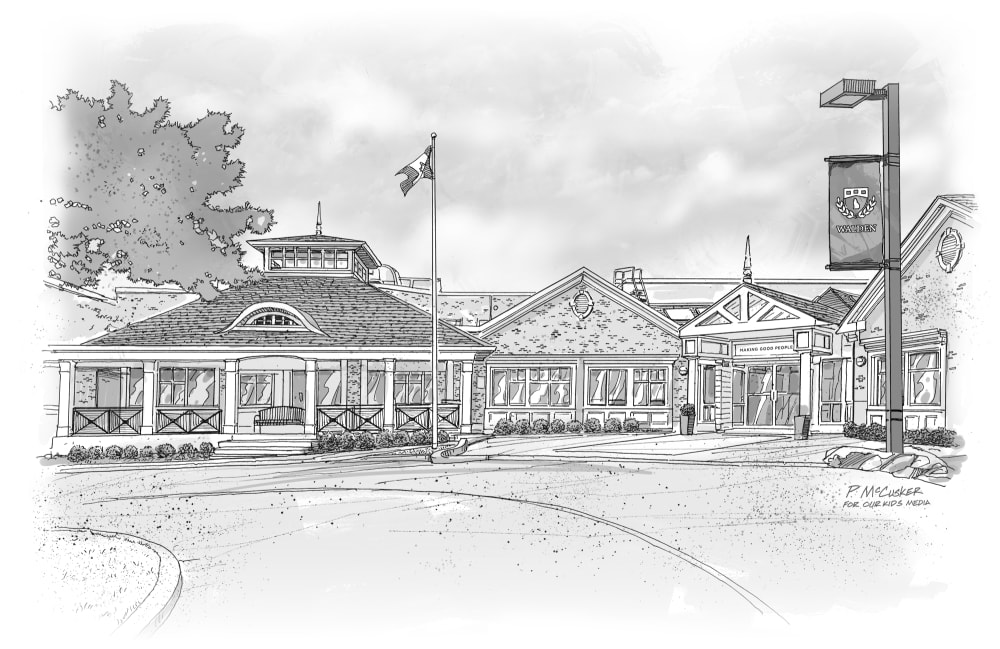
The phrase above the front entrance of Walden International School, “Making Good People,” is the clearest shorthand for the school’s educational philosophy, and it appears repeatedly in the way teachers, administrators, students, and parents describe the school. The phrase is tied to specific routines, such as morning meetings and self-regulation charts, as well as educational values, such as inquiry-based learning, cultivating student voice, self-awareness, responsibility, and respect.
Walden’s identity is shaped by the International Baccalaureate (IB) framework, and the school has integrated it uniquely into its educational philosophy. “Everything in our programming is centred around making good people,” says Daphne Perugini, Head of School. “What makes that easier is the Learner Profile Attributes, which are part of the IB Programme.” The language of inquiry, agency, reflection, and the learner profile shows up in how young students practice naming their feelings and in how older students debate current events.
In the Senior Kindergarten room, students use photographs of themselves to identify learner-profile attributes and to place themselves on a self-regulation chart. “The goal is to help children arrive in the zone defined by calmness, focus, and being ready to learn,” says Denise McIntosh, Senior Kindergarten teacher. These classroom practices are part of the overarching effort of connecting emotional self-awareness and academic growth.
CHARACTER EDUCATION
Head of School Daphne Perugini describes Walden as having begun “as a solution to a problem,” emerging from dissatisfaction with more old-fashioned school models. Her vision of the school places character development at the centre as the condition that gives academic achievement a human-centred meaning. “Being academically successful is important,” Perugini says, “but the absence of being a good person, really, makes all the other things unimportant.”
Character education is part of all grade levels. In the early years, teachers use language around kindness, honesty, emotional awareness, and repair. Senior Kindergarten students learn to recognize emotional states through Zones of Regulation and daily greetings, which allow the teacher to quickly notice when something is off.
Walden’s IB learner profile provides much of the vocabulary for this work. “Children start using the language themselves,” says McIntosh. “They notice when a classmate returns a lost paper or shows care toward another student.” In that sense, the learner profile functions like a shared moral and intellectual language, rather than simply a poster on the wall.
ACADEMICS
Walden’s academic program is built around the Ontario curriculum taught through the IB framework. In the Primary Years Program (PYP), the emphasis is on transdisciplinary, inquiry-based learning, as opposed to treating subjects in isolation. For example, a unit on structures can bring together science, social studies, design, history, and communication. Students learn about bridges and buildings, but beyond that, they learn to ask where materials come from, how a structure is made, and how designs address human needs. In this way, knowledge is tied to real-world contexts and activities.
The Grade 3 teacher, Jenefer Monica, describes the program as “transdisciplinary learning,” “inquiry-based,” and “student-centred and not teacher-focused.” Students take an active part in shaping the direction of their learning. They ask questions at the beginning of a unit, pursue individual lines of interest, choose formats for demonstrating their understanding, and take responsibility for completing work they have helped design.
Monica recalls two students who had studied structures months earlier, returning from family trips with photographs of the Golden Gate Bridge and London Bridge, independently taking what they had learned to situations beyond the classroom. Similarly, Rory McCorquodale, Grade 5 teacher, describes a financial literacy discussion that developed into a debate about whether taxes are beneficial. The goal, in short, is not to simply cover content, but to practise thinking with it.
Teachers, of course, teach foundational skills, and the school can adjust its programming where it identifies a need to strengthen literacy and math. But students demonstrate understanding in a range of ways.
In small classes, teachers can notice when a student needs help, a different format, an extension, or a new way into the work. Annelieke Hogenbirk, a Grade 1 teacher, says her class does not exceed 16 students and currently has 9, which allows her to respond quickly and personally. “I have time to spend with every one of the students,” says Hogenbirk. “If somebody needs help, I can really honestly say, ‘I’ll be there in a moment,’ because I will be there in a moment. I don’t have 20 others in between to get to.” Heidi Corley, the Grade 4 teacher, similarly explains that quieter students will not be missed because the teacher knows what is happening with each child.
LEARNING ENVIRONMENT
People frequently describe Walden as a close community. Corley tells her class early in the year that they are all her children for the year, “I will be your mama bear for the year,” she tells them. “I will be here. If you get hurt, I will protect you.” Part of supportive relationships, Corley explains, is recognizing when a mistake is made and asking, “How do we fix it?”
Students, too, describe the school in terms of belonging. Amelia, a Grade 7 student who joined Walden recently, says teachers and classmates helped her feel less anxious and more included in a new environment. She points to teacher availability before school, from 8:10 to 8:55 am, as a valuable form of support. Valencia, a Grade 8 student who has attended Walden for eight years, describes the school as a place of strong relationships and personal growth. She adds that the Approaches to Learning framework has helped her manage academics alongside competitive hockey and ARCT piano.
The school appears particularly attentive to students who may not have felt fully at ease elsewhere. One teacher says, “A kid can really be free to be who they are here.” New students visit for two days so both the family and school can assess fit. That emphasis on fit is also reflected in Perugini’s comments about admissions. She frames the school’s work as mission-driven rather than revenue-driven, saying she will help families find another school if Walden is not right for the child.
FACULTY CULTURE AND TEACHING STYLE
The transdisciplinary approach, integral to Walden’s educational philosophy, is also apparent in the teachers. All the teachers we spoke with contribute beyond their classroom teaching through musical theatre, athletics, chess club, ecology and recycling work, outdoor education, parent events, and student performances. For example, a physical education teacher attends music performances, while an arts teacher would support tournaments. Students notice when adults show up outside their assigned domains, which signals that the teacher’s interest in them extends beyond a single subject.
This cross-departmental culture aligns with the IB approach. Physical education connects to classroom units, as when Grade 2 students studying simple machines explore their own arms as levers while throwing a ball. Performing arts connect music, history, perspective-taking, composition, and advocacy.
Technology is present, but it is not treated as the centre of learning. Teachers describe using Chromebooks, Google Docs, videos, and digital tools to engage students and support literacy, but they also emphasize books, sources, inquiry, and foundational understanding. In music, one teacher explains that students need to understand rhythm, notation, and structure before relying on software. Otherwise, they may know that something sounds wrong without understanding why.
ARTS, ATHLETICS, AND OUTDOOR EDUCATION
Walden’s co-curricular life seems strongest where it reflects the same principles as the classroom, namely participation, exploratory learning, and collaboration. Students mention volleyball, ultimate frisbee, badminton, track and field, math club, musical theatre, and stage management. In phys-ed, effort is valued more than natural ability. The message is not that every child will excel at every sport, but that every child can practise, improve, and find something they enjoy.
Music, drama, and dance are treated as self-expressive activities that require students to take risks in a supportive environment. Teela Comeau, Walden’s Performing Arts & Music teacher, says she talks explicitly with students about how “vulnerable it can be to put yourself out there.” In class, students learn to help one another with chords, movement, timing, and performance “without being judgmental,” so the arts become a setting for collaboration, confidence-building, and mutual support.
The school musical is a community effort. It brings together teachers, students, and families in a shared creative project. Some contribute to costumes and set design; others to choreography, music direction, or rehearsals; and many contribute behind the scenes.
Outdoor education is another notable area in Walden’s student life. Camping and wilderness experiences are opportunities for resilience and alternative forms of achievement. A student who struggles with essay writing may gain confidence by building a fire, helping a group, or discovering a sense of competence in the outdoors. The camping program has included Grades 6 and 7, with plans to extend to Grades 6, 7, and 8, including possible canoeing and portaging experiences in Algonquin. The fact that students wanted to return even after a rainy trip shows how meaningful the program has become for students.
The recurring pattern is that Walden does not separate academics, character education, wellness, and co-curricular life into separate categories. Its strongest work seems to happen when those categories overlap, when participating in the musical teaches collaboration, when a camping trip teaches about resilience, when a debate teaches listening, when a Grade 5 exhibition turns research into public responsibility, or when a kindergarten greeting gives a teacher enough information to support a child before the formal school day has even started.