
The 2026 OUR KIDS Private School Expo is coming to cities near you. Get your family pass



Sacred Heart School of Halifax THE OUR KIDS REVIEW
Verified Review
OUR KIDS verifies every review by confirming the reviewer’s identity and their firsthand experience with the school. Learn more
The 50-page review of Sacred Heart School of Halifax, published as a book (in print and online), is part of our series of in-depth accounts of Canada's leading private schools. Insights were garnered by OUR KIDS editor visiting the school and interviewing students, parents, faculty and administrators.
OUR KIDS editor speaks about Sacred Heart School of Halifax
Introduction
One of the most frequently mentioned words in any conversation about Sacred Heart School of Halifax is “community.” From students and parents to teachers and administrators, everyone sings the praises of the communal atmosphere within the institution. Sacred Heart’s longevity may contribute to that shared appreciation.
When you walk through the main entrance, the first thing you notice is the bright and open feel of the reception area. Natural light spills into the space from a bank of windows that rises to the top of the vaulted ceiling. You will also notice the loft-style study area at the top of the stairs featuring a banner showcasing the many nations that are part of the Sacred Heart Network, with national flags arranged in a heart shape.
Visitors receive a warm welcome at the reception desk and comfortable seating in the waiting area. Immediately over the chairs, a large sign proudly displays the names of donors who support the school at various levels. There is also a sampling of recent yearbooks to peruse, demonstrating a quiet pride in everything the school represents.
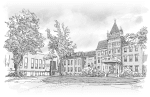
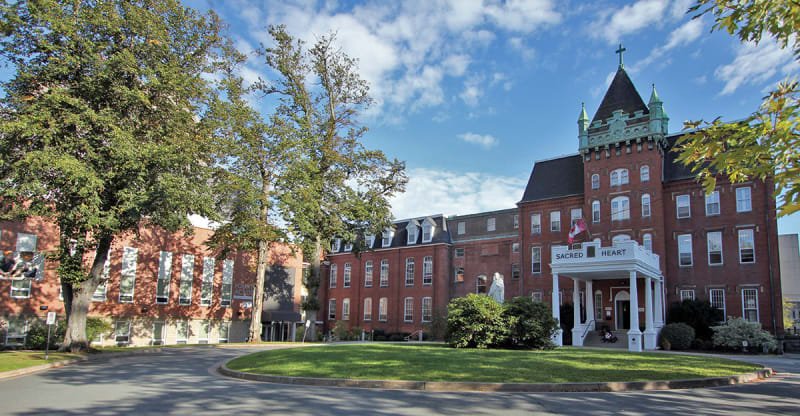
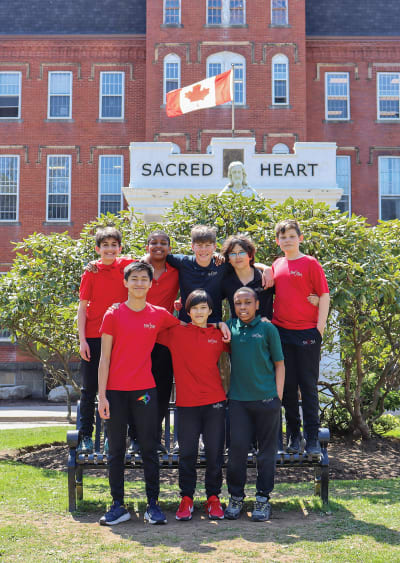
The school dates back more than 175 years and is a popular landmark in the heart of the city. Situated on Spring Garden Road, one of downtown Halifax’s busiest thoroughfares, the school easily stands out from its neighbours. The striking architecture of the original building blends with a more modern extension to create an eclectic experience inside and out. The rooms are clean and well-lit, and the original building retains much of its charm with vintage furnishings, curios, and architectural features.
That blend of tradition and modernity also extends to the student body. Despite the obvious presence of uniforms, students demonstrate a sense of comfort and relaxation that you might not expect from a private school.
Basics
Sacred Heart School of Halifax is an independent day school for students in Halifax, Nova Scotia. From Junior Primary to Grade 12, students engage in rigorous academics while fully embracing critical thinking and exploring a range of social skills. Every child is recognized as an individual and encouraged to find and pursue their unique interests.
Sacred Heart promotes balanced learning through programs designed to support students’ minds, bodies, and spirits. Students often engage with the outside community, exploring aspects of social justice, leadership, and activism. For them, success goes beyond grades, accolades, and careers to include how much they can contribute to making the world a better place.
While established as a Catholic institution, Sacred Heart School welcomes students of all faiths. Their inclusive religious curriculum focuses on Catholicism while promoting a broader understanding of world religions and instilling a strong moral code that includes generosity, respect, and love.
Sacred Heart School follows the educational guidelines of the Nova Scotia Department of Education and exceeds minimum standards. As an independent, not-for-profit school outside the public system, however, they follow a different structure from the Halifax Regional Centre for Education (HRCE). Certified by both the Canadian Accredited Independent Schools (CAIS) and the Sacred Heart Commission on Goals (SCHOG), Sacred Heart School aspires to meet the highest standards, not only in education, but also in governance, management, and leadership.
As one of only two Canadian and 23 U.S. schools in the Sacred Heart Network, Sacred Heart School of Halifax is uniquely positioned to fulfill SCHOG’s mission to achieve outstanding academic and co-curricular standards. Being part of the broader global network also adds an international flavour and encourages inter-school exchanges in North America and around the world.
Only two other schools in Halifax are CAIS-certified. This means ongoing pursuit of educational excellence, intentional practices, and accountability aligned with high national standards. CAIS reviews each school through a combination of self-assessment and peer review, with a focus on 12 key metrics: strategic direction, school leadership, governance, education program foundation, learning and teaching, student well-being and support, essential concepts, recruitment and community engagement, human resources, finance, and facilities and infrastructure.
Sacred Heart School is currently implementing a three-year Strategic Plan to help adapt to a changing world. By focusing now on strengthening all aspects of their operations, they expect to be better prepared to face the future and continue to provide an exceptional experience for students, giving them all the tools they need to succeed regardless of the challenges they may face.
History
Beyond Halifax, Sacred Heart School has its roots in post-revolutionary France, where Saint Madeleine Sophie Barat started the Society of the Sacred Heart of Jesus—also known as the Religious of the Sacred Heart or, in the original French, Religieuses du Sacré-Cœur de Jésus (RSCJ)—in 1800. The following year, the first Sacred Heart School opened in Amiens, France.
Saint Madeleine Sophie Barat believed that education was key to shaping a better world for everyone, especially for girls. In the wake of the French Revolution, her outlook demonstrated a singular vision. She also believed that education involved more than filling children’s heads with information. In her innovative approach, spiritual, moral, and social instruction helped promote and enhance intellectual pursuits, producing well-rounded students.
“What is the good of teaching various subjects,” she asked, “of wasting time in learning them, if at the same time we cannot teach children the words of life and touch their hearts and their consciences?”
By 1818, Saint Rose Philippine Duchesne brought the Society to North America and established the first Sacred Heart School in the New World in St. Louis, Missouri, after making a pioneering journey across the Atlantic and the American frontier.
Another member of the RSCJ, Sister Mary Aloysia Hardey, led the establishment of the Convent of the Sacred Heart in Halifax in 1849. Initially, the sisters established the convent at Brookside, which would later be known as the Lord Nelson Hotel, just off Spring Garden Road. Within a week, they opened a school for girls. A mere two years later, they relocated a short distance away to what would become the school’s permanent location.
While primarily considered a girls’ school for much of its history, Sacred Heart has long opened its doors to boys in one way or another. Supported by public funds, they operated a co-educational Sacred Heart School, known as the College Street School, in the mid-1900s. More recently, in 2005, they established a boys’ high school, which initially found temporary lodging at the Canadian Martyrs Church on the campus of nearby Saint Mary’s University, and was moved to its permanent location on their main campus and renamed the Fountain Academy of the Sacred Heart.
From 1849 to 1985, the school operated under the name Convent of the Sacred Heart. An Act of Legislation under the Nova Scotia Government reincorporated the institution as the Sacred Heart School of Halifax. To this day, the school remains part of the global Sacred Heart Network, which comprises more than 150 schools in 50 countries.
Leadership
The Board of Governors oversees and sets the strategic direction for Sacred Heart and relies on a small Leadership Team led by the Head of School to manage the day-to-day running of the school. Administrators include the Director of Facilities and IT, the Senior School Principal, the Director of Finance and Administration, the Director of Advancement and Alumni Relations, the Director of Marketing and Communications, the Director of Admissions, the Elementary School Principal, and the Executive Assistant to the Head of School.
Their interconnected roles and responsibilities help Sacred Heart School achieve its Five Goals: “a personal and active faith in God; a deep respect for intellectual values; social awareness that impels to action; the building of community as a Christian value; and personal growth in an atmosphere of wise freedom.”
Beyond their official administrative roles, members of the Leadership Team often lend a personal touch to daily life at the school. As a parent, Leona Milne recounts, “One thing that really stands out to me is that every morning at the school drop-off, we drop off our children by the main entrance, which you probably walked through. There’s always somebody at the front of the door holding the door open. It’s usually Mr. Phillips, our Head of School, and Dr. MacAskill, the Principal of the Senior School. They greet every child by name, which amazes me because they know every single child here. And it’s just such a nice way to welcome someone to school every single day. It feels very personal; your child isn’t just one of many.”
Key words for Sacred Heart School of Halifax: Community. Faith. Excellence.
Academics

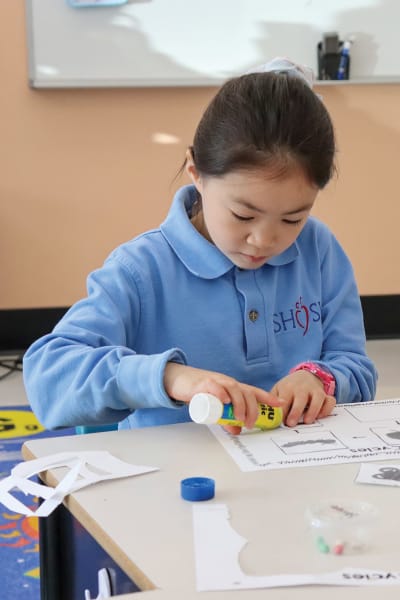
Sacred Heart School’s Junior Primary Program for four-year-olds provides a supportive environment that prepares the children for more formal education. While much of the focus is on play, the school ensures that purpose drives each activity. The children learn essential social skills, such as independence and empathy, while gaining an early understanding of academic subjects like reading, writing, and mathematics. Junior Primary students also benefit from French, art, and music specialists.
The whole-child approach continues and expands in the co-ed Elementary School. The Enrichment Program has been developed to enhance the Elementary experience, with expanded learning opportunities designed to inspire curiosity and elevate the already exceptional academic foundation. The Enhanced French Program is introduced in Grades 1 and 2 to help students gain an early comfort level with Canada’s two official languages. As their learning continues, they take daily French classes up to Grade 6 and can go on to earn a French fluency diploma by the time they finish Senior School.
Elementary School students also engage in focused reading, according to Leona Milne. “My daughter’s in Elementary School,” she says. “So is my son. They start doing reading programs, where the teacher will sit down and read with your child, determine their reading level, and then customize a reading program for your child. And your child brings home reading books at their appropriate level. Every week, that gets reassessed, and they get more challenging books, which sounds really simple, but I feel like it’s very curated to my child’s abilities. I’ve always really appreciated that.”
Milne also points out a key feature of the Elementary School that helps set Sacred Heart apart. “One thing that I noticed at another private school was when we were touring the school and walking around; I noticed that there was no artwork on the school walls, which, for me at an elementary school, seems really alarming. What do kids do when they’re in art class? There was no artwork on the walls. And then we did our tour here in the school. If you walk around the school, there’s artwork everywhere. It made me realize how much of a community this was, where the children were so proud to display their artwork.”
Throughout Grades 7 to 9, a single-gender learning environment supports the development of focused study and organizational habits essential to higher learning and professional life. In Grades 10 to 12, which are co-educational, students delve deeper into social justice and leadership.
Even at the Senior School level, students continue to receive individualized attention and benefit from the whole-child approach that drives Sacred Heart School’s academic vision. Students seeking to challenge themselves further have the option of enrolling in the Advanced Placement (AP) Program and earning college credit equivalent to that of a first-year university student.
“The academic program at Sacred Heart School of Halifax was rigorous, personal, and incredibly supportive,” says alum Kogie Esteban. “The AP program gave me a strong advantage in transitioning into university. Sacred Heart’s focus on academic excellence, critical thinking, and independent learning ensures thorough preparation for university-level expectations.” The sentiment is echoed by Dr. Vurain Tabvuma, father of two boys at Sacred Heart. “We really appreciate the robustness and rigour of the academic program,” says Vurain. “It prepares them well for university. They have world-class classrooms and laboratories. They are also exceptional in developing strong communication and presentation skills among the students.”
By the time students reach Senior School, they are starting to think about their long-term plans, including post-secondary education and employment. For students like Samuel Bassil, currently in Grade 10, that future remains somewhat open. “I’ve taken a liking to math. I really enjoy that,” he says when asked about his career path. “I will take business and economics, which is being offered next year, and I’m really looking forward to it. That’s something I’ve developed outside of school, but also through school; there are many programs to choose from.”
Clearly engaged in the topic, he quickly adds, “I’m heading over to Ontario next weekend for a global business day. I only found out about it because I was offered it by the school. They brought it up to us in university prep class. If I hadn’t known about it, I wouldn’t have been able to go, and now I’m really looking forward to it. The leadership skills that I’ve been taught at the school have really helped propel it. Whether it’s speaking at the Basilica today or attending a Sacred Heart Summit—a leadership conference back in October—things like that really helped me understand what I want to do, and to know that it’s related to the field of business. The idea of talking to people, growing, being a leader, public speaking—those types of things that I was able to really hone in and develop—it’s thanks to Sacred Heart for a good part of it.”
The academic environment
Like many private and independent schools, Sacred Heart offers small class sizes as part of its dedication to giving each student personalized attention. The average class in the Elementary School is 12-15, and 15-18 in the Senior School.
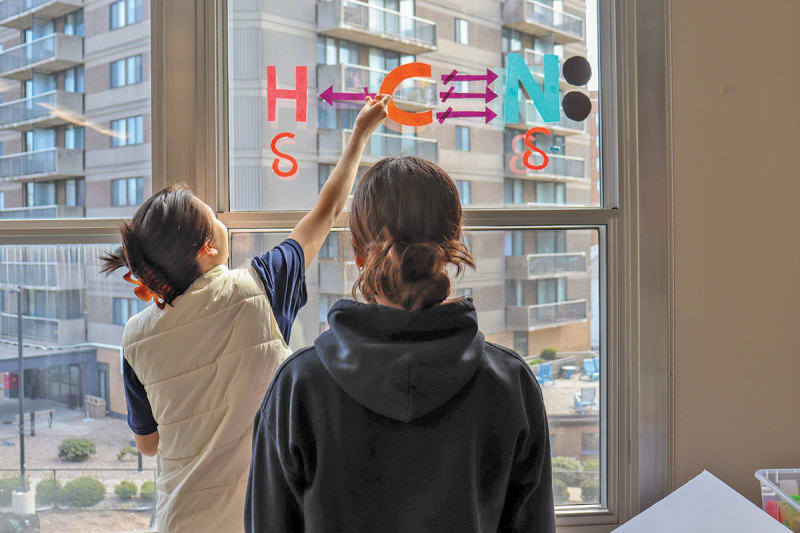
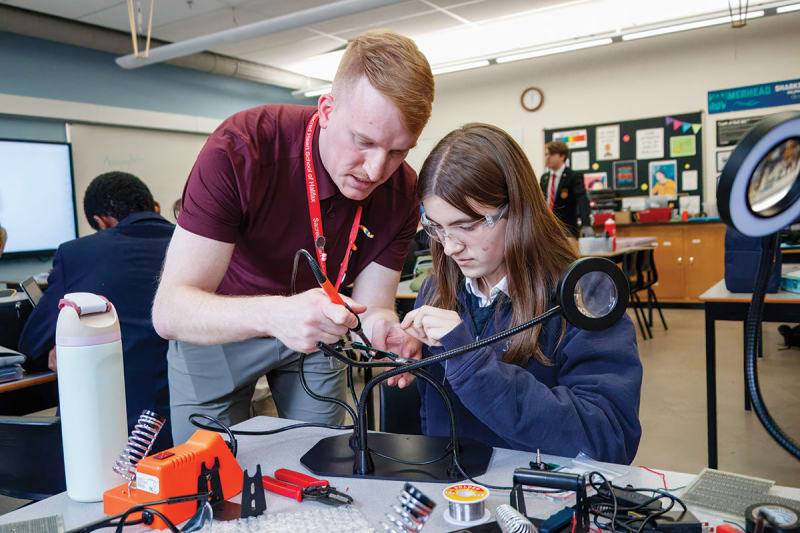
Senior School Physics and Math teacher Shoneth Leadbetter succinctly explains her preference for smaller classes. “I find that small class sizes are necessary for delivering the content the way I would like to deliver the content. It’s a lot more one-on-one. I can do a lot more with labs.”
She goes on to describe a recent event in one of her classes that illustrates the impact on both students and teachers. “I had a conversation with one of my classes today about the fact that, as a teacher at Sacred Heart, I’m not just teaching the content; I’m teaching them to be citizens of the world. And we had a side conversation about Earth Day, so we ended up down that path a little and how they can be good classmates and good members of our community at large.”
Sacred Heart School provides devices to early Elementary students, while all others are required to bring their own. Classrooms are equipped with interactive whiteboards (SmartBoards), which are large touch-sensitive displays that connect to a computer and projector. These devices allow users to control a connected computer directly from the board.
Computers are available in every room, and students have access to the school’s wireless network. Starting in Grade 3, students use laptops in the classroom. The school also offers a file-sharing program that permits students to access class notes remotely. They can also collaborate with teachers and other students at any time.
The school also has four advanced science labs, an Innovation Lab in the Senior School, and a comprehensive Campus Library stocked with print and digital materials.
Despite its embrace of technology, the school does have one limitation on students’ access. They recently updated their cell phone policy to ban students’ devices, including cell phones, earbuds, headphones, and smartwatches, from the campus during school hours. The ban also applies during lunchtime and any free periods.
Enrichment Program
The Elementary School’s Enrichment Program, introduced in Grade 3, is designed to nurture students’ curiosity, support their individual talents and interests, and extend learning beyond the regular classroom experience. The program includes two main components: Enrichment Clusters and Differentiated Teaching and Learning. Differentiated Teaching and Learning is integrated into the curriculum, with teachers personalizing instructions, creating a supportive environment where each student can explore their individual learning path.
Enrichment clusters give students the chance to explore topics of interest in a relaxed, hands-on setting over a six- to eight-week period. With guidance from teachers and outside experts, students engage in activities that reflect real-world themes, like science, digital media, the arts, or well-being, without the pressure of grading. Once a period ends, they have the option to choose a new topic from a predetermined list. They rank their preferences to help guide their group placements.
Leona Milne considers enrichment clusters to be a valuable part of her daughter’s education and happily shares her experience with the new program. “The kids get to pick what their topic is, and they rank them,” she says. “Then, based on their rankings, they get assigned to their groups. For a few weeks, they get to go for about an hour or two hours, I believe, on Fridays or a Wednesday afternoon, and they go with their teacher, and they focus on that enrichment topic.”
“For my daughter, she did one on being cheerful and being emotionally self-regulated,” Leona adds. “The grand finale was that they brought in a dog, and it was like being aware of how you feel, aware of your emotional well-being and how to regulate your own emotions. I thought that was just so useful.”
In addition to helping teachers identify students’ interests and strengths, an important outcome of the Enrichment Program is that students begin to develop self-awareness, are guided by their curiosity and natural inclinations to learn, and start taking ownership of their education.
The instructional day
Sacred Heart is committed to supporting students every step of the way. They provide intentional support for academic, physical, social-emotional, and spiritual health and growth.
Specialized academic resources include a Learning Strategist in each school for students who need extra support, a University Prep Counsellor for high school students, and two Vice Principals in the Senior School, one dedicated to academics and one to student life. Each school also has a School Counsellor. With committed faculty and small class sizes, they create a tailored learning environment focused on relational learning, ensuring that every student feels recognized, nurtured, and valued.
Grade 10 student Samuel Bassil considers his Sacred Heart experience to be extremely beneficial, especially in terms of preparation. “I feel as though it has taught me things like discipline and work effort that you don’t really see at public school. You are expected to do more. You are expected to use the resources if you need them. You are expected to have challenges where you know you’ve got to step out of your comfort zone. You can’t coast. You have to be driven and focused. I play hockey, and I work out. Between that and school, I have to really learn skills like time management. They don’t just give you all this work and don’t tell you how to manage it. They do aid you in that transition.”
In terms of social-emotional well-being, their School Counsellors, along with the Vice Principal of Student Life in the Senior School, provide individualized care and attention to students. They work alongside faculty members to teach health in Elementary School and Core in Senior School, emphasizing social-emotional learning and character education. This is reinforced through assemblies, advisories, and special guests who address meaningful issues.
Physical education and personal wellness are also top priorities and are integrated into the curriculum across all grade levels. Students also have added opportunities to stay active by participating in clubs, sports, and a wealth of extracurricular activities.
Spiritual life is an essential part of Sacred Heart’s ethos and enhances its commitment to academic excellence. As such, religious studies are part of their curriculum. They come together as a community for liturgies and special services. They also encourage healthy spiritual practices, such as Espacio (literally meaning “space”), which provides conscious time for prayer and reflection, and respect for all faiths.
French language
While stopping short of a full immersion program, Sacred Heart provides a strong French curriculum. The program offers various options, including age- and aptitude-appropriate lessons, to help students progress with the language and potentially earn a French Diploma for bilingual proficiency (DELF).
In Grades 1 and 2, students begin their exposure through the Enhanced French Program, which provides daily lessons in English and French. This approach helps students build a strong foundation as they refine their oral fluency, gain confidence, and perhaps even learn to love French. Students in Grades 3 through 6 continue the process through daily core French classes, bringing them one step closer to earning a French fluency diploma.
As students move into Senior School, the program continues its overall emphasis on improving French literacy skills, including listening, speaking, reading, and writing. The curriculum utilizes effective, time-tested techniques that enable students to achieve fluency, allowing them to engage confidently in conversation. During this time, students are also exposed to French and French-Canadian culture.
In Grades 10 to 12, the school splits the French program into Academic and Advanced courses. Students with less background in French who are eager to progress alongside comparably skilled peers engage in the Academic coursework. By contrast, students graduating from the Advanced stream gain a stronger foundation in grammar, presentation, writing, French literature, and oral fluency.
Advanced Placement (AP) Program
Sacred Heart offers the internationally recognized Advanced Placement (AP) program. AP provides students with rigorous, university-level courses that are acknowledged worldwide. Sacred Heart’s AP program includes educational travel, boutique online options, and hands-on learning experiences with local specialists.
There are numerous benefits to participating in the AP program. Students can select specific subject areas to excel in, rather than being required to take a predetermined set of advanced courses as in the International Baccalaureate (IB) program. Additionally, students can earn first-year university credits before even entering university, whereas standard-level IB programs typically do not grant university credit at most institutions.
Unlike the IB program, where enrollment is mandatory, students do not need to be enrolled in a class to take an AP exam. Participation in AP demonstrates to universities that students are well-prepared for their first year of study. Furthermore, the AP program is widely recognized well beyond North America and is highly esteemed by top colleges and universities. AP qualifications help distinguish Sacred Heart students from local students, many of whom follow the IB curriculum.
Physics and Math teacher Shoneth Leadbetter believes strongly in the AP program while recognizing that it’s not suited to every student. “I appreciate that we offer a combination of particularly challenging classes and options for those who don’t want to take those classes,” she says. “I like that the AP framework allows for choice in some subjects to go that way and not others, whereas with IB, you’re kind of all in. I like that flexibility with students who are really interested in and/or excel in the arts and want to pursue more challenging courses that way. I do like that we’re maintaining a challenging academic path for those who want it. I feel we do a very good job of preparing students for university, and I’m very much in the feedback cycle with our alumni.”
Extracurriculars
Sacred Heart recognizes that there is more to schooling than academics. Students have numerous opportunities to engage in extracurricular or co-curricular activities. In addition to arts and athletics, students can participate in programs such as Karate, Chess Club, the International Student Society, the Yearbook Club, Girls at Bat, and Pixel Pioneers. The Robotics Club is especially popular.
In addition to exploring personal interests, Senior students often take on additional responsibilities by helping younger students as Playground Mentors and Student Reading Buddies. Leona Milne, parent of two Elementary School students, explains Reading Buddies this way: “Senior students will partner up with a buddy in Elementary School, and they will do a reading program together where they get together once a week and read together. And that doesn’t necessarily happen at a traditional elementary school that ends at a certain grade. It’s because the spread is so great here that this opportunity is even available.”
Visual and performing arts programs
Sacred Heart incorporates a vibrant arts program into its teaching model. For students with an interest and talent, the school offers three key study options: music, performing arts, and visual arts.
The music program offers students a range of opportunities to engage throughout their academic tenure. At the Senior level, students can participate in choral musical presentations and perform at school events as part of the Senior Choir and the liturgical choir. Similarly, the Elementary Choir performs at school events and in public venues. The Band Program spans Grades 6 through 12, allowing students to develop their technical, creative, and performance skills to the fullest. Perhaps most significantly, music classes are offered to students in Grades JP-10, ensuring that students have ample opportunities to engage with music from multiple perspectives, including creativity, art appreciation, and historical context.
For the performing arts, the school focuses on two key programs: the Senior School musical and the Elementary School musical.
The visual arts are an integral part of Sacred Heart’s overall culture. The art program begins in the Elementary School and extends to Fine Arts classes in the Senior School. Teachers focus on fostering creativity and imagination while helping students develop solid artistic techniques.
Athletics
Beyond academic and social skills, students benefit from recreational and competitive athletics. The athletics program promotes good sportsmanship and collaborative teamwork at both levels, all of which contribute to participants’ personal growth, confidence, and resilience.
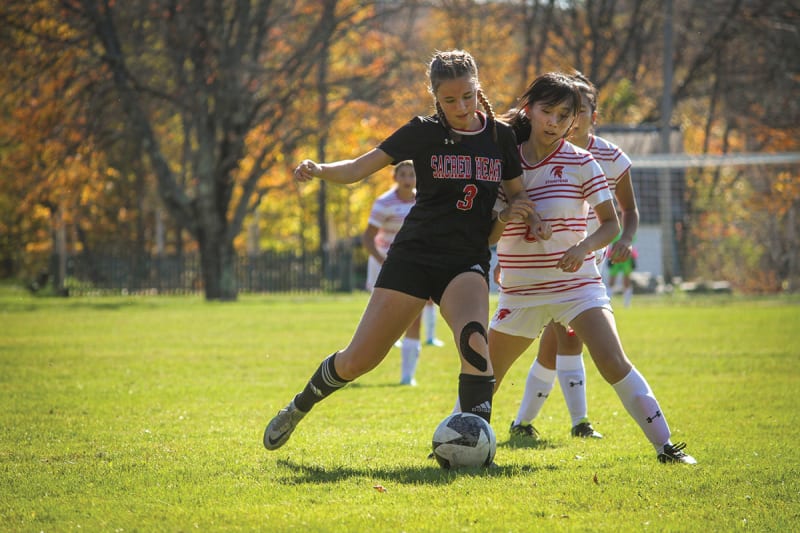
Senior School students are collectively part of the Sharks, whether playing competitively or recreationally. Competitive sports include basketball, field hockey, soccer, track and field, volleyball, and more. Teams compete as part of School Sport Nova Scotia (SSNS), Halifax Regional Centre for Education (HRCE) Junior High Sports, the Canadian Accredited Independent Schools (CAIS), and the Metro Independent League (MIL). There are a variety of recreational sports to choose from, like badminton, swimming, and ultimate frisbee.
Over the years, Sacred Heart has also supported elite athletes in balancing their training and competition schedules with academic life. The faculty provides flexible support to students who may miss class time due to travel or training commitments. This supportive, individualized approach has enabled many student-athletes to thrive in both arenas. Among the school’s alumni are three Olympians, as well as numerous U SPORTS and NCAA scholar-athletes, and national and international competitors in sports such as swimming, gymnastics, paddling, running, and sailing.
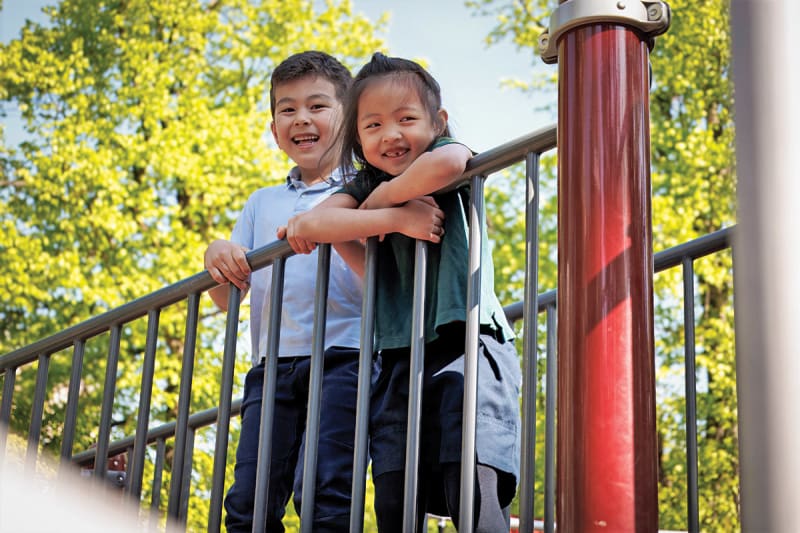
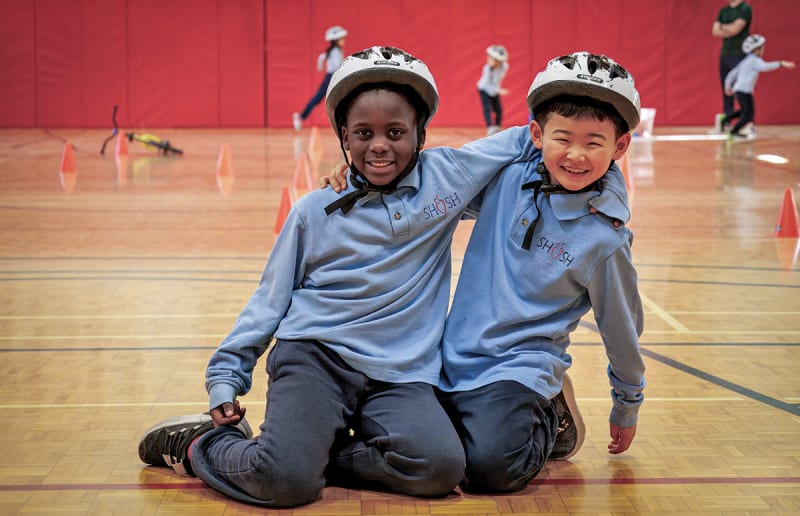
For Elementary School students, the focus is on the physical literacy program. The school schedules physical education three times a week, featuring a mix of organized and free play activities intended to promote healthy, active living. Students also have access to an on-site state-of-the-art playground for both structured and free play.
Jeff Britton is a Health and Physical Education (PE) teacher at Sacred Heart. As such, he sees firsthand the differences in students’ athletic abilities and credits the school with a rounded approach to sport and fitness. “We’ve done a really good job here demonstrating that not everyone is going to be a team sport player. Within our PE program, we incorporate a lot of personal fitness, personal wellness, yoga, and balance. We even use a different teaching space for some of our PE, which provides a more natural environment for a yoga lesson rather than a soccer match or a basketball match.”
He goes on to say, “I approach PE with a growth mindset, whereas maybe a traditional PE is you have to learn how to make that shot. It’s not that I don’t care that you can’t make the shot, but it’s more important if you’re putting in the time and you’re engaged and trying to improve.” He explains that he avoids making comparisons between students, preferring to focus on how each individual has progressed over time. “If you can already make 80% of the free throws in basketball,” he says, “let’s keep trying. There’s always room to improve.”
He also recognizes the importance of promoting healthy lifestyles at an early age. “I read an article early in my PE teaching career that basically said if you lose kids between Grades 4 and 6, it’s really hard to get them back into being physically active once they become teenagers. And then adulthood is a whole other challenge.”
Community engagement
Raising young people to be good citizens is a vital part of Sacred Heart’s ongoing mission. With that in mind, students are actively encouraged to engage in community service.
Alumna Sarah Cassidy recounts her early experience with community engagement. “When I was here as a 12-year-old, I went to the Abbie J. Lane hospital and fed the geriatric patients. That was my first experience with outreach into the community. My two daughters went here, and they both experienced that same outreach because that’s encouraged. Social justice is encouraged.”
Physics and Math teacher Shoneth Leadbetter believes community engagement is a vital part of every student’s education. “I really love that we have service as part of our curriculum,” she says. “I feel it’s important for students, especially of the demographic that has the ability to attend a private school, to understand we’re part of a larger community. I think now more than ever—although always throughout the history of the world—that’s important. Turning off a phone and going and physically helping others is something that really speaks to me, and something else that has pulled me to stay with this school as long as I have. I think that part of Sacred Heart sets us apart; it is something of value. We’re creating people who not only have the academic background to make a difference but also hopefully learn the value of helping others when they can.”
Student leadership
As part of its ongoing effort to produce well-rounded adults with a wide range of capabilities, Sacred Heart actively promotes the concept of student leadership, with an emphasis on combining boldness, decisiveness, and innovation with empathy and inclusivity. Student Councils are an important part of both the Elementary School and the Senior School. Leadership skills are further developed in Senior School with opportunities to serve as Student Prefects, Class Representatives, and Heads of Houses. Students also have ample opportunity to demonstrate their leadership through volunteering and community engagement.
School community
As an independent school, Sacred Heart has no neighbourhood restrictions on attendance. Students come from throughout Halifax and the surrounding area. This arrangement comes with both pros and cons. While students are exposed to a broader range of experiences and backgrounds, they and their parents may find community-based friendships more challenging to form.
Students join and leave Sacred Heart at various points during the overall educational process, each depending on personal circumstances. For some, that means being enrolled from Primary through Senior, while others may only stay for a few years.
Class of ‘76 alumna Sarah Cassidy’s experience in bringing her daughters to Sacred Heart exemplifies this point. “I was hoping for them to come in Grade 7, similar to my experience,” she says, “but the local public schools were amalgamating, and there became a rift between two different school communities. We just thought, ‘We don’t want this to disrupt their education.’ They started in Primary and stayed until Grade 8. Then, they went to the public school system. But to me, at that point, they had such a wonderful foundation.”
In addressing this change of institutions from private to public, Cassidy says, “I was kind of worried. Are they going to be uncomfortable in this mixed world? But they were confident women. And they were going to have to get out into this mixed world sooner or later. So, at some point, you do have to prepare them.”
The Senior School recently entered a new chapter with the launch of the Diamond Model, a hybrid approach that combines the benefits of both single-gender and co-educational learning. Students learn in single-gender classrooms from Grades 7 to 9, then move into a coed setting in Grades 10 to 12. The structure honours students’ developmental stages while preparing them for the world they step into after graduation.
Angela Surrette, a parent, alumna, and Past Board Chair, sees the shift as a natural progression. “Men and women—boys and girls—need to learn to work together, to socialize together,” she says. “It’s mirroring the world and reality, so I’m in support of it. The tradition and history still remain.”
Health and Physical Education teacher Jeff Britton, whose children also attend Sacred Heart, welcomes the change and looks at it from multiple perspectives: “It provides an opportunity for a richer course offering and more flexibility in the teaching staff. I’m really excited about it as a faculty member, but even more so as a parent for when my kids eventually get to high school.”
International students
Students from around the world come to study at Sacred Heart for both short and long periods. International students at Sacred Heart School of Halifax are welcomed into a Homestay Program that is an extension of the school’s emphasis on care and community. Students live with carefully selected Canadian families in Halifax, where they experience daily life within a safe, supportive, and English-speaking environment. The program operates in partnership with International Student Guardianship Canada (ISGC), which provides 24/7 support and multilingual communication with families around the world.
For international students at Sacred Heart, Homestay life allows for cultural exchange, personal growth, and a sense of belonging, while also supporting academic success and full participation in school life.
Exchange Program
As a member of the global Sacred Heart Network, the school offers its students the opportunity to study abroad through its Exchange Program. With more than 150 Sacred Heart schools to choose from, the possibilities to explore other languages and cultures while continuing their education and expanding their networks may seem endless.
Far more than a cultural or linguistic exchange, the program is a transformative educational opportunity through which students build global friendships, expand their worldviews, and build the confidence and resourcefulness that will serve them well beyond school. And, because the student is travelling to another Sacred Heart school, parents can rest assured that the exchange school teaches in accordance with the same Mission and values.
The dress code
All students are required to wear one of two types of uniforms, depending on the day and activity. The regular uniform is worn on most days, while a dress uniform is designated for formal occasions, such as liturgies and special assemblies.
On most Fridays, students wear spirit gear, which consists of casual, branded clothing; this gear is also available for purchase online. Students also have the opportunity to wear their own clothing on Colour Days, which are called for special occasions, often to raise awareness for specific social initiatives. Additionally, every Elementary student is allowed one personal Colour Day each year to celebrate their birthday.
The on-site School Shop sells all uniform items. The Parents’ Guild class representative provides weekly reminders about which uniform is to be worn.
Parents and alumni
The Parents’ Guild provides vital support to the school through various activities. Their two top priorities are building community and fundraising. One of the Guild’s landmark events is the annual Christmas Fair, a volunteer-led effort that features a Christmas craft market and an online auction. They also host events, such as the annual Ice Cream Social and a welcome lunch for returning faculty and staff at the beginning of the academic year. While not every parent is an active member, many volunteer their time to make sure the Guild supports the school.
Many past students stay connected to the school through robust alumni relations. One of the school’s signature events is the annual Christmas Wine and Cheese. Carolyn McKenzie, the Senior School Student Counsellor, describes the event as feeling “like you’re downtown. The place is popping. From my point of view, there’s a lot of happiness.”
Sarah Cassidy is an alumna of the Class of ’76, an Associate of the RSCJ, and Past Alumni President for Canada. She understands how conflicting priorities can keep some alumni and parents away from active involvement. “It’d be lovely to have those alums in our alumni association,” she says. “We invite parents of alumni to come back because so many of them, especially if they’re in the Parents’ Guild, have devoted their whole child’s education to helping.”
Many alumni return to give back and stay connected to the life of the school. They volunteer their time to coach teams, help with major events, or speak with current students about their post-secondary experiences and career paths. Their ongoing involvement benefits the school community, offering current students insight, mentorship, a deeper appreciation for the broader school network, and a meaningful sense of connection across generations.
Pastoral care
Sacred Heart is an independent school founded on Catholic principles but welcoming individuals of all faiths. Approximately half of their students identify as Catholic, while many others practice different religions, including Islam, Judaism, Hinduism, and Buddhism, or belong to other Christian denominations. Some students may not identify with any particular religion or may be in search of their spiritual path. Sacred Heart embraces students from all religious, ethnic, and racial backgrounds.
Parents appreciate the spiritual dimension of the school, which emphasizes values such as love, respect, generosity, and forgiveness. All students, from both Elementary and Senior School levels, take part in an inclusive and engaging religious curriculum. These courses promote understanding and respect for the meaningful rituals and traditions of various religions around the world.
Students are encouraged to explore their relationship with God, themselves, others, and all creation. They also have the opportunity to share their religious traditions with their classmates. Throughout the academic year, students learn about scripture and liturgical seasons and participate in assemblies, masses, and celebrations that honour the founding members of the Society of the Sacred Heart.
Additionally, Elementary School students enjoy weekly liturgical singing practices, where they learn songs for upcoming celebrations. These songs reinforce the core themes of love, respect, generosity, and forgiveness.
The core tenets of Sacred Heart’s existence appeal to students, faculty, and staff for varying reasons. Some find comfort in exploring their spirituality without pressure to conform to any particular religious practice. Others enjoy the more academic side of studying comparative world religions.
As the Senior School Student Counsellor, Carolyn McKenzie views the overall spiritual underpinnings of the school as especially appealing. “What brought me here was that it’s a beautiful, loving, intimate, small community where people were cared about,” she says.
Perhaps conscious that she might be perceived as painting too rosy a picture, she adds, “I don’t want to suggest there aren’t hard days or there aren’t hard moments or hard things. Certainly, it’s a lot of work – academically, socially, and emotionally.”
“Teen psychology becomes an important factor,” says McKenzie. “Students’ brains are still developing, and they face challenges even on good days. With impulse control not fully there yet, they may say things and do things.”
When dealing with students’ emotional and behavioural issues, McKenzie defines her approach as relational, in a process that starts with asking questions. “‘What’s going on? Are you okay? Why did you do that? Why are you saying that?’ And that relational approach—whether it’s someone who’s having trouble or having a great day—is golden, in my opinion, and it is priority one for me. And I would say the same for our Vice Principal.”
The attention to students’ emotional needs seems to pay off in the long run. McKenzie points out that returning alumni often validate the approach. “When the alum come back—and they do, in droves—they say how well prepared they were and how happy. The vast majority of the time, they really feel prepared and very lucky and very fortunate. And they get that. They’re called to do things like service work for other people.”
Sacred Heart also provides a supportive environment for faculty and staff. “Over 32 years, a lot of messy things have happened in people’s lives,” McKenzie says. “And I have felt very supported. I could go to my principal right now and say, ‘I can’t tell you why, but I’m leaving right now, and I probably won’t be back till Monday.’ And he would say, ‘Do you need a ride? Can we get some suppers organized?’”
Food service
Sacred Heart School’s Lunch Room provides a communal space for students to share their midday meal break. There is no on-site kitchen. Instead, students have the option of bringing meals from home or pre-ordering lunches from the Parents’ Guild Lunch Program. Some of those providers are Sacred Heart families, giving back, in a way, to the school that has had an impact on their lives. The Lunch Program is managed by the Parents’ Guild and is one of its major fundraisers.
After School Program
Sacred Heart School of Halifax provides an After School Program for Junior Primary to Grade 6. Hours run from class dismissal to 5:30 p.m. to accommodate standard work schedules.
The program includes a light, healthy snack and supervised activities, as well as the option to do homework. When the weather permits, students can enjoy the school’s outdoor playground under the supervision of staff.
Parents are charged a nominal hourly fee for the service, and pre-registration is required. Tax receipts are provided.
Getting in
All prospective students must undergo an eligibility assessment, which varies according to the grade at which they would enter the school. For Junior Primary and Primary, the child shadows a Junior Primary class for half a day. For Grades 1 through 9, local prospects visit the campus for a day and/or participate in an on-campus assessment. Those living outside the city take their assessments online. For students registering for Grades 10 through 12, local prospects complete their ISEE assessment on campus, while others take the assessment online.
Before the assessment, parents are encouraged to research the school and make arrangements for a tour. Assuming the school is a good fit, children and their parents can apply online without incurring any fees. For Junior Primary and Primary, the application includes a copy of the child’s government-issued identification (such as a birth certificate or passport).
For all other grades, the required documents include the following: a birth certificate or passport, two most recent year-end report cards, any available current-year report cards, a teacher recommendation form, and a student profile.
The admissions process is intentionally structured to give families meaningful exposure to school life while also providing the school with a clear sense of each child’s strengths and needs. Beyond formal assessments, prospective students and their parents often spend time with teachers and, in some cases, interact with current students. These experiences allow families to see how academics, extracurriculars, and daily routines actually unfold. By emphasizing this kind of engagement early on, the school makes sure that new students enter with a sense of familiarity and preparedness.
Lisa Bedford’s two daughters are currently enrolled in the Elementary School. Their shared story highlights the process that prospective students and their parents go through. “We had been looking—our children went to a different private school in the city—since pre-Primary,” she says, “so for six years, we were looking for something with a little more academic rigour, a bit more support, extracurricular activities, and something supportive of our values of being a good person, a good moral compass, good community and service.
“This school really stood out, so we came for a tour, and we talked to friends and colleagues who have children here. It was really an easy, easy sell,” Lisa says.
“When you’re coming for a tour, the information they provide, the way they showcase the school, the programs, the teachers, what they have to offer—you really feel comfortable in your investments. There’s a high level of accountability—very responsive—and a really nice atmosphere when you come here, so it almost sells itself. What was wrapped around us when we were making a decision made it easy.”
Sarah Cassidy and her two sisters are all graduates of Sacred Heart, and she fully appreciates the full cost of their education—a price that extends beyond tuition. “My parents basically didn’t buy a home so they could send us to university,” she says. “At that time, the tuition here was more than at university. After we all graduated, they bought a home. There’s a lot of sacrifice for people who want their children to be sent here. They prioritize education.”
Money matters
Applicants can apply for merit-based Entrance Scholarships if applying to join from Grades 7 to 12. Awarded scholarships cover a range of amounts against the cost of tuition. Other scholarships are available to current students from Grades 6 through 10.
Once a child is accepted, the admission fee is due by August 1. For late admissions, payment is due before the child’s first class. There is also an enrollment deposit due upon signing the enrollment contract, which is applied to tuition. Tuition fees vary depending on the student’s grade level.
Parents often cite their willingness to make sacrifices in other areas of their lives to provide their children with the best possible education.
Leona Milne, who currently has two children at Sacred Heart—and more on the way—recognizes the cost in dollar terms but thinks beyond that aspect. “It is an investment,” she says, “and it is a long-term decision for our family, so we thought really long and hard before we enrolled our daughter, who’s our eldest. She’s currently in Grade 3. We looked around, we shopped around for different schools, and I think we—well, I know we settled here because I just felt like the school’s values really aligned with our family values. And I know that, academically, it’s fairly rigorous here. There would be a lot of enrichment opportunities for my children. Then, when we got here, it felt very warm and welcoming, and we really liked that about the school.”
When asked what she would say to parents considering Sacred Heart School, Sarah Cassidy says, “It’s an investment in the future of your children. It’s sacrificing. I mean, you may not be able to take your trips or buy a car, but it’s just a short period of your life. There are so many potential opportunities to see your child grow and be supported, loved, and extended beyond your own family. That’s something you don’t find in a lot of schools. They just don’t have the time. Take that opportunity to think of postponing some of the things that you want in life, and give your children this opportunity.”
In addition to student fees and tuition, Sacred Heart School relies on fundraising efforts to support its ongoing operations. Designated donations are accepted via their website to support their Annual Giving and Bursary Funds, along with an option to make an undesignated donation. Their recently completed Dare to Be! campaign proved to be a financial success, leading to infrastructure upgrades and the expansion of their Bursary Program, which also benefits from their annual Big Hearts Bursary Benefit.
Sacred Heart places great value on acknowledging the contributions of its many donors, regardless of the dollar amount given, with an itemized listing in its annual report and in various community communications.
Takeaway
Sacred Heart School offers a rigorous education with individualized attention in small class sizes (12-17 students on average). Programs include an Elementary Enrichment Program, and students can pursue an Advanced Placement (AP) program for university credit. The school also has an excellent athletics program for both competitive and recreational athletes, a robust array of extracurricular clubs and activities, and a vibrant visual and performing arts program.
Technology is integrated into the curriculum, with laptops and interactive whiteboards, though a recent policy bans student cell phones, smartwatches, and other personal devices during school hours. Community engagement and service are highly encouraged. The school provides a supportive pastoral care environment, focusing on relational approaches to student well-being. Food service is available through pre-ordered lunches from the Parents’ Guild Lunch Program; as there is no on-site kitchen. Prospective students undergo an eligibility assessment, which includes campus visits or online assessments, depending on their grade and location.
While rooted in Roman Catholic tradition, the school welcomes students of all faiths and offers an inclusive, values-based religious curriculum. It adheres to and exceeds the Nova Scotia Department of Education guidelines and holds dual accreditation from Canadian Accredited Independent Schools (CAIS) and the Sacred Heart Commission on Goals (SCHOG), reflecting its commitment to excellence in education, governance, management, and leadership.
As with any private or independent school, parents should weigh their child’s specific needs, both academically and personally, against the financial cost associated with their attendance. To help parents make an informed decision, Sacred Heart provides a considerable amount of publicly available information on their policies and practices and welcomes prospective students and their parents to tour the facility and ask questions.
Overall, Sacred Heart presents as a warm, inviting space with clean, bright rooms and relaxed, happy students who carry themselves with poise and confidence. The school provides a strong academic foundation enhanced with a whole-child approach that helps turn young people into well-rounded adults with the skills they need to succeed in the world, both professionally and personally.
Having recently celebrated its 175th anniversary, Sacred Heart School of Halifax is highly regarded in the local community and looks forward to carrying its legacy forward for another 175 years.