The 2026 OUR KIDS Private School Expo is coming to cities near you. Get your family pass



Sacred Heart School of Halifax KEY INSIGHTS
Each school is different. Sacred Heart School of Halifax's Feature Review excerpts disclose its unique character. Based on discussions with the school's alumni, parents, students, and administrators, they reveal the school’s distinctive culture, community, and identity.
What we know
- Sacred Heart School of Halifax integrates rigorous academics with a whole-child, values-based education rooted in community and global Sacred Heart traditions.
- The school offers a unique diamond model: coed and single-gender learning, with strong arts, athletics, and leadership opportunities.
- Located in downtown Halifax, it combines historic legacy with innovation, welcoming students of all faiths and backgrounds.
Our editor speaks about the school
Handpicked excerpts
One of the most frequently mentioned words in any conversation about Sacred Heart School of Halifax is “community.” From students and parents to teachers and administrators, everyone sings the praises of the communal atmosphere within the institution. Sacred Heart’s longevity contributes to that shared sentiment.
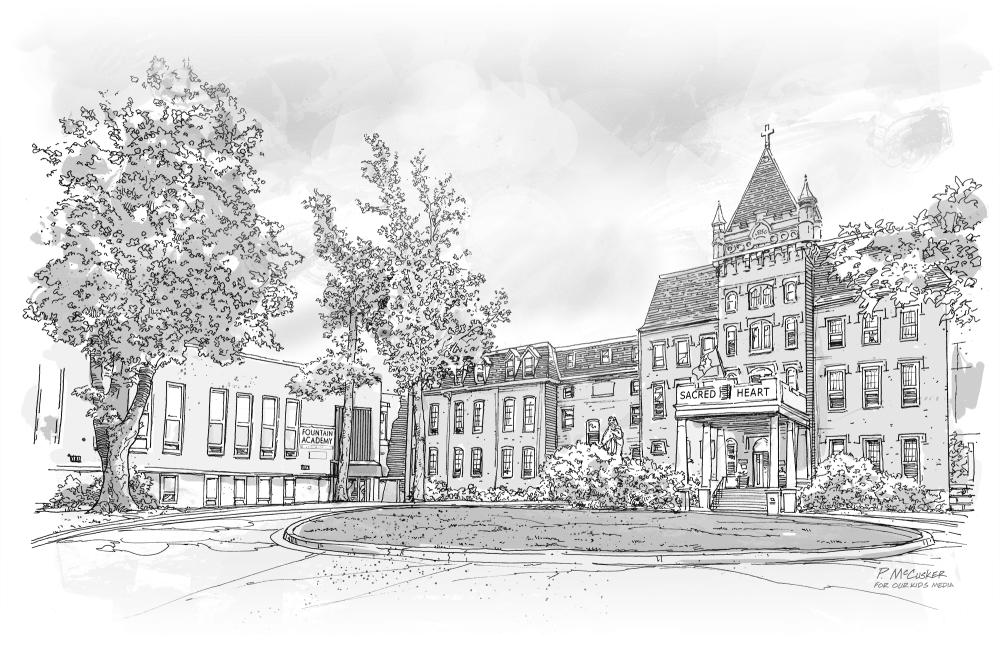
The school dates back more than 175 years and is an iconic landmark in the heart of the city. Situated on Spring Garden Road, one of downtown Halifax’s most well-known thoroughfares, the school easily stands out from its neighbours. The striking architecture of the original building blends with a more modern extension to create an environment that seamlessly blends old and new.
Rooted in history, faith, and unique traditions, Sacred Heart is part of a global network of schools united by a shared mission and values that instill a strong moral compass—an integral part of the School’s fabric.
BASICS
Sacred Heart School of Halifax is an independent day school in Halifax, Nova Scotia. From Junior Primary to Grade 12, students engage in rigorous academics while fully embracing critical thinking and exploring a range of social skills. With a whole-child philosophy, the emphasis here is on academic, social, emotional, physical, and spiritual growth, as each child is recognized as an individual and encouraged to find and pursue their unique interests.
Students often engage with the broader community, exploring aspects of social justice, leadership, and activism. For them, success goes beyond grades and accolades; it also includes how much they contribute to making the world a better place.
While established as a Catholic institution, Sacred Heart School welcomes students of all faiths. Their inclusive religious curriculum focuses on Catholicism while promoting a broader understanding of world religions and instilling a strong moral code that includes generosity, respect, and love.
Beginning in the 2025/26 academic year, the Senior High School moves from a single-gender model to a co-ed one, while the Junior High School stays single-gender, part of the move to a new diamond model of education.
SCHOOL LEADERSHIP
The Board of Governors oversees Sacred Heart School and relies on a small Leadership Team led by the Head of School to manage the day-to-day running of the school. Administrators include the Senior and Elementary School Principals, the Director of Finance and Administration, the Director of Facilities and IT, the Director of Advancement and Alumni Relations, the Director of Marketing and Communications, the Director of Admissions, and the Executive Assistant to the Head of School.
Their interconnected roles and responsibilities help Sacred Heart School educate to its five goals shared across all Sacred Heart Network schools: “A personal and active faith in God; A deep respect for intellectual values; Social awareness that impels to action; The building of community as a Christian value, and Personal growth in an atmosphere of wise freedom.”
BACKGROUND
Beyond the confines of Halifax, the school has its roots in post-revolutionary France, where St. Madeleine Sophie Barat started the Society of the Sacred Heart of Jesus (RSCJ) in 1800. The following year, the first Sacred Heart School opened in Amiens, France.
St. Madeleine Sophie Barat believed that education was key to shaping a better world for everyone, especially for girls. In the wake of the French Revolution, her outlook demonstrated a singular vision. She also believed that education involved more than filling children’s heads with information. In her innovative approach, spiritual, moral, and social instruction helped promote and enhance intellectual pursuits, producing well-rounded students.
“What is the good of teaching various subjects,” she said, “of wasting time in learning them, if at the same time we cannot teach children the words of life and touch their hearts and their consciences?”
By 1818, St. Rose Philippine Duchesne brought the Society to North America and established the first Sacred Heart School in the New World in St. Louis, Missouri, after making a pioneering journey across the Atlantic and the American frontier.
Another member of the RSCJ, Sister Mary Aloysis Hardey, led the establishment of the Convent of the Sacred Heart in Halifax in 1849. Initially, the sisters established the convent at Brookside, which would later be known as the Lord Nelson Hotel, just off Spring Garden Road. Within a week, they opened a school for young girls. A mere two years later, they relocated a short distance away to what would become the school’s permanent location.
While a girls’ school for much of its history, Sacred Heart eventually opened its doors to boys. In the mid-1900s, they operated a public, co-educational school, known as the College Street School. More recently, in 2005, they established a boys’ high school, which initially found temporary lodging at the Canadian Martyrs Church on the campus of nearby Saint Mary’s University. Finally, in 2010, they established the Fountain Academy of the Sacred Heart on campus.
From 1849 to 1985, the school operated under the name Convent of the Sacred Heart. An Act of Legislation under the Nova Scotia Government reincorporated the institution as the Sacred Heart School of Halifax. To this day, the school remains part of the global Sacred Heart Network, which comprises more than 150 schools.
ACADEMICS
Sacred Heart School’s Junior Primary Program for four-year-olds provides a supportive environment that prepares the children for more formal education. While there is a focus on play, the school ensures that purpose drives each activity. The children learn essential social skills, such as independence and empathy, while gaining an early understanding of academic subjects like reading, writing, and math. There is also instruction from specialists in French, Music, and Phys-Ed, and students enjoy access to all of the campus facilities.
The whole-child approach continues and expands in the co-ed Elementary School as the school lays a very strong academic foundation primarily through instructional blocks of reading, writing, and math. French is a focus for all Elementary grade levels, helping students gain an early comfort level with the language that sets them up well for more advanced French programs and eventual certification in the Senior School. There is also learning across many disciplines, including physical education, music, science, art, social studies, and religion. The annual Elementary School Musical for students in Grades 3-6 is widely regarded for its creative excellence and sells out every year. A new Enrichment Program is being offered in the 2025-26 School Year that includes both differentiated teaching and learning and enrichment clusters.
While academics are the focus in Senior School, students continue to receive individualized attention and benefit from the whole-child approach that drives Sacred Heart School’s academic vision. Students seeking to challenge themselves further have the option of enrolling in Advanced Placement (AP) courses, which allow them to focus on areas they want to specialize in while potentially earning college credits. University preparation classes and counselling give them highly personalized options for their future, while Core classes help students navigate complex social issues. There is also an emphasis on leadership, social justice, and charitable activities.
“We really appreciate the robustness and rigour of the academic program,” says Vurain Tabvuma, parent of two boys at Sacred Heart. “It prepares them well for university. They have world-class classrooms and laboratories. They are also exceptional in developing strong communication and presentation skills among the students.”
VISUAL AND PERFORMING ARTS
Sacred Heart incorporates a vibrant arts program into its teaching model, with three key options: music, performing arts, and visual arts. The music program offers students a range of opportunities to engage throughout their academic tenure: choral musical presentations, the Senior Choir, and the Liturgy choral group for Seniors; the Elementary Choir; the Band Program for Grades 6 through 12; and music classes at all grade levels. There are also numerous performing arts options at the Senior School, and students in Grades 3-6 can take part in the Elementary School musical. The art program begins in the Elementary School and extends to Fine Arts classes in the Senior School. Teachers focus on nurturing the students’ creativity and imagination while helping them develop solid artistic techniques across media.
ATHLETICS
Beyond academic and social skills, students benefit from recreational and competitive athletics. The athletics program promotes good sportsmanship and collaborative teamwork at both levels, all of which contribute to participants’ personal growth, confidence, and resilience.
Senior School students are collectively part of the Sharks, whether playing competitively or recreationally. Competitive sports include basketball, soccer, field hockey, track and field, volleyball, badminton, and more. Teams compete as part of School Sport Nova Scotia (SSNS), the Canadian Accredited Independent Schools (CAIS), and the Metro Independent League (MIL).
Sacred Heart excels at allowing elite athletes the flexibility to pursue their outside athletic journey while faculty supports and nurtures student-athletes to maintain a strong academic standing.
CLUBS AND ACTIVITIES
Besides arts and athletics, students can participate in a wealth of cocurricular and extracurricular programs and clubs, such as Robotics, Karate, Battle of the Books, Chess Club, the International Student Society, the Yearbook Club, Girls at Bat, and Pixel Pioneers, just to name a few. In addition to exploring personal interests and gaining new skills, students can discover their leadership potential and meet new friends.
“These activities were valuable in helping them to integrate,” says Mary Shakespeare, a parent at Sacred Heart, “not just into the Sacred Heart community, but in many cases into the greater community as well.”
GETTING IN
All prospective students must undergo an eligibility assessment, which varies according to the grade at which they would enter the school. For Junior Primary and Primary, the child shadows a class for half a day. For Grades 1 through 9, prospective students can visit the campus for a day and/or participate in an on-campus assessment. Those living outside the city take their assessments online. For potential students registering for Grades 10 through 12, they complete their ISEE assessment on campus or online.
Before the assessment, parents are encouraged to research the school and make arrangements for a tour. Assuming the school is a good fit, children and their parents can apply online. Admission fees are only required for families who have been accepted by the school.
Applicants can apply online for merit-based Entrance Scholarships if applying to join from Grades 7 to 12. Other scholarships are available to current students from Grades 6 through 10. Financial assistance is available and is supported by a robust Bursary Fund.