The 2026 OUR KIDS Private School Expo is coming to cities near you. Get your family pass



University of Toronto Schools THE OUR KIDS REVIEW
Verified Review
OUR KIDS verifies every review by confirming the reviewer’s identity and their firsthand experience with the school. Learn more
The 50-page review of University of Toronto Schools, published as a book (in print and online), is part of our series of in-depth accounts of Canada's leading private schools. Insights were garnered by OUR KIDS editor visiting the school and interviewing students, parents, faculty and administrators.

Introduction
University of Toronto Schools is synonymous with academic excellence and accelerated learning opportunities. UTS students take up to 10 courses a year starting in Grade 7 with additional enrichment through AP coursework, contest preparation, and both individual and team competitions.
The same drive that makes UTS students exceptional in the classroom shows up everywhere else at the school. Up to 100 clubs and co-curriculars run in a given year, led by students themselves—proof that academic rigour, leadership, and diverse interests can thrive together.
“While this is a fast-paced school where students have a demanding course load and multiple co-curricular involvements, there’s a lot of joy here because they genuinely love to learn,” says Principal Leanne Foster. Many UTS community members we met were eager to dispel the misconception that students spend all their days heads-down with their studies. “The UTS ethos is about far more than academic success,” says one parent. “Doing well in academics is cool here, but so is students being able to define themselves through activities such as music, arts, robotics, or athletics.”
UTS families, students, alumni, and staff also emphasized what one parent calls the “real-world” focus of the school. As evidence, they pointed to the lack of uniforms, coeducational environment, socioeconomic diversity among students (facilitated by substantial needs-based financial assistance), and understated yet distinctively modern architecture. The school doesn’t look like or operate like Toronto’s traditional, well-known private schools, something that UTS families and staff consider a strength. “It’s very much an independent school,” says Jill Strimas, Vice Principal, Learning and Innovation. “It has its own unique personality and way of doing things.”
Make no mistake, though, this is a school with rigorous academic expectations that attracts students from families who deeply value education. The stellar reputation of UTS and its alumni draws extremely competent, remarkably committed students willing to commute from across the Greater Toronto Area.
Given the school’s academic demands, students must successfully navigate a competitive admissions process that involves both entrance testing and multiple mini-interviews. Once students are in, however, there are ample academic and social-emotional supports in place to ensure they can keep up. “We help students find strategies to manage the pressure,” says Foster. A system of interconnected academic support and wellness programs allows students to access a range of individualized assistance, from after-school sessions with teachers and peer tutoring to guidance programs in organization skills, stress management, and mental health. It’s all part of a wider school culture that values students’ well-being just as much as their scholarly success.
Parents told us they were attracted to the school’s accelerated curriculum and leading academic status among independent schools, but only in part. They also chose UTS because it offers students a holistic education and a sense of belonging within a relatively small, close-knit community. “We sent our kids because we wanted a school that focused on intellectual curiosity and engaged global citizenship,” says one parent of a current student and a graduate. Another says, “We were looking for balance for our son, a mix of strong academics and great learning outside the classroom.”
UTS is a lively place before and after the bell rings. A rich array of co-curricular activities – including athletics at all levels and dozens of clubs – gives students a wide field for exploring their enthusiasms and new interests. “Our message to students is that balance between academic and non-academic life is vital,” says Garry Kollins, Vice Principal, Student Life.
Inclusion is another foundational value at UTS. Human rights, equity, and anti-racism initiatives permeate the formal and informal curricula. Our conversations affirmed that there’s a place for everyone at UTS and ongoing efforts to foster students’ embrace of diversity of ideas, identities, and backgrounds.
“There’s a culture of pride here among both students and staff members,” says one parent. Several staff members expressed this sentiment explicitly, saying they’d always wanted to work at UTS and jumped at the opportunity when it came up. The fact that the teaching staff is also exceptional, with many teachers holding advanced degrees, comes as no surprise.
UTS occupies a distinctive place in Canada as the country’s only independent, merit-based preparatory secondary school affiliated with a university. UTS families frequently cite the benefits of educational and research partnerships with the university and access to U of T facilities.
With outstanding academics as its foundation, UTS has built a rich, well-rounded learning experience for students.
Basics
The location of UTS alone sets it apart from other Toronto-area independent schools. Being embedded on the downtown campus of Canada’s largest university visually signals the academic orientation of UTS.
Depending on which direction visitors arrive from along Bloor Street West, they’ll see either the school’s original neo-gothic three-storey brick building or the sleek, modern 2022 addition. Despite the sharply contrasting architecture, the whole structure is impressive and signals its belonging to the U of T campus, where the old and new sit side-by-side. The renovation itself is the work of a UTS alumnus: architect Don Schmitt, C.M., a principal at Diamond Schmitt Architects whose firm has also shaped several buildings on the U of T campus.
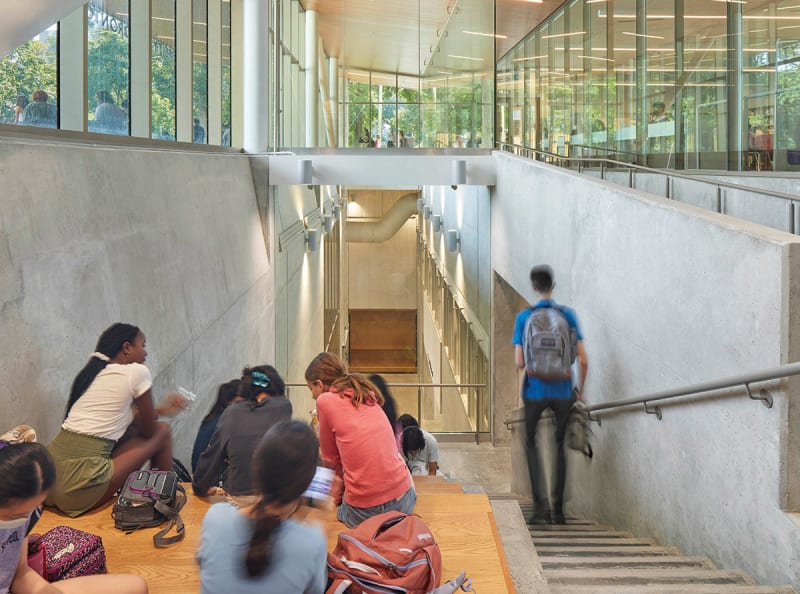
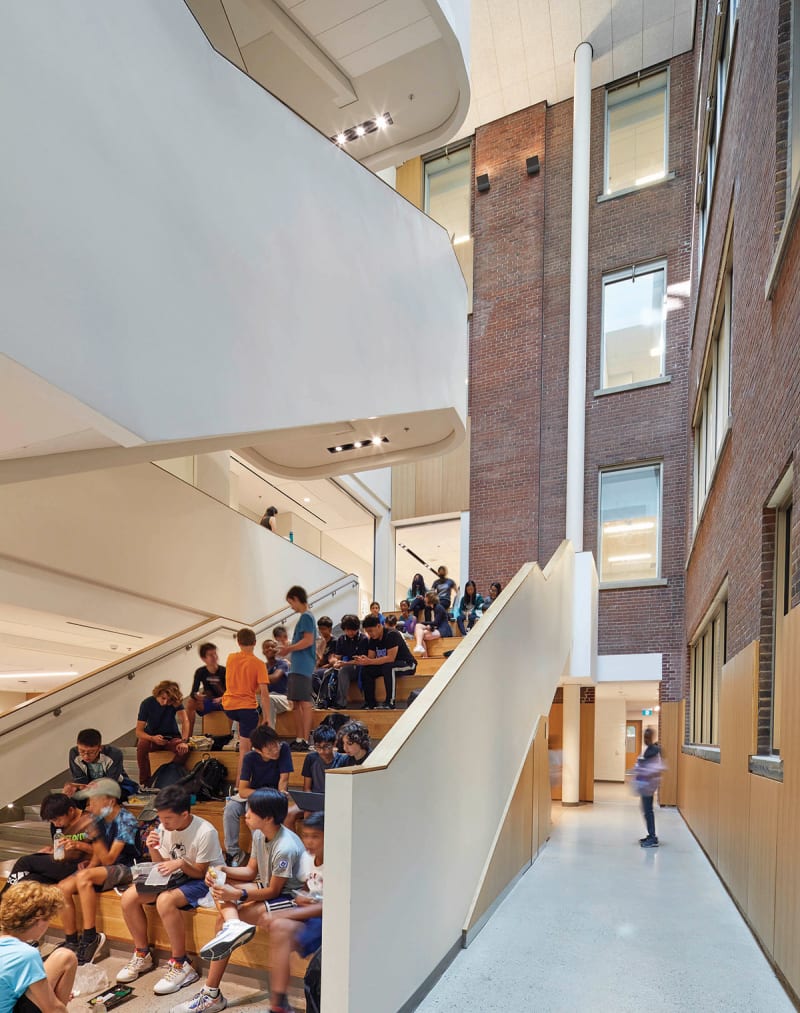
Inside, UTS doesn’t look or feel like any other independent school in the city. Stepping into the high-ceilinged, skylit Fleck Atrium, visitors encounter a decidedly post-secondary atmosphere. The exposed red brick walls of the old building contrast with light wood, stone, and concrete. The upper floors overlook the atrium, and central staircases are open, giving everything a spacious and airy quality. A popular spot for students to gather is the deep and wide Learning Stairs, purpose-built for hanging out, studying, or eating lunch.
The lack of a cafeteria is the only drawback related to the school’s facilities mentioned by students and families. Still, everyone qualified their comments by saying it “isn’t a big deal” and doesn’t detract from student life. The school is surrounded by a wide variety of food options on campus and along Bloor Street, and many students like to get outside for at least part of the lunch hour. At the beginning of Grade 7, students are matched with a Grade 11 buddy to orient them both to UTS and the city beyond its doors. Once the new students are confident, they’re free to venture out on their own for lunch.
One of the things new students and families must learn is the UTS terminology for each of the school’s six years: Grades 7 and 8 are Foundation 1 and 2 (F1 and F2); Grades 9 and 10 are Middle 3 and 4 (M3 and M4); and Grades 11 and 12 are Senior 5 and 6 (S5 and S6). This system keeps students connected to their chronological cohort even when their accelerated programs include courses typically taken in later grades. On our visit, we noticed a note of pride when UTS community members explained this distinctive terminology.
“I always tell people, we’re not a fancy prep school,” says one Grade 11 student. “It’s not the UTS identity.” Several UTS community members we met expressed the same sentiment about the valuing of substance over showy amenities. While the school doesn’t have a formal dining hall, rolling lawns, a pool or tennis courts, UTS offers a state-of-the-art 120,000-square-foot facility situated amongst some of U of T’s most prominent programs and faculties.
The entire school community comes together for monthly assemblies and performances in the 700-seat Withrow Auditorium, whose cantilevered exterior is finished in white brick. On the day we visited, the taiko drumming group, led by a UTS alum, was rehearsing. For smaller gatherings and productions, the Jackman Theatre, with its backstage area and dressing rooms, gives students the experience of professional performers.
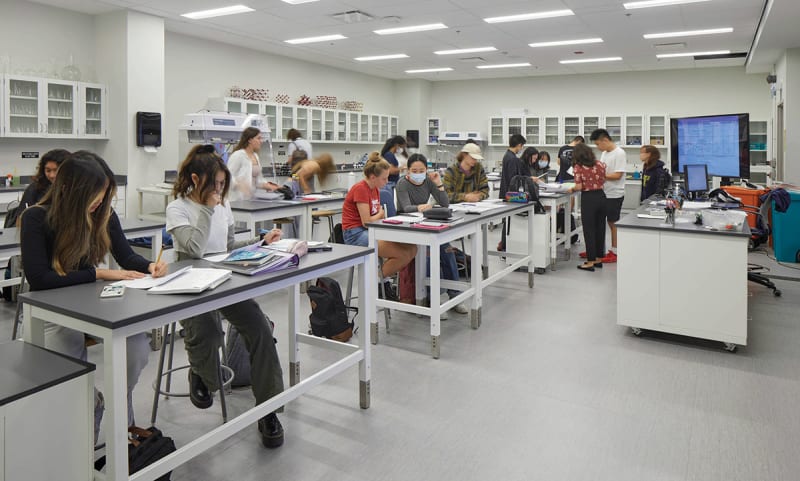
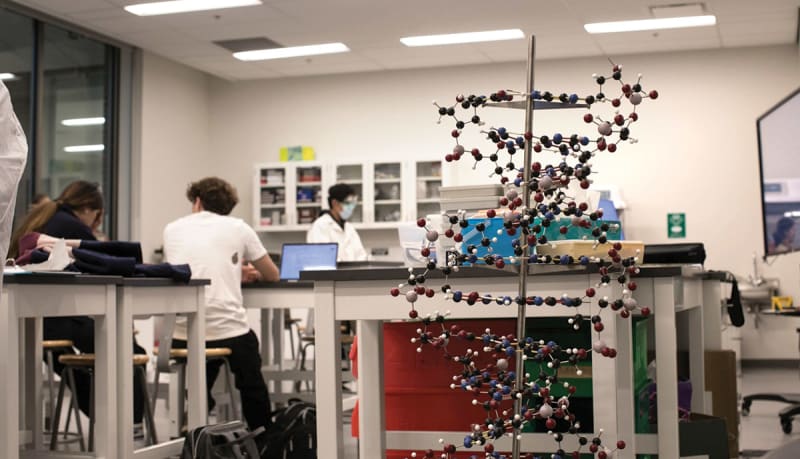
Classrooms in the renewed building are bright and well-sized, with dedicated art studios, music ensemble and practice rooms, and wet labs for science classes. The Lang Innovation Lab came up frequently in our conversations as a centrepiece of the school’s curricular and co-curricular life. “This is where a lot of students come during and after classes,” says our Grade 12 tour guide. “We have 3D printers, laser cutters, woodworking, and other design tools. It’s a creative space where we can work on projects in all different courses.”
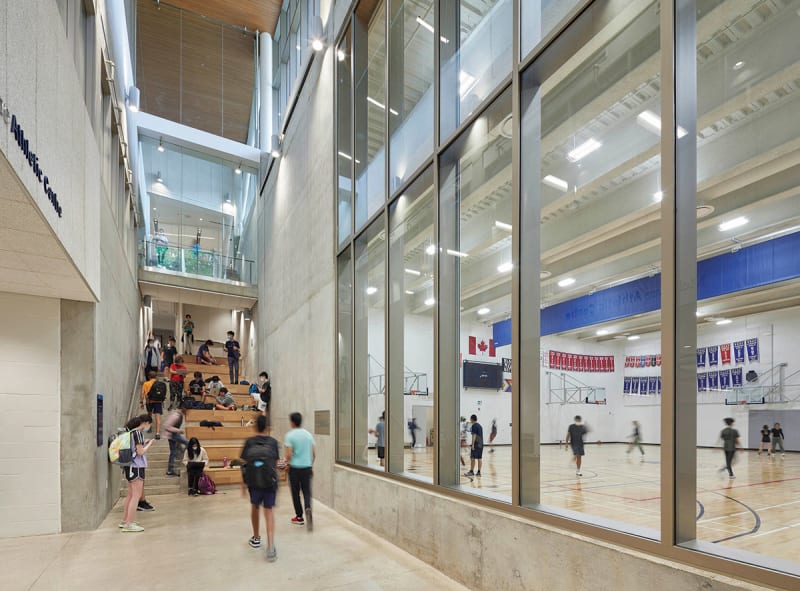
For a relatively small school, UTS’s athletic facilities punch above their weight. The double McIntyre Gymnasium has enough floor and seating space to accommodate not just home games but inter-school tournaments. “We’ve hosted packed OFSAA games,” says Kollins, referring to the Ontario Federation of School Athletic Associations.
The gym is below grade but open to the entire height of the building, with expanses of specialty windows (designed by a UTS graduate) etched with chemical symbols for bird safety. Our tour guide proudly pointed these out, remarking that students mark their progress in chemistry by their ability to decipher the symbols over the years.
Student athletes, recreational players, and physical education students work out in the Ridley Fitness Centre overlooking the gym. It’s amongst the best-equipped high school training facilities in the city’s core.
Additionally, the affiliation agreement with U of T allows UTS students to access athletic resources such as Varsity Stadium and Arena, the Athletic Centre, and several outdoor fields for PhysEd classes or team practices.
Students told us they appreciate the experience of using these high-level training facilities, though it seemed that a few had come to take them for granted after several years. This makes sense, given that UTS students are so closely interconnected with U of T. In fact, many cited the university’s main library—Robarts Library—as their preferred study space. “It’s where most of my friends go,” says one Grade 12 student.
The advantages offered by a top academic school situated on a university campus are enough to justify long commutes among many UTS families. “We have students coming from across the GTA because there are no admission boundaries,” says Charline Wan, Director of Admissions. “They’re willing to make that sacrifice.” Royan Lee, Head of Middle and Senior Schools, says substantial travel to school is normalized among UTS students and families. “It’s just considered the price you pay for an education of this quality.”
Parents told us that they and their children quickly became accustomed to the travel, as difficult as it could be, and had no regrets. “At first, it felt far-reaching for us to ever consider a downtown Toronto school, but we made the leap after another family we knew did it,” says one. According to another, “Some UTS parents were worried about their kids being on the subway, but they’re resilient, and all the students do it. It became a non-issue pretty quickly.”
In our chats with students, most reported commutes of an hour or more and shared stories of making friends with fellow students who share their routes. “There’s a GO Train cluster and subway groups that travel together,” says Lee.
While students no doubt use their phones to pass the time on their way to school, once in the building, the devices are prohibited. Staff encourage students to leave them in their lockers, or at least in their bags. Based on our observations, the policy is working.
Background
Much has changed since UTS opened its doors at 371 Bloor Street West to 325 students in 1910. Back then, all the students were male and most, if not all, were Christian. British traditions permeated the school. Today, the school is home to students with diverse gender, religious, cultural, and racial identities.
Yet some things haven’t changed. “Merit-based admission of the most academically qualified students has always been fundamental to the very essence of UTS,” says Martha Drake, Executive Director, Advancement.
UTS started as a lab school for U of T’s education department, a place where teachers-in-training could practice their skills. The founders’ aim was to eventually establish three schools—a boys’ school, girls’ school, and technical school—which explains the plural “s” in the name University of Toronto Schools. Funding ran out after the boys’ school launched.
Current events and social movements shaped the school’s evolution over the decades. Nearly 400 members of the UTS community served in the First World War, and nearly 1,000 in the Second World War. In the 1960s, in solidarity with the student activist movements across North America, UTS students called for curricular reform that resulted in changes such as stronger music and art programs and the introduction of outdoor education. In 1973, the school became coed.
Tuition remained very low through the 1980s, making the school accessible to academically exceptional students from most socioeconomic backgrounds. In 1993, however, the provincial government ended public funding of UTS, and tuition had to increase. To preserve accessibility, the school launched a fundraising campaign to create the bursary endowment that’s now so critical to many UTS families.
Another existential challenge came in 2010, when funding from U of T stopped. “We were in peril of ceasing to exist for a few years after that,” says Drake. “But through the hard work of the UTS community and some negotiation, we secured a formal 50-year affiliation agreement with U of T in 2015. This is the longest term of any U of T affiliate.”
The affiliation agreement included plans to redevelop and expand the UTS building, prompting the Building the Future campaign, which raised $62.5 million toward a renovation designed by UTS graduate Don Schmitt.
The students of a century ago would find today’s UTS vastly different in terms of its physical footprint, modern facilities, and student body. What has endured is its deeply rooted academic excellence and intellectual curiosity. “The essential character of UTS has stayed true,” says Wan. “It’s a feeling that comes from students who love learning, and an environment that stimulates and excites that love of learning.”
Leadership
Dr. Leanne Foster was drawn to teaching starting in early childhood, when she would line up her teddy bears alongside her younger sister and deliver lessons. From her teens onward, she volunteered in various roles that involved working with children. Yet she started her career on the business side of publishing, travelling the world in a career that was successful but not entirely satisfying.
“It gave me valuable experience in running operations, which I still use today,” says Foster. “But I kept coming back to the notion of teaching. I realized it was what I was meant to do.” So, she returned to her alma mater, U of T, and earned a Bachelor of Education, followed soon after by a Master of Education and a PhD. After several years as a special education consultant at the Toronto District School Board, where she worked with both elementary and secondary schools, Foster shifted to the independent school sector.
Before becoming UTS’s 15th principal in 2023, she held senior leadership roles at Branksome Hall School, St. Clement’s School, and Trafalgar Castle School, where she was Head of School for eight years. “UTS was the only school that could have drawn me away,” says Foster. “I’d long admired the school’s affiliation with U of T and its commitment to high academic standards.”
As someone with multiple degrees from U of T, she says it felt a bit like coming home. “I loved the idea of being engaged with the university and conducting research with faculty members and our students. Most of all, though, what drew me to UTS was the opportunity to work with students who are so committed to learning and excited about making a difference in the world.”
Foster says she still hasn’t gotten used to hearing about the extraordinary things UTS students do inside and outside the classroom. When we spoke, she described the awe she felt in learning that a UTS club launched a high-altitude balloon equipped with tracking equipment a couple of months before. “It got up above 16,000 metres!” she says. “I’m always humbled when I hear about things like this. It gives me so much joy in my job. I see my role as making sure that I’m supporting and guiding students in using all their brilliance and enthusiasm for good.”
Creating a culture of joy, compassion, and belonging is a top priority for Foster, whose graduate studies in education focused on equity studies, school improvement, and educational change management. Establishing this kind of environment involves forging strong relationships with both students and staff, she says. “Occasionally I have to have difficult conversations, but I aim to be approachable, supportive, and curious. I always tell them that I want to be able to say yes to all their wonderful ideas, but I also have high expectations because we’re UTS.”
Academics
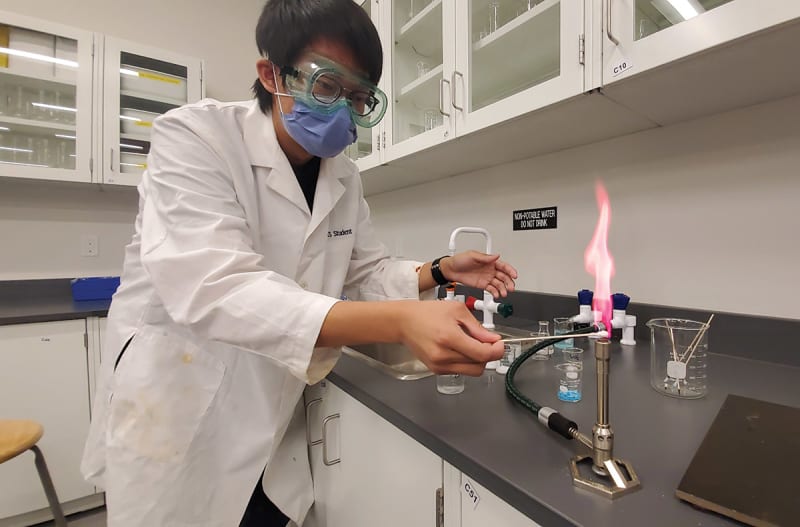
UTS students are equipped for a challenging academic curriculum and actively seek it. “Our enriched and accelerated program is designed for students who are looking for more than the standard curriculum,” says Foster.
“They thrive here because they are ready to grapple with difficult content,” says Strimas. “It allows them to keep pushing themselves. It’s incredible when you go into a classroom because it’s almost like sparks are going off around the room.”
The families we spoke with agreed. “Before visiting UTS, I knew about their focus on academic excellence, but when we visited and met the teachers and saw the various classrooms, I started to appreciate the innovation mindset, the research mindset, and the hands-on approach to learning,” says one parent. “It became clear how much they organize learning around curiosity and innovation, which intrigued us even more.”
From Grade 7 on, students take up to 10 courses per year, allowing them to complete courses at the next grade level in certain subjects. “Our students fulfill academic requirements that surpass provincial criteria, adding breadth and depth to their learning,” says Wan. In the end, they can earn a UTS Diploma and, optionally, an AP Capstone Diploma in addition to the regular Ontario Secondary School Diploma.
The rationale, says Wan, is for students to take courses in a wide range of subject areas at a high level before turning away from any potential pathway. By graduation, UTS expects students to have a Grade 12 credit in three of four broad subject areas: the humanities, arts, STEM, and languages. This structure allows students to make informed decisions about their next steps. “It results in exponential personal and intellectual growth that prepares them for advanced post-secondary programs,” says Wan.
The UTS languages program is worth describing in some detail, as the parents we spoke with found it both unique and valuable. First, every student must take Latin in Grade 8. “When I heard about this, I questioned the need for a course in a dead language,” says one parent. “The staff helped me understand that it’s about students starting from scratch together in learning something new. They put a lot of thought into it, just like they did with the design of the whole academic program.”
Strimas says the Latin requirement is just another way that UTS gives smart students opportunities for growth. “These kids crave the experience of tackling difficult, sometimes frustrating, new challenges. Latin is hard, and they have to build grit and lean on each other. There’s a certain pride in that, and we hear them making jokes in Latin in the hallways.” The consistent popularity of the Classics Club (see Extracurriculars) is further evidence that many students in fact relish the challenge.
Second, unlike the provincial curriculum requirement of just one high school French credit, the school expects students to earn a Grade 12 credit in one of five languages: French, German, Mandarin, Spanish, or Latin. It’s part of UTS’s dedication to preparing students for citizenship in a globalized world.
Another key difference in the academic program is that courses run the full year, rather than being separated into two semesters. “It keeps students immersed in each subject, so they have time to absorb the material and take advantage of all the complementary co-curricular opportunities like trips, guest speakers, and performances,” says Wan. “It also minimizes the loss of knowledge and skills that can happen when students are away from a subject for months at a time.”
Managing academic responsibilities that extend beyond the norm is part of UTS student life. “Reaching ahead [...] requires not just academic competence but strong skills in areas such as time management,” says Lee. The students we met acknowledged these pressures but insisted they’re worth it. “I know I have much more to do than my friends from other schools,” says one Grade 9 student. “But I didn’t feel as challenged at my former school.”
The UTS Advanced Placement (AP) program is a central vehicle for students wanting to capitalize on the school’s enriched academic offerings. They can choose from among a full range of AP courses, complete the Seminar & Research Certificate, or go all the way and earn the AP Capstone Diploma. Along the way, they can leverage U of T research and faculty connections, and some even publish their research findings in academic journals. A significant proportion of senior UTS students choose the AP pathway.
At a time when artificial intelligence is disrupting every facet of education, UTS is confronting the transformation proactively and on multiple fronts. The school established a Director of AI Integration to help teachers assess if, when, and how AI tools can enhance student learning. More recently, the school created a new role: a Director of Learning, Ethics and AI, who will support pedagogy, faculty development, and research related to emerging technologies. These investments come at a time when guidance and policy on AI in secondary schools are scarce at best.
The school also hosts ongoing AI-focused educational events for staff, families, and students, often featuring leading experts from U of T. “We’re able to access the finest minds to help guide us in these emerging areas,” says Foster.
“We’re doubling down on our commitment to embracing technological change while ensuring that the calibre of academics and learning at UTS isn’t compromised. We have a lot of conversations about ethics and academic integrity with our students. They’ll remain deep critical thinkers because we’re serious about not letting the cognitive downloading associated with AI happen in this building. We’re UTS. We don’t take shortcuts.”
Academic culture and support
You might think that bringing more than 600 academically exceptional students together in one building would result in fierce academic rivalry. But UTS has managed to create an atmosphere where mutual support and what many students, alumni, and parents call “friendly competition” prevail.
Everyone we spoke with acknowledged that UTS students tend to be highly motivated in academics. “There’s a drive in these students,” says one parent. Foster agrees, saying “their love of learning often comes with a love of achieving.” Not surprisingly, UTS students frequently earn national and international recognition in academics, research, and innovation.
Some alumni reflected on former classmates who struggled with perfectionism, but most agreed that the UTS environment was inspiring. “It felt like a very positive thing when the students around me were working hard, so I wanted to work hard too,” says one recent graduate.
The school cultivates an academic culture based on mutual support and respect through programs such as peer tutoring. “We all want to do our best, and we’re very ambitious,” says one Grade 11 student. “But the pressure is often internal, not about bringing other people down.”
Students arriving at UTS are often used to being at the top of their class in their previous schools, so when they find themselves among others with the same abilities, it can be an adjustment. “Some kids respond well to that change and thrive, while others might have some difficulty initially,” says Lee.
The parents we met described how the happiness and ease their children felt in being with similarly motivated peers generally outweighed the challenges of this transition. “Even for gifted students, the sheer volume of work can be tough,” says one parent of a Grade 7 student. “But at the same time, he enjoys being with like-minded kids.”
Another parent of one current student and one graduate explained UTS’s personalized academic support system through the examples of her two children with markedly different learning styles and needs. “We talk about academic rigour at UTS, but it’s not rigour without due attention to pace, capacity, and the unique skills and talents of individual learners,” she says. “With both of our kids, the school helped them find ways to overcome their limitations and learn how to learn. We’ve seen the magnitude of the impact this support has had on their academic success.”
To ensure this success, the school provides individualized support and skill-building when needed. This could involve occasional one-on-one help from teachers before or after school, workshops on time management and study habits with guidance counsellors, peer tutoring, or an accommodations plan developed with a Learning Strategies teacher for students with an identified learning difference.
“Every student passes rigorous academic tests to be at UTS, so none of them are below grade level,” says Foster. “But some have uneven learning profiles, meaning they could be well beyond their grade level in one subject but at their grade level in another.” Whatever their needs or goals might be, UTS meets them where they are with enrichment or support.
Pedagogical Approach
Extraordinary students need extraordinary teachers. It’s a simple truth that plays out in every UTS classroom. “When we’re hiring, we look first and foremost for subject matter experts,” says Foster. “Our teachers need to know their material. But no teacher can know everything, so we also look for people who are intellectually curious and always learning alongside their students.”
Every UTS community member we spoke with emphasized the outstanding calibre of the teaching staff, frequently pointing out the unusually high number of staff members with postgraduate degrees. Four members of the school’s senior leadership team alone have PhDs. “In my professional journey, I’ve been incredibly inspired by the educational leaders who work here now, or did so in the past,” says Strimas. “I always hoped I would end up at UTS.”
The parents we met had nothing but praise for the teachers’ level of dedication and the innovative teaching methods they use to keep their very bright students not only challenged but interested and attentive. “They bring a high level of expertise, but also of originality, in the way they tackle curriculum, field trips, and approaches to learning,” says one. Another says, “They’re very deliberate about the kinds of teachers they hire because this isn’t your regular student cohort. They learn differently and ask different types of questions.”
UTS students tend to be knowledgeable, quick to learn, and independent-minded. “Our teachers curate experiences that invite a very high level of engagement and agency from students,” says Strimas.
Our conversations with students and alumni demonstrated that all these efforts pay off in the classroom. “The teachers are really flexible,” says one Grade 11 student. “If you ever feel like you aren’t challenged in class, they’re willing to try to figure out something that will.” One graduate says, “We were never limited by what was in the textbook or what was in the curriculum. There was always a desire in teachers to help students learn and explore outside of those limits.”
Several alumni also commented on the strong, trusting relationships between teachers and students, which sometimes extend beyond graduation. “It’s amazing how kind these teachers can be and how good about yourself they can make you feel,” says one alum. “I think that’s one of the reasons why I was so willing to reach out to them for help whenever I needed it. Even now, I keep in contact with a lot of UTS teachers.”
While UTS doesn’t have an explicit character education component in its academic programming, teachers embed this learning throughout the curriculum, says Foster. “We believe strongly in the importance of character education, but we don’t tend to bring in third parties to do this work separately from the day-to-day. It’s part of how teachers interact with students every day.”
Among the many so-called “soft skills” UTS teachers cultivate in students, self-awareness, self-regulation, and communication are paramount. “We’re clear and explicit with them about how to communicate with clarity and listen actively,” says Strimas. “We also emphasize the concepts of civil discourse, especially how to engage with different perspectives and challenging ideas in a way that upholds our shared humanity.”
One parent who holds a leadership role in the parent association was excited to tell us about a recent school-wide initiative focused on ethical leadership. “Essentially, it involves a variety of programming inside and outside the classroom that teaches students about becoming good global citizens who give back to society,” she says.
Even with their packed curricular, co-curricular, and research schedules, UTS teachers find time for one-on-one meetings with students and parents. “They’re very accessible for extra-help sessions outside class times,” says a Grade 12 student. According to parents, it’s easy to book time apart from scheduled parent-teacher nights to discuss students’ progress. “They’re absolutely available when you feel you need a little more feedback on your child,” says one.
Another parent sums it up like this: “UTS teachers are people that you can tell are there because they love to teach, not just for a job.”
Eureka! Research Institute
The Eureka! Research Institute at UTS supports teachers’ continuous improvement in the classroom while enabling students to participate in research on education. Founded in 2017, the institute links UTS with partners at U of T and the Ontario Institute for Studies in Education. Teachers, students, university faculty members, and researchers co-design projects that explore the latest best practices in teaching and learning.
The aim, says Foster, is to bring innovative, research-based educational practices into the classroom. “We’re fortunate to be one of the very few schools in Canada to have a permanent, on-site research program in partnership with a university,” she says.
One of the institute’s many benefits is that it gives students hands-on research experience. A few students we met were involved in ongoing projects, including participating in a cultural exchange with a Tokyo school hosted by Eureka! in partnership with U of T’s Centre for the Study of Global Japan. Other global collaborations have connected UTS with researchers in Shanghai, Copenhagen, and Frankfurt to better understand effective teaching practices across different cultural contexts.
Recent research has examined environmental sustainability, along with learning and assessment strategies in the age of AI.
University Preparation
There was consensus in our conversations with alumni, students, and parents that UTS gives students a unique advantage in the university transition process. For one, a web of connections links UTS with the University of Toronto. “I feel like a university student already,” says one Grade 10 student, echoing a sentiment we heard from several others. One parent told us her daughter “basically lives at Robarts Library” outside of school time.
Apart from being physically situated within the campus of the country’s top-ranked university, students also benefit from multiple educational and research collaborations between the two institutions. U of T professors often visit UTS classrooms to deliver in-depth talks in their areas of expertise. Faculty members also partner with UTS teachers and students on research projects through UTS’s Eureka! Research Institute. “Our relationship with U of T creates all these enrichment channels for students,” says Strimas. “So, there isn’t a firm line between the end of high school and the start of university because our students are already experiencing post-secondary life in many ways.”
The numbers tell an impressive story about the success of UTS graduates. A quarter of students go on to attend elite institutions in the U.S. and U.K., with the rest attending Canada’s leading post-secondary schools. According to a graduate we spoke with at Harvard, it’s easy to find UTS alumni at Harvard and other illustrious institutions in the Boston area.
But there’s more to the story than the statistics. Parents we spoke with want prospective families to know that it’s all right if their child doesn’t want to be a doctor, engineer, or lawyer. “I chose UTS by looking at the breadth of university majors that recent graduates took,” says one parent. Nearly 60% of 2025 graduates chose STEM programs, and 16% opted for business, while 24% pursued expressive arts, humanities, and social sciences. “You could have a very musical child or athletic child who excels academically, and they could go here and learn from amazing people,” she says. “It’s a well-rounded school that opens up so many opportunities.”
UTS students take their university applications very seriously, and so does the school. By Grade 12, the accelerated academic program creates space in students’ timetables, freeing up time to work on leadership roles and co-curricular activities that can be pivotal to securing competitive post-secondary offers. This is also when students take AP exams, on which their average scores consistently exceed provincial and global averages.
In our conversations with alumni, several say they found the transition to first-year university less challenging than many of their peers from other schools. “I honestly haven’t felt the level of growth going into university that I felt at UTS,” says one.
In the end, graduates take diverse and sometimes winding paths to success, maybe in part because of the wide scope of their learning at UTS. One graduate we spoke with studied chemistry and classics as an undergraduate at Yale, prompting one of the college’s deans, himself a UTS alum, to call it “a very UTS thing to do.” We also learned that students here are rarely content with a single degree, not surprising given their appetite for discovery.
Wellness
UTS is committed to ensuring that academic excellence doesn’t come at the expense of students’ well-being. The school has a comprehensive network of professionals dedicated to supporting students’ social-emotional, physical, and mental health.
“Our students are high achievers, but that doesn’t mean that some of them don’t have exceptional needs,” says Foster. “Though we don’t feel the need to label everything, we know that neurodivergence often comes along with this type of student. Not only is this accepted and normalized by staff and students, but we have very strong supports in place for students with exceptionalities.”
Whether it’s autism, ADHD, learning disabilities, or mental health concerns such as anxiety, UTS helps students manage their challenges and build on their strengths. The support team includes half a dozen guidance counsellors, three social workers and a nurse, not to mention student-led groups such as the Wellness Committee and a chapter of the mental health organization Jack.org.
Students told us that mental health is “huge” at UTS, expressing an awareness and appreciation that there are many trusted adults in the building ready to listen and support them. “You know that they’ll always be there for you,” says one Grade 10 student.
Teachers model and teach well-being strategies in the classroom, while formal guidance classes explicitly build skills that foster stress management and positive mental health. “We’re all involved in one big, consistent, collaborative effort to mitigate behaviours such as unhealthy perfectionism, which we see a fair bit in this student population,” says Lee. Requiring physical education through Grade 11, rather than only through Grade 9 as mandated provincially, further promotes health and resilience.
The parents we spoke with described their confidence in the wraparound care afforded to their children at UTS. “Everyone’s eyes and ears are open, keeping a close watch on the kids,” says one parent of two students. “It’s true from the principal down to school security. It’s an academically rigorous school, but no student is going to get lost. There’s a big safety net there to catch them if anything is bubbling up in terms of distress or conflict.”
Nancy Dawe, Vice Principal, Student Experience, says her team works closely not only with classroom teachers but also with parents. “Families are often the first to raise concerns about their children’s well-being with the school, and we follow up with the right connections. But students can also easily self-refer for one-on-one counselling with a guidance counsellor or social worker.”
Dawe says she’s noted a steady decline in stigma among students related to help-seeking around social and emotional health concerns. “The increase in our drop-in appointments indicates that it’s become much more normalized for kids. The barrier we’re still facing is with some families who are reluctant for their children to talk about their mental health.”
To help overcome this attitude, UTS offers a variety of virtual and in-person educational programs for parents about youth well-being. A recent panel session included members of the UTS support team and former students discussing issues such as healthy coping strategies. “One big fear that some parents have is that their child is the only one struggling with something,” says Dawe. “We want them to know that this is definitely untrue, even if our robust confidentiality policies might make it appear this way.”
In our conversations with parents, they shared stories of UTS staff quickly and effectively managing their children’s one-time or ongoing difficulties. “I have two kids, an introvert and an extrovert with very different preferences and challenges,” says one. “They’re both doing well because the school supports them as the whole kids they are.”
Extracurriculars
For an intensely academic school, UTS offers students a wide variety of co-curricular programs designed both to complement and counterbalance their formal education. The myth that UTS is all work and no play dissolves quickly after a few conversations with students, alumni, and teachers. “I feel like some people think UTS is this place where you come to just take a million courses and learn everything,” says one Grade 10 student. “But it’s more of a place where you learn who you are and what you want to do with your life.”
The school gives even the youngest students the autonomy to choose and launch interest-based activities. There are typically around 100 clubs led by students and supported by teachers. Having students at the helm of co-curricular activities aligns with the school’s mandate to nurture their independence and leadership. One parent says the school helps students rise to high expectations and prepare for post-secondary education by treating them “like little adults.” “There’s a lot of emphasis on giving agency to the kids as leaders of their co-curriculars.”
“There’s this bravery around taking risks in our students,” says Strimas. “They come to us with big ideas, and we help them understand all the different moving parts, diverse perspectives, and logistics of getting things off the ground. We’re very transparent with them when they run into big challenges. We want them to understand the complexity of the world, and co-curriculars are a great way to do that.”
In other words, says Foster, “UTS students learn leadership by practising leadership. We provide guidance and feedback, but they learn by doing.” A couple of days before our visit, the school hosted the student-run Southern Ontario Model United Nations conference, Canada’s largest model UN conference.
The parents we met spoke of a common pattern where younger UTS students, caught up in the infectious energy of a highly motivated and engaged student body, tend to sign up for many clubs, sports, and performing groups on arriving at the school. “My son joined about 10 things and quickly realized it wasn’t sustainable, so he now focuses on about four core activities,” says one parent.
Whether they’re refining their debating skills, practising musical performances, perfecting a work of art, or training for an upcoming game, UTS students are all in on co-curriculars. Their exceptional energy and dedication are evident in the long hours they devote to school life outside the classroom. “We’re talking about students who commute hours to school each day but still come in early and stay late by choice,” says Wan.
Kollins says UTS students are just as driven to excel in their co-curricular activities as in their academics. “At some schools, they have to make co-curriculars mandatory or push the kids to get involved. Here, it’s the opposite. They’re passionate and hard-working, so sometimes they take on too much. We nurture their interests but also have a system that ensures co-curricular leadership roles are well distributed.”
In our conversations with alumni, they affirmed the necessity of this system and the limits it imposes. “It’s about making sure students balance all their commitments, and it works pretty well,” says one graduate, who was school captain and held several other prominent co-curricular roles at different times.
Parents expressed their admiration for the quality, not just the quantity, of co-curricular options at UTS. “There are some top-tier opportunities,” says one, noting that one of her daughters recently travelled to Copenhagen for an exchange as part of the UTS Global Citizenship Program. Real-world learning is critical in this program, which enables students to participate in international partnerships and exchanges where they can immerse themselves in new languages and cultures. Students also travel extensively for academic competitions, mostly in math, science, and business.
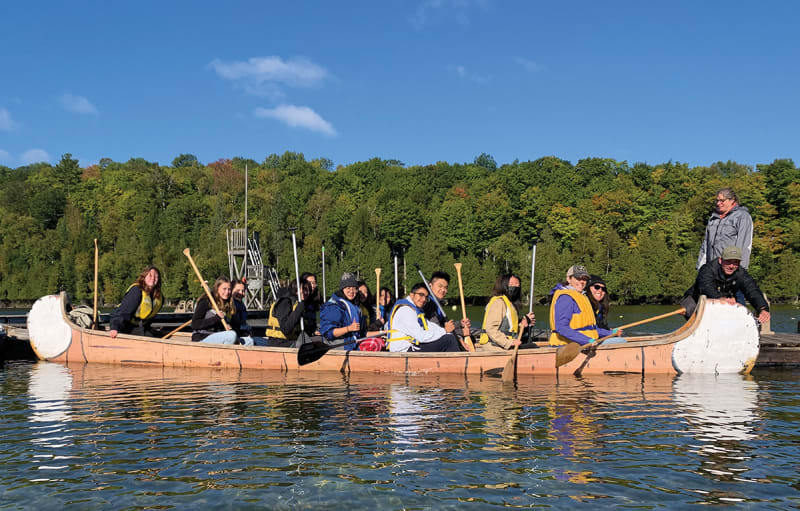
There are multiple outlets for experiential learning at UTS. Students build on their classroom lessons by visiting the rich cultural and historic sites in Toronto or taking excursions to cities such as Ottawa, London, New York, and Washington. They also explore nature through UTS’s outdoor education program, which brings them to Ontario camps where the focus is on fun, games, and friendships but also on team-building, mentorship, and leadership. When asked about their best memories of UTS, several alumni spoke of these camping experiences. “Those are the moments where you feel like you’re bonding with the school community as a whole,” says one.
Every year, Grade 12 students accompany Grade 7 students to a camp where the new students get to know each other, and the older students hone their leadership abilities. It’s one example of how the school uses co-curricular programming to develop students’ leadership abilities. Others include the Buddy System between Grades 7 and 11 and peer-to-peer workshops led by trained student facilitators.
Service learning is integral to UTS’s co-curricular programs, which help students gain the 60 hours of community service required for the UTS Diploma. “Some of our clubs have longstanding community partnerships, such as the Best Buddies program that pairs UTS students with students from a local school who have developmental needs,” says Kollins. There’s also the Bridge Project, where UTS students volunteer as English-language tutors for refugee and newcomer children in collaboration with the Afghan Women’s Organization.
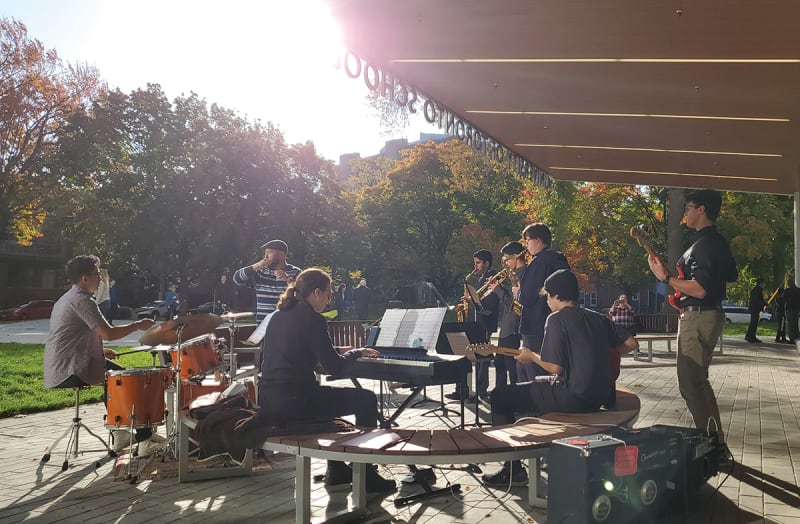
The arts figure prominently in the school’s co-curricular life. The Café features diverse vocal and instrumental performances, followed by Jazz Night. Each January, the annual student-run production, simply called Show, draws the UTS community together. “It’s big, with about 20% of the school participating,” says our student tour guide. “Most students do it at least one year they’re at UTS, and some do it every year.”
The music program is a jewel in the UTS crown, according to the people we met. “It’s one of our stand-out programs, even though there’s no requirement for students to have musical training for admission,” says Wan. “At the same time, we also welcome accomplished musicians, including many who have completed the highest levels of conservatory training and some hoping to go to Juilliard. They come together with students who are relatively new to music in various ensembles and demonstrate leadership and mentorship.” The school has a composer-in-residence program and collaborates with the Scarborough Philharmonic Orchestra through its artistic director and former music teacher Ron Royer.
Regarding athletics, UTS community members made a point of correcting a mistaken belief among some people outside the school. “I think they downplay the role of sports here because we’re known for being so academic,” says one Grade 12 student. “But sports are a big part of students’ lives.”
In fact, at least half of all UTS students play on a competitive team at one point in their school career, says Kollins. “It’s a myth that UTS doesn’t have a strong athletics program. It’s an important part of school life. We’ve had some really good teams over the years in volleyball, badminton, track and field, and skiing.” The UTS Blues (named after the U of T Blues) compete at the city, regional, and provincial levels.
While some teams grow and dwindle along with student interest, there are opportunities for students of any ability to join an intramural or competitive team in most sports. “While it’s harder to get on our volleyball or soccer teams, kids have more of a chance of making many teams here than in some big, competitive public schools,” says Kollins.
Student Body and Diversity
Diversity and inclusion are among UTS’s top values, and the student body proves the school is walking the talk. Nearly 25% of students receive needs-based financial aid totalling more than $3.6 million per year, opening the doors to families from a broader range of socioeconomic backgrounds. “I like that students come from a lot of different backgrounds and have different life experiences,” says one Grade 11 student.
Parents expressed their appreciation for the socioeconomic diversity of UTS families, suggesting that it makes for a less intimidating and more vibrant school community. “Some other schools we visited had a bit of an aura in terms of generational wealth and legacy connections to the school,” says one. Another parent says, “I believe there’s some value in kids growing up with people from a wider spread of socioeconomic status, and that’s part of the reason we chose UTS.” According to one graduate, “UTS families are generally working families who want their children to get an exceptional education. We have some students who come from very wealthy backgrounds, but that’s not our culture here.”
A scan of the hallways reveals significant racial and ethnic diversity among students, but the senior school leaders we spoke with say there’s more work to be done in this area. “We want to ensure our students are representative of Toronto’s population, so we’re actively reaching out to groups who have been historically underrepresented at UTS,” says Foster, adding that Black and Indigenous families are among these groups.
For now, UTS promotes diversity and inclusion initiatives across the student experience. “At some schools, it can feel like a top-down effort,” says Nasreen Khan, Head of Anti-racism, Equity, Diversity, Inclusion and Outreach. “Here, it’s multifaceted, running through all our departments, and driven by students and staff.”
The school conducts an annual equity survey of students to collect demographic data and ask about their experiences at UTS. “We’re committed to collecting data to understand how students with different identities are feeling, so we can respond effectively in terms of equity initiatives,” says Khan. “It’s been very encouraging to see from the survey results that the sense of belonging is going up among students from marginalized communities.”
Khan says the curriculum continues to evolve to incorporate wide-ranging perspectives in students’ assigned reading, research sources, and project topics. School-wide events invite students to learn about and honour multiple identities. A few weeks before our visit, a team of students, staff, and guest speakers organized the UTS Day of Pink. “It was like a celebratory block party, where students could choose from among a dozen age-appropriate workshops on topics such as 2SLGBTQ+ history, poetry, and theatre organized by community organizations and teachers,” says Khan.
The school culture promotes respect for and celebration of all identities. To set the tone and clarify expectations from the start, Grade 7 students participate in an anti-racism workshop. “We have a big internal norm of being inclusive here,” says one Grade 12 student. “If we hear someone say something that’s not okay, there’s accountability among students to call it out.” The school has even developed a way for students and staff to confidentially report incidents of harassment and discrimination, called the Stepping Forward Tool. “It’s modelled on a tool that many universities have,” says Khan.
In our discussions with students from a variety of grades, they agreed that the tool is a good thing but is rarely used and said there’s broad cohesion across the student body (with the typical issues that crop up in teen social dynamics). “There’s a strong sense of community here that’s a lot more inclusive than you would find in other schools,” says one Grade 10 student.
To boost that feeling of belonging among Black and Indigenous students and families, UTS runs the Community Connections program. A few times each year, members of these historically underrepresented groups at UTS come together virtually or in person to share experiences, discuss opportunities, and ask questions. Students gather for games and conversation in one space, says Khan, while parents and caregivers congregate in another for informal discussion. At certain times of year, the program invites prospective and incoming families to join to ask questions and forge new friendships.
When asked about their fondest memories of UTS, alumni most often mention their friendships. “Maybe it’s because we spent so many hours together commuting and on co-curriculars, or because we stayed together for six years instead of moving for high school,” says one grad living in the U.S. for graduate school. “But every time I go back to Toronto, meeting up with my UTS friends is mandatory, and it always will be.”
Kollins says he’s observed these fast and lasting bonds develop over his nearly two decades at UTS. “This is a great place for students who might not fit in at other schools to find their niche.” Strimas agrees, saying, “For a lot of kids that haven’t found their place in other spaces, they come here, and they do.”
Strimas adds that students’ shared enthusiasm around learning and discovery creates fertile ground for friendships and fun. “Some people may think the school would be this very stressful environment due to the academic demands, but in fact it’s this very joyful environment, because students are all coming to it with the same energy in the same way.”
According to Lee, he’s seen a shift in the student body ever since he joined UTS. “I’m very proud of the fact that the day-to-day culture has improved from being sometimes more heads-down in the books. We have a lot of introverted, highly focused, highly academic kids, and we’ve put an emphasis on creating more of a sense of community and connectedness among them.” From what we observed and heard from students and other UTS community members, these efforts are succeeding.
Like most independent schools, UTS further enhances ties among students through a House system that features friendly rivalries in events such as intramurals, a track and field day at U of T’s Varsity Stadium, seasonal competitions like pumpkin carving and gingerbread house decorating, and – the student favourite by far – House Island Day at Centre Island each June.
Getting in
The UTS “brand,” as some parents described it, was well known to most of the families we spoke with if they grew up in Toronto. Others learned about it through word-of-mouth during their school search, while a small subset set an ambition for their children to attend the school very early on. “It was my dream for my children since before I got pregnant,” says one parent. Similarly, some parents told us the only independent school they would consider sending their child to was UTS, so they didn’t apply elsewhere.
Most of the parents we spoke with say they were strongly influenced by their knowledge of UTS alumni’s success. “We knew people who had graduated from UTS, and we felt like they stood out throughout their whole career,” says one. Another echoes this sentiment, “Our admiration for UTS alumni—how they think about the world and the kinds of careers that were enabled by their secondary school experience—turned us on to the school.”
One of the biggest attractions, something all the families we met highlighted, is the school’s bursary program. Whether they access financial support or not, parents told us it creates a school culture that balances academic excellence with equity, diversity, and inclusion.
UTS distributes more than $3.6 million in bursary funds each year to nearly 25% of students, and those numbers are on the rise thanks to the growth of the bursary endowment through alumni and family contributions. “The bursary is the equalizer,” says Drake, noting that it covers between 5% and 100% of tuition, depending on students’ financial situations. “It allows students to thrive. Not just the ones on the support, but all students because we can bring some of the brightest and most curious students together.”
In addition to the tuition bursary, students receive a supplemental bursary covering the same percentage of fee-based class trips and co-curricular activities such as travel for athletic and academic competitions. Drake says the school is particularly proud of this extra support, since these costs can add up and restrict students’ capacity to participate in the full life of the school.
“For my family, it wouldn’t have been possible for our two kids to attend UTS without the bursary support,” says one parent, who relies on 50% coverage. “We’ll be forever grateful. If or when I’m ever in a position to return and pay forward that gratitude, I plan to do it because the school deserves it. They’re changing lives with that kind of support.” Families reapply for bursary support each year, and families who have never received support in the past can apply at any time if their financial situation changes.
A third-party financial services firm handles the bursary application process in parallel with the academic application process. While the latter is similar to other independent schools, it has unique features in keeping with UTS’s high academic standards. All applicants must complete the UTS Entrance Test, which focuses on English and math skills. Based on their test results, along with a thorough review of school reports and teacher references, they may be invited to the next stage for interviews and a group task.
“We select between one-third and one-half of our candidates for interviews, and we only interview students, not families, because our process assesses the students’ abilities,” says Wan. The school has adopted the Multiple Mini Interview format used for medical school applicants, which involves a series of short, structured interview stations that assess a variety of skills and competencies. More than 100 UTS alumni volunteer to help conduct these interviews.
About 100 students start Grade 7 each year, with around 22 new students joining in Grade 9. The overall acceptance rate for these entry years is around 20%. A handful of spots are available in Grades 10 and 11, depending on attrition. Every student must be living in the GTA with a parent or guardian, a policy that Wan says is necessary due to the need for strong, wraparound student support. “This is a very demanding environment, and we need families to provide the support at home while we deliver it at school.”
Parents
Our conversations with UTS parents revealed that families have varying levels of direct involvement with the school but share enthusiasm about supporting its mission of academic excellence and inclusion.
The UTS Parents’ Association is large and highly active for a school of this modest size. “We’re a diverse team,” says one member of the association’s executive. “We make sure that the group has diversity in ethnicity and diversity of thought so that we can best represent everyone’s interests.” Members sit on committees aligned to the school’s priorities, such as wellness and anti-racism.
While a core group of parents invests considerable time in ongoing leadership roles in the association, others put their names on a list for occasional, short-term volunteer involvement. “Not everyone can make a substantial time commitment, but our parents show up when they’re needed,” says one member. While a fair assumption might be that a commuter school would have less parent volunteer engagement, the opposite is true. “Parents are looking for connections with the school and with other parents,” says another association member.
There are social events each year that bring together families from each grade for picnics, dinners, or drinks. Some families build on this through informal channels. “We started inviting parents to come visit for a while at pickup time after our son’s birthday parties, and other parents did the same,” says one parent.
The association keeps all UTS families informed of the latest happenings through a regular newsletter and grade-specific WhatsApp groups. “We actively reach out regularly to all parents to invite them to virtual and in-person speaker series and presentations about timely topics related to education and youth, such as mental health, social media, and the rise of AI,” says one member.
Recently, the school collaborated with the Parents’ Association on a panel discussion about student well-being that explored the impact of parental academic pressure. It’s an issue that several UTS community members raised in our meetings, pointing to the minority of UTS parents who sometimes place excessive expectations on their children. “We’re always working with both students and parents to offer information about healthy versus unhealthy standards of excellence, and how to find balance,” says Dawe.
For incoming UTS families, the Parents’ Association supports an orientation program that includes social activities for students and parents. “After the whole group portion of the event, we break people up by geography, not grade, because we’re a commuter school,” says one member. “It’s a quick way to get to know the UTS families in your area.”
One of the Parents’ Association’s central contributions to the school is the Summer Experiential Program, where parents working across different industries and fields welcome UTS students into their workplaces for short- or long-term placements. The association also holds a Dragons’ Den-style innovation grant competition where students present their ideas and requests for funding.
Alumni
UTS alumni are powerful and enthusiastic ambassadors for the school. Some stand out in very public ways, including one Fields Medalist, two Nobel Laureates, 21 Rhodes Scholars, and 55 Order of Canada recipients. Others are leaders and pioneers in their fields, while many quietly uphold UTS’s traditions of excellence, equity, and global citizenship in their personal and professional lives.
Graduates tend to sustain both their UTS friendships and their ties to the school itself. “Our alumni community is cohesive,” says Drake. “It’s a strong community that cares about the school and current students. I just returned from a Vancouver branch event where we had a 50-year age span of graduates, and they were all making these incredible connections.”
In speaking to several alumni, we learned that they tend to stay connected to their classmates no matter where their post-secondary education or careers take them. “We have grade representatives that organize events and keep us all in touch, and we get together every holiday season,” says one graduate studying in Boston.
Drake, who often attends alumni reunions and branch events, says UTS alumni not only show up for special gatherings but also give their time and financial resources to support the school’s ongoing success. “When the school lost funding from U of T in 2010, alumni came forward to advocate and donate. Thousands of alumni contributed to the Building the Future campaign, which fully renovated and expanded the building. And our alumni are absolutely passionate about giving to our bursary program.”
Graduates also give back to UTS by volunteering at events and at speaking engagements, as well as participating in the Branching Out program, which engages students with alumni to consider a wide variety of higher education programs and careers.
The UTS Connects networking platform enables alumni to reconnect with old friends, post jobs or search for them, or promote businesses. “We just tend to be a really close-knit group,” says one recent graduate. “It’s true during our time at UTS but also after graduation.”
Whether the next steps are around the corner at U of T or at universities around the world, UTS graduates share a bond that spans time, distance, and even generations, starting with a love of learning, a curiosity turned into a passion, and a lasting desire to make a difference in the world.