University of Toronto Schools KEY INSIGHTS
Each school is different. University of Toronto Schools's Feature Review excerpts disclose its unique character. Based on discussions with the school's alumni, parents, students, and administrators, they reveal the school’s distinctive culture, community, and identity.
What we know
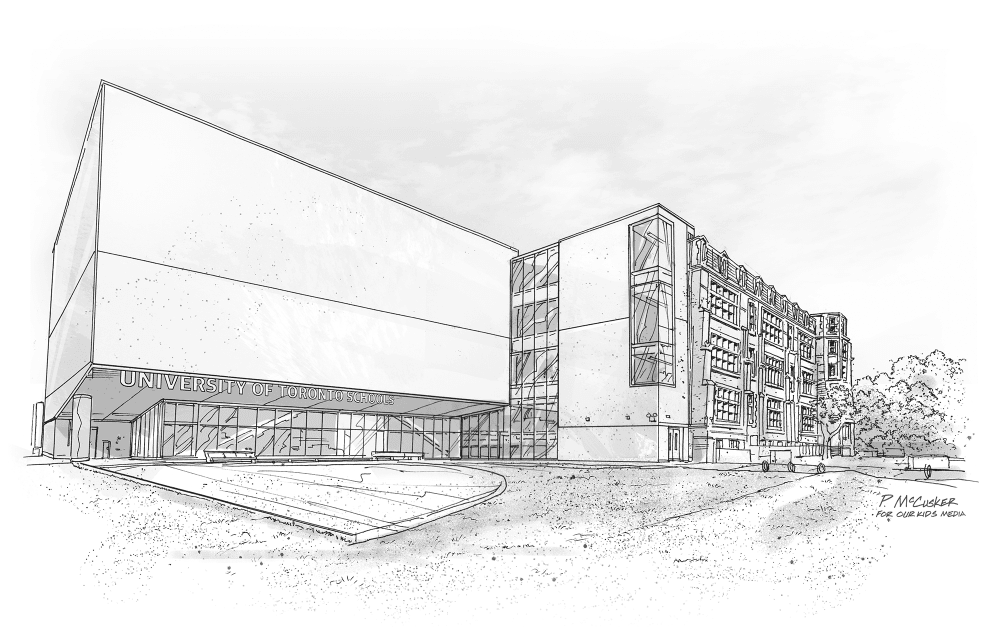
- The enriched and accelerated academic program at UTS is designed for students who are equipped for and seeking a challenge.
- UTS is committed to reducing admission barriers for academically qualified students, providing nearly 25% of families with needs-based financial aid.
- A formal 50-year affiliation with the University of Toronto makes UTS distinctive among Canadian independent secondary schools, offering students access to U of T facilities and faculty expertise.
Our editor speaks about the school
Handpicked excerpts
University of Toronto Schools (UTS) is synonymous with academic excellence, yet it offers so much more than that. It’s a place where high-achieving students can push their intellectual exploration to new heights in the classroom. It’s also a place where kids can pursue their passions and try out new interests outside the classroom, all in an environment that fosters inclusion, autonomy, and balance.
“While this is a fast-paced school where students have a demanding course load and multiple co-curricular involvements, there’s a lot of joy here because they genuinely love to learn,” says Principal Leanne Foster. Many UTS community members we met were eager to dispel the misconception that students spend all their days heads-down with their studies. “The UTS ethos is about far more than academic success,” says one parent. “Doing well in academics is cool here, but so is students defining themselves through activities such as music, arts, robotics, or athletics.”
Make no mistake, though, this is a school with rigorous academic expectations that attracts students from families who deeply value education. The stellar reputation of the school and its alumni draws exceptional kids willing to commute from across the Greater Toronto Area. As one parent says, “There’s a culture of pride here.” UTS occupies a distinctive place in Canada as the country’s only independent, merit-based preparatory secondary school affiliated with a university.
THE CURRICULAR PROGRAM
UTS students are not only equipped for a challenging academic curriculum but also seek it. “Our enriched and accelerated program is designed for students who are looking for more than the standard curriculum,” says Foster.
“They thrive here because they want to grapple with difficult content,” says Jill Strimas, Vice Principal, Learning and Innovation. “It allows them to keep pushing themselves.”
From Grade 7 on, students take 10 courses per year, allowing them to complete courses at the next grade level in certain subjects. “Our students fulfill academic requirements that surpass provincial criteria, adding breadth and depth to their learning. This results in exponential personal and intellectual growth that prepares them for advanced post-secondary programs,” says Charline Wan, Director of Admissions. In the end, they can earn a UTS Diploma and AP Capstone Diploma in addition to the regular Ontario Secondary School Diploma.
“Reaching ahead [...] requires not just academic competence but strong skills in areas such as time management,” says Royan Lee, Head of Senior and Middle School. To ensure students’ success, the school provides individualized academic support and skill-building when needed.
THE ACADEMIC ENVIRONMENT
You might think that bringing more than 600 academically exceptional students together in one building would result in fierce academic rivalry. But UTS has managed to create an atmosphere where mutual support and what many students, alumni, and parents call “friendly competition” prevail.
Everyone we spoke with acknowledged that UTS students tend to be highly motivated when it comes to academics. “There’s a drive in these students,” says one parent. Some alumni reflected on former classmates who contended with perfectionism or family expectations, but most agreed that the UTS environment was inspiring. “It felt like a very positive thing where the students around me were working really hard, so I wanted to work hard too,” says one recent graduate.
The school cultivates an academic culture based on mutual support and respect through programs such as peer tutoring. “We all want to do our best, and we’re very ambitious,” says one Grade 11 student. “But the pressure is often internal, not about bringing other people down.”
THE AFFILIATION WITH U OF T
Beyond a formal 50-year affiliation agreement, a web of connections links UTS with the University of Toronto. The school sits right on campus and UTS students can access library and athletic facilities. “I feel like a university student already,” says one Grade 10 student, echoing a sentiment we heard from several others. One parent told us her daughter “basically lives at Robarts Library” outside of school time.
Apart from being physically situated within the campus of the country’s top-ranked university, students also benefit from multiple educational and research collaborations between the two institutions. U of T professors regularly visit UTS classrooms to deliver in-depth talks in their areas of expertise. Faculty members also partner with UTS teachers and students on research projects through UTS’s Eureka Research Institute. “Our relationship with U of T creates all these enrichment channels for students,” says Strimas.
UNIVERSITY PREPARATION
When it comes to the success of UTS graduates, the numbers are impressive. But there’s more to the story than the statistics. A quarter of students go on to attend elite institutions in the U.S. and U.K., with the rest attending Canada’s leading post-secondary schools. Nearly 60% of 2025 graduates chose STEM programs, and 16% opted for business, while 24% pursued liberal arts, humanities, expressive arts and social sciences.
Parents we spoke with wanted prospective families to know that it’s all right if your child doesn’t want to be a doctor, engineer, or lawyer. “I chose UTS by looking at the breadth of university majors that recent graduates took,” says one parent. “You could have a very musical child or athletic child who excels academically, and they could go here and learn from amazing people. It’s a well-rounded school that opens up so many opportunities.”
UTS students take their university applications very seriously, and so does the school. By Grade 12, the accelerated academic program creates space in students’ timetables, freeing up time to work on leadership roles and co-curricular activities that can be pivotal to securing competitive post-secondary offers. It’s also the time for AP exams, where UTS students consistently score above provincial and global averages.
In the end, graduates take diverse and sometimes winding paths to success, maybe in part because of the wide scope of their learning at UTS. One graduate we spoke with studied chemistry and classics as an undergraduate at Yale, prompting one of the college’s deans, himself a UTS alum, to call it “a very UTS thing to do.” We also learned that students here are rarely content with a single degree, not surprising given their appetite for discovery.
CO-CURRICULAR PROGRAMS
For an intensely academic school, UTS offers students a rich variety of co-curricular programs designed both to complement and counterbalance their formal education. The myth that UTS is all work and no play dissolves quickly after a few conversations with students, alumni, and teachers. “I feel like some people think UTS is this place where you come to just take a million courses and learn everything,” says one Grade 10 student. “But I feel like it’s more of a place where you learn who you are and what you want to do with your life.”
The school gives even the youngest students the autonomy to choose and even launch interest-based activities. Some years, there are up to 100 clubs, not to mention competitive and intramural sports teams.
Garry Kollins, Vice Principal, Student Life, says UTS students are just as driven to excel in their co-curricular activities as their academics. “They’re passionate and hard-working, so sometimes they take on too much. We nurture their interests but also have a system that ensures co-curricular leadership roles are evenly distributed.”
The exceptional energy and dedication of UTS students are evident in the long hours they devote to maximizing all aspects of their student experience. “We’re talking about students who often commute hours to school each day but still come in early and stay late by choice,” says Wan. Whether they’re practising musical performances, perfecting a work of art, training for an upcoming game, or refining their debating skills, UTS students are all in.
THE STUDENT BODY
Diversity and inclusion are among the school’s top values, and the student body proves the school is walking the talk. Nearly 25% of students receive needs-based financial aid, totalling more than $3.6 million per year. “I like that students come from a lot of different backgrounds and have different life experiences,” says one Grade 11 student.
Parents also expressed their appreciation for the socioeconomic diversity of UTS families, suggesting that it makes for a less intimidating and more vibrant school community. “Some other schools we visited had a bit of an aura in terms of generational wealth and legacy connections to the school,” says one.
A scan of the hallways reveals significant racial and ethnic diversity among students, but the senior school leaders we spoke with say there’s more work to be done in this area. “We want to ensure our students are representative of Toronto’s population, so we’re actively reaching out to groups who have been historically underrepresented at UTS,” says Foster, adding that Black and Indigenous families are among these groups.
For now, UTS promotes diversity and inclusion initiatives across the student experience. The curriculum continues to evolve to incorporate wide-ranging perspectives, and the school culture promotes respect for and celebration of all identities. “We have a big internal norm of being inclusive here,” says one Grade 12 student. “If we hear someone say something that’s not okay, there’s accountability among students to call it out.”