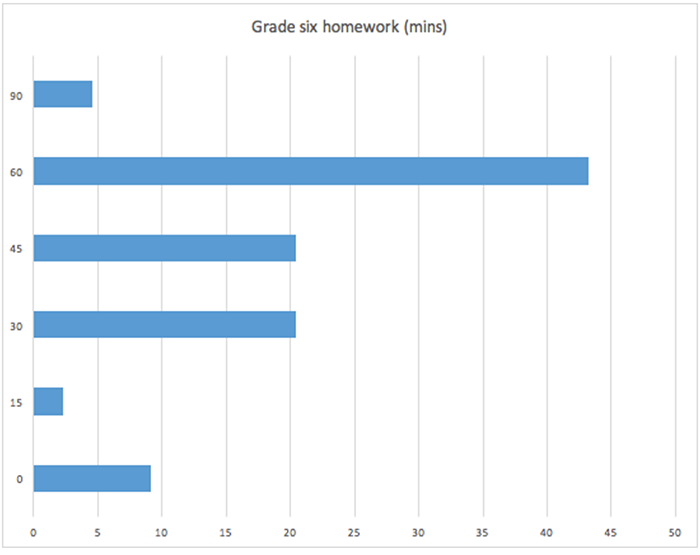
Figure 1: Distribution of homework amounts in Grade 6 among schools featured on OurKids.net.
There’s a longstanding debate over homework. Should school‑age children receive it? From which grade? And how much is appropriate? Opinions vary widely.
On one side, traditionalists argue that homework reinforces learning, ideally starting in Grade 1 and increasing over time.
Progressives, by contrast, argue that homework is often ineffective and that early grades in particular should have minimal or no homework.
Understanding this debate can help you assess the homework policy of any prospective school—and whether it aligns with your family’s values and your child’s needs.
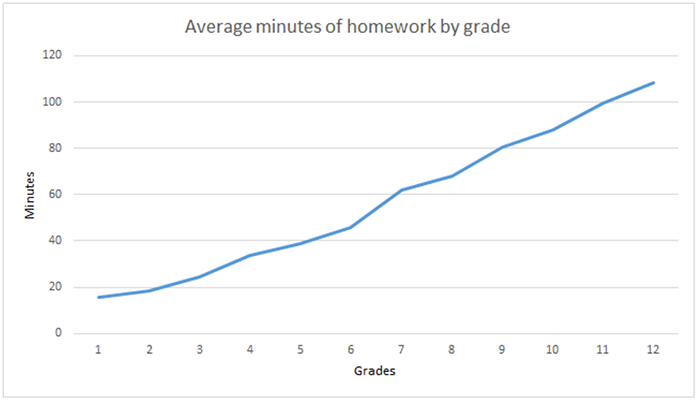
Figure 2: Average homework assigned by grade among schools on OurKids.net.
Contents
The case for homework
Supporters claim that well-designed homework is integral to learning and skill development.
In Cultural Literacy (1987), E. D. Hirsch argues that homework allows students to revisit classroom lessons, reinforcing them outside class time to aid retention and deeper understanding.
Practicing basics—like multiplication tables or geography—helps embed foundational knowledge. Homework gives that extra time to revisit and strengthen learning.
Michael Zwaagstra, a homework proponent, compares academic habits to other disciplines: a pianist practices scales, a basketball player rehearses drills. Similarly, academic skills demand consistent practice.
“Basic skills like grammar, spelling, and multiplication tables require drill … Learning to begin projects, to problem-solve on one’s own … must be nurtured early via homework. Barr (2007)”
Beyond academics, homework can build study habits, self-discipline, and organization.
Arguments for homework:
- It reinforces classroom learning and helps consolidate concepts.
- It provides a chance to practice new skills and deepen understanding.
- It develops self-discipline, time management, and study routines.
- It allows for independent inquiry and exploration beyond class.
- It opens opportunities for parent engagement in learning (without taking over instruction).
- It helps children learn to manage tasks and responsibilities over time.
Critics argue that when homework is poorly designed, it becomes busy work—not meaningful learning. The counter is not to eliminate homework entirely, but to assign it intentionally.
“The best way to address the homework issue is for teachers to assign meaningful tasks—skills and concepts recently learned—rather than busy work. (Zwaagstra, 2009)”
Among schools listed on OurKids.net:
- 84 % begin homework by Grade 1 or earlier.
- 9 % delay homework until Grade 7 or later.
- 5.6 % assign no homework at all at any grade level.
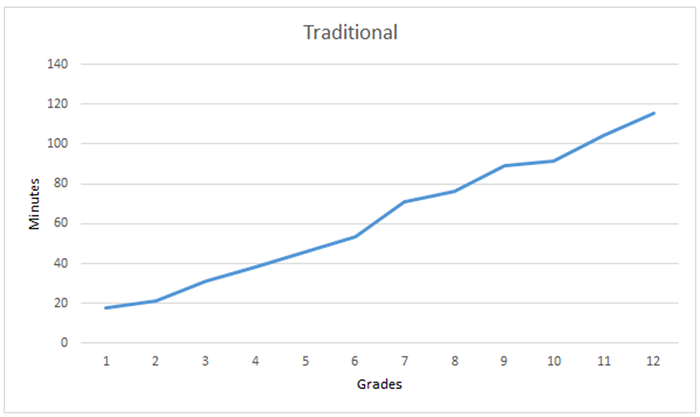
Figure 3: Average homework by grade in traditional schools (OurKids.net).
The case against homework
Many educators and parents question whether homework is beneficial—especially in early grades.
Critics argue it can undermine motivation, create stress, and intrude on family time. In The Homework Myth, Alfie Kohn contends these negative effects outweigh purported benefits.
According to Kralovec and Buell in End Homework Now, homework often compresses family time and burdens parents with enforcement concerns.
“Homework squeezes family life. Parents have educational agendas for their children. They want to pass on their cultural heritage, religious beliefs, and important life skills. They want to teach their children how to be good citizens and how to share in the responsibilities of running a home. More homework makes parents put their own agendas on hold even as they often struggle to help their children cope with homework assignments. Additionally, families need time to constitute themselves as families. According to a 1998 survey by Public Agenda, nearly 50 percent of parents reported having a serious argument with their children over homework, and 34 percent reported homework as a source of stress and struggle. Parents often have conflicting feelings about homework, viewing it as a way for their children to succeed but also as imposing serious limits on family time.
Zwaagstra (2009), meanwhile, tries to address this kind of claim:
Perhaps the most specious and troublesome claim is that homework takes away time for more valuable activities for students, such as exercising or talking to parents. Using the University of Michigan Institute for Social Research data—often quoted by homework opponents—one quickly finds that the average television viewing for school-aged children is more than two hours a day. If there is anything that takes time away from constructive childhood activities, it is watching mindless television programs. (One wonders whether homework opponents plan to encourage governments to pass laws that restrict the number of hours that children are permitted to watch television during weeknights.)
A 2007 OISE study in Ontario found that many parents question the utility of homework. They cite lack of feedback, excessive quantity, and poor alignment with class work. The effect on family dynamics is a recurrent concern.
Arguments against homework:
- It may encroach on time for rest, play, and family.
- Often, homework is repetitive or not meaningful.
- Evidence of its effectiveness—especially in early grades—is weak.
- High loads can lead to frustration, burnout, and diminished love of learning.
- It places pressure on families and can exacerbate inequality (not all homes have equal support).
Critics note that some teachers use homework to shift instructional burdens onto parents, rather than ensuring mastery in class time.
Recent research on homework
What does empirical evidence say? Results are mixed and context‑dependent.
The Duke homework study
One influential study by Harrison Cooper’s team reviewed 60+ studies (1987–2003) and found that homework correlates with academic gains—but only under certain conditions.
For elementary students, the study found minimal impact. In middle school, student outcomes improved until homework reached 1–2 hours nightly. In high school, performance correlated with homework up to about 2–3 hours per night.
This supports a “sweet spot”: too little homework yields modest gains; too much becomes counterproductive.
Critiques of the Duke study
Some, including Kohn, argue that the conclusions are weak. For younger students, the link between homework and performance is often negligible. For older students, the correlation fades with better statistical controls.
The study also focuses heavily on grades, leaving out other educational goals—motivation, creativity, well-being, and long-term study habits.
What the research suggests:
- At elementary levels, homework shows little academic return.
- In middle/high school, homework can help—within moderation.
- There is a threshold beyond which extra homework becomes counterproductive.
- Feedback and meaningful design amplify homework’s value.
- Homework’s effects on attitudes, habits, and equity remain under-researched.
Homework in public schools
As you compare schools, check whether the public school system in your area imposes homework guidelines.
Homework policies in public schools may be constrained by district rules or board policies, unlike in private schools, which have more autonomy.
Example: TDSB homework policy
The Toronto District School Board introduced a homework policy (April 2008) limiting nightly homework: up to one hour in Grades 7–8, two hours in high school. It also barred homework over holidays and removal of penalization for late work.
The change drew both praise for easing burden and criticism for slowing class progression—some advanced students felt under-challenged as class time absorbed material previously assigned as homework.
Homework in Canadian private schools
In private schools, homework policies vary widely, reflecting each school’s educational philosophy. Unlike in public systems, private schools are free to set their own rules.
Private schools often fall into two camps: traditional (pro-homework) and progressive (minimal homework).
Traditional private schools
These schools typically emphasize academic rigour. They follow a structured curriculum and regularly assign homework, increasing complexity and time with each grade.
Progressive private schools
Progressive schools—like Montessori, Waldorf, or Reggio Emilia—tend to de-emphasize homework. They focus more on exploration, inquiry, and student-driven work, sometimes eliminating homework entirely in early grades.
Classroom flipping
Some progressive schools adopt a flipped classroom model: students do reading or reflection at home, and hands-on, project work in class. Though popular in higher education, this approach is still being tested at lower levels.
In our survey, about 20.3 % of featured schools employ classroom flipping.
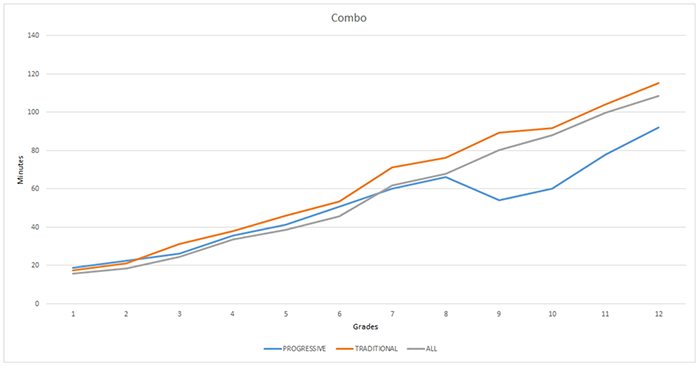
Figure 5: Comparison of assigned homework between traditional and progressive schools.
Guidelines for evaluating a school’s homework policy
The research is unsettled—but certain qualities distinguish strong homework policies. Understanding them helps you evaluate whether a school’s approach will suit your child.
First, ask whether the school has a formal homework policy. If not, find out if individual teachers or programs have one.
Request a copy—you should be able to review how homework is assigned, monitored, and integrated with teaching. The policies should balance rigour and well-being.
Characteristics of effective homework policies
- Homework should be purposeful: reinforcing or extending class learning, not busywork.
- It should be differentiated to meet varying student needs, including learning accommodations.
- Teachers should provide feedback promptly—written or oral—to guide improvement.
- Homework time should be reasonable, e.g. ~1 hour/day in lower grades, 1–2 hours in middle, and no more than 2–3 hours in high school.
- Assignments should grow gradually each grade—perhaps 10 extra minutes per grade.
- Parents can support learning, but should not carry the burden of teaching homework.
- Homework shouldn’t require resources or technology that students lack access to.
- Expectations should be clearly communicated before leaving school each day.
- Homework tasks should not require extra instruction beyond class time.
- When feasible, offer homework support or help sessions.