
The 2026 OUR KIDS Private School Expo is coming to cities near you. Get your family pass
From STEM to STEAM: seeing the “art” in science
It’s STEAM, not STEM, and it’s the new focus many schools are taking to ensure students receive a well-rounded education.
With the ability to be nimble, Montreal’s private schools are shaping programming that goes beyond the regular curriculum—creative, innovative, and increasingly interdisciplinary.
As families explore options, it can help to compare schools by age and stage—private elementary, middle, and high school—and then narrow based on program strengths, language pathways, and the kind of support a child needs.

At the Trafalgar School for Girls, for example, seeing the “art” in science is one way of turning STEM (science/technology/engineering/math) into STEAM. The school’s inquiry-based learning approach, along with a longstanding collaboration with McGill University, is seen as a hallmark, says Nadine Paree, associate director of admissions at the school affectionately known as “Traf.”
(In fact, “we exist because of McGill,” she explains. “In 1887, they wanted to encourage more women to go to university and needed a school to prepare them for post-secondary.”)
“The thing that makes us unique and different is that we are small; we’ve been a liberal-arts type school. We’re very big on inquiry-based learning. We’re very big on community. We have a close tie with McGill University; we have a collaboration with them, we’re often doing research projects with them, with our students,” she says.
“We’re very into multidisciplinary projects, so the English department works with the math department, which works with the science department, and they put together these really cool and interesting projects,” she adds. “Our girls really find their voices and understand how to take their space and own their space.”
At Traf, “I always say that we were doing STEM before STEM was a thing,” Paree adds. “We have all the names, from the beginning of the school, on plaques, who have graduated with honours from McGill, and you see science, science, technology ... by empowering women, no matter what generation it is, it creates that innovation where they’re going to go into these disciplines and learn and advance things.”
Teachers brainstorm and offer up ideas, including one who said, “Art is science; there is no part of art that doesn’t have an element of science to it. She has a project that looks like an art project, but it’s all about science. A lot of the girls who made it were very rigid with grades, and they really let loose on this project ... their creativity flowed. The way they looked at it was different because they were letting themselves be more open and less number-driven. We do a lot of (innovating) like that.”
Why curriculum breadth matters in the private school decision
It’s that kind of deep understanding—and the opportunity to enrich lessons—that often leads families to consider private education.
“They are looking at curriculum gaps in the public sector,” says Michael Hayes, founder and CEO of education consulting firm SchoolAdvice. “Private schools lay out curriculum that they can see ... the other option they’re looking for is diversity in terms of choice in curriculum, a school that will have a good arts program or good athletic program, and that’s something that makes each private school unique.”
“If you’re looking at going into performing arts, that’s one of the reasons many students want to get into St. George’s School of Montreal—they’ve got a great liberal arts program, they’ve got a great theatre group,” and they have produced a number of high-profile graduates, he adds.
Some families also compare program pathways using broader resources on public and private education, and by reviewing how schools perform across the city in Montreal private school rankings.
Building pathways: added courses, enrichment, and flexibility
At Kells Academy, STEAM is also a focus, and biology was added as an option, as it is not part of the Quebec curriculum. “We know that many of our students will be going to our Grade 12 and then on to Ontario or B.C. or someplace like that for university—it’s a feature of Kells that is (unique),” and a need that families identified, says high school principal Tom Malone.
The school also provides math support and enrichment. “Typically we have a contingent of kids who are working one year ahead of everybody else and students who struggle in math. There’s a range that we can accommodate for sure,” he says.
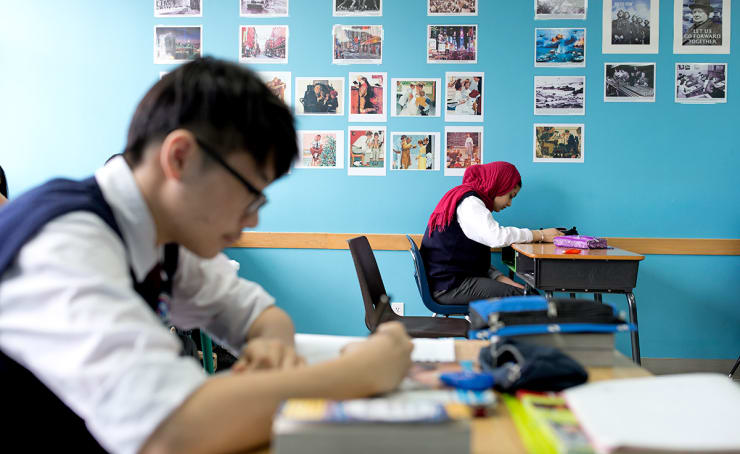
Kells features three levels for both English and French—enriched, regular, and ESL—and additional levels for those new to English or French, serving its international population.
For one English-speaking Montreal family, their son’s French was not top-of-the-class, but his interest in it was, and he was placed on the enriched side. “It was not because he is the best at French, but because he has a willingness to learn the language,” says Kevin, who himself attended private school as a child. “The staff do a really good job of recognizing student interest,” on top of ability.
“It’s a great approach to keep students engaged, because if everybody is learning the same thing, and you’re not getting it—or you get it too quickly—there needs to be something more.”
Kells sets aside a 90-minute weekly period for a “flex” enrichment class during the high school day, which includes a choice of chess, cinema/film studies, drama, math, sports, robotics, and yoga.
Students enrolled in the Grade 12 program, which uses the Ontario curriculum, must also complete 10 hours of volunteer work. (In Ontario, students who study the entire four years of the curriculum are required to do 40 hours.)
For families evaluating fit, it can also help to use child-centred guides on how a child’s traits shape school choice, including interest areas such as the arts and STEM.
Bilingual fluency and holistic programming across Montreal private schools
At The Study, students learn in both official languages, with “a unique, dual mother tongue program,” says Lindsay Woods, director of advancement, marketing and communications at the all-girls school. That means students are not “learning French as a second language; they’re learning French in tandem with their English curriculum.”
In elementary school, students spend a day learning in English and another in French, “so they’re developing both streams, which is really unique,” and brings benefits in the two languages, she adds.
“It’s not just bilingualism, but it’s fluency, and understanding French culture, understanding French language, understanding thinking in French, thinking in two languages.”
For families specifically interested in bilingual pathways, language-focused options can also include language immersion and related programming models across Montreal private schools.

For Kevin, parent to two sons—his youngest at an all-boys school and the other at co-ed Kells Academy—his eldest is in enriched English, “which is great, he loves to read. But even being in that enriched environment, there are things that he wants to do more of, and the teachers are still facilitating that side of it as well. It’s a great option when you have classes that are that small—you can really tailor things a bit more to the student.”
He also likes that Kells is growing its athletic offerings for students, on top of the academics, and that is part of the holistic development private schools are nurturing.
At Trafalgar, the school also offers extra support periods in the calendar, as well as activities where all clubs meet, to fit students’ schedules.
“It’s a long day, and they need to have a work-life balance,” says Paree. “We don’t want our students constantly doing schoolwork, because there’s academic growth and there’s personal growth. They’re learning how to become adults, so they need to have both of those.”
The school has built-in times twice a week when teachers are in the school and available, just to give students a classroom to work on group projects in or seek homework help if needed. At the elementary level, curriculum support is often led during class, with smaller breakout groups.
For Kevin’s elementary-aged son, his teacher pulls three to four kids together to focus on the same curriculum but with approaches targeted to their needs. “It’s great to have that opportunity to do that,” he says. “I just love that adaptability and curriculum at both schools.”
Families exploring specialized pathways may also look for International Baccalaureate schools, and compare supports for specific learner profiles, including Special needs services and Gifted programming.
Compare Montreal private schools in one place
Many families also use the annual OUR KIDS Private School Expo in Montreal as a step in their school search. By bringing admissions teams from a range of independent schools into one setting, the expo makes it easier to compare programs, ask practical questions about supports and applications, and get a first feel for a school’s culture before booking tours. For parents still refining a shortlist or hoping to compare specialized, faith-based, and university-preparatory options side by side, it can be a good place to begin. Learn more about the Montreal Private School Expo.
List of Montreal private schools
Access school reviews, insights, and comparisons through our comprehensive reports below.
 Montreal, Quebec Rue Sherbrooke/Ave Connaught "College Prep International, a traditional private school in Montreal, offers English instruction with partial French immersion, for grades five to twelve. Its average class size range from 12 to 18 Students." —From the school
|
 Montreal, Quebec "We believe in Girls' Education. Trafalgar offers a strong liberal arts education, a comprehensive STEAM program, a broad and dynamic athletics program and a host of leadership opportunities through clubs and activities." —From the school
|
 Rigaud, Quebec Rue Saint-Pierre/Rue Bourget "Collège Bourget is a day and boarding school located between Montreal and Ottawa. French and English high school programs are offered. Bourget aims to foster personal autonomy, academic development, and perseverance." —From the school
|
 Montreal, Quebec Wellington/Robert-Bourassa "Garderie Bonne Aventure welcomes children ages 6 months to 5 years. We focus on independence and building confidence. Our center has an in-house chef who prepares the meals. We have a very international clientele." —From the school
|
 Kirkland, Quebec Rue Edmond/Ch Ste-Marie "Kuper Academy offers programs from pre-school to Pre-University (Grade 12) in Kirkland. Its average class size is 22 students." —From the school
|
 Westmount, Quebec Mount Pleasant Avenue/Cedar Avenue "Located in Montreal, QC, Miss Edgar’s & Miss Cramp’s School offers a bilingual education for girls from K-12. From entrepreneurship to STEAM, our unique learning environment empowers girls to lead the way." —From the school
|
 Montreal, Quebec De Maisonneuve West/Park Row West "At Kells, flexibility is key. We develop programs allowing students to work within their comfort zone, which may be above, below or at grade level. The result is students who outperform even their own expectations." —From the school
|
 Westmount, Quebec The Boulevard/Place Braeside "The Study, founded in 1915, is one of Canada's premier all-girls' schools. Our bilingual mother-tongue program, experiential learning, and small classes help girls become leaders who are driven to make a difference." —From the school
|
 Montreal / Westmount, Quebec "Our community inspires students to discover joy and passion in their learning, purpose in their lives, and the confidence to express their unique selves in a nurturing, inclusive, and collaborative environment." —From the school
|
 Laval, Quebec Notre-Dame/ "Laval’s only private English high school—no certificate of eligibility required. A launchpad for future leaders, lifelong learners, and thoughtful citizens through strong academics and real-world learning. Grades 7-12." —From the school
|