- Open Day (October 9, 2026)

WMHS is a private high school dedicated to holistic and student-cantered learning environment. Located in the heart of Warsaw, the school offers Pre-IB (Year 9&10) and International Baccalaureate (IB) Diploma Programme (IBDP) (Year 11&12).
The school is built on the key values: respect, fair play, and empathy and blends prestigious and internationally recognised IBDP with the educational philosophy of Maria Montessori emphasising the importance of responsibility for one’s own development.
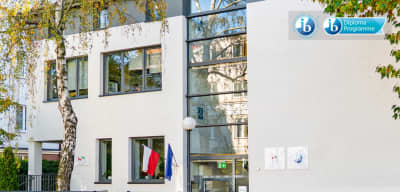
Warsaw Montessori High School (WMHS) is an innovative international high school in Warsaw that combines Dr. Maria Montessori’s educational philosophy with the prestigious International Baccalaureate Diploma Programme (IB DP). As an IB World School since 2020, WMHS offers students a seamless academic pathway from Pre-IB (Years 9 & 10) to the full IB Diploma Programme (Years 11 & 12), preparing them for success at top universities around the world.
The school’s mission is to nurture curious, independent, and responsible young people who develop not only academically but also emotionally and socially. Learning at WMHS is based on trust, self-discipline, and meaningful engagement with the world.
Located at Pytlasińskiego 13a in Warsaw, the campus provides a warm, inclusive, and bilingual environment where classes are taught in English and Polish. Small class sizes, close teacher-student relationships, and a focus on individual growth ensure that each student can fully develop their talents and ambitions.
The IB curriculum at WMHS encourages critical thinking, creativity, and global awareness. Students can choose from a wide range of subjects, including sciences, literature, and social studies. The teaching staff consists of passionate, highly qualified educators who inspire students to take initiative and pursue knowledge with confidence.
Graduates of Warsaw Montessori High School earn an IB Diploma recognized worldwide, equipping them with the academic skills and life values necessary for higher education and beyond. WMHS is a place where education meets purpose, and where every student learns to lead with curiosity, empathy, and integrity.


Gallery showcasing specific locations and facilities found at Warsaw Montessori High School.
Central to your child's school experience is the underlying curriculum taught in the classroom. "Curriculum" refers to both what is taught and how it's taught. When considering the different curricula outlined in the next few pages, keep in mind that few schools fall neatly into one category or another. Most schools' curricula comprise a blend of best practices drawn from multiple curriculum types. Having said that, most schools do have a general overall curriculum type. These are identified for each school on OurKids.net.
Primary Curriculum: Liberal ArtsSuch an approach to curriculum shares with traditional programs their emphasis on core knowledge-acquisition, but tends to borrow more best practices from the progressive approach. The goal isn't to prepare students for vocational life, but rather to encourage an appreciation of the benefits of education itself, including academic and personal development. There is an emphasis on knowledge acquisition as well as theoretical and academic learning, but the real focus is on cultivating the intellect.
Secondary Curriculum: Polish Curriculum (Ministry of National Eduction, MEN), Montessori| Focus |
|---|
| Academic |
| Flexible pacing style | offered |
|---|---|
| Subject-streaming (tracking) | |
| Multi-age classrooms as standard | |
| Ability-grouping (in-class) as common | |
| Frequent use of cyber-learning (at-their-own-pace) | |
| Regular guided independent study opportunities | |
| Differentiated assessment |
| Subject type | offered |
|---|---|
| Learning strategy and study counselling; habit formation | |
| Extra support and minor accommodations for children experiencing subclinical difficulties |
| Subject type | offered |
|---|---|
| Accommodations | |
| Modifications | |
| Extra support |
| Special needs | Accomodations
Formal adjustments are made to the delivery of lessons to help mitigate the learning difficulty or exceptionality. The underlying content and expectations remain unchanged with accommodations, however. (Example: allowing a student to write tests in a quieter room). | Modifications The underlying content and expectations are modified and/or simplified for the sake of the student. (Examples: allowing student to use a calculator on a test when other students can’t; allowing students to bring word-banks or “cheat sheets” into certain tests, etc) | Remediation Research-based therapeutic measures that target and ameliorate the underlying weakness. |
|---|---|---|---|
| Learning disabilities | |||
| ADHD (moderate to severe) | |||
| Dyslexia (Language-Based Learning Disability) | |||
| Auditory Processing Disorder (APD) | |||
| Dyscalculia | |||
| Dysgraphia | |||
| Language Processing Disorder | |||
| Nonverbal Learning Disorders (NLD) | |||
| Visual Perceptual/Visual Motor Deficit | |||
| Developmental | |||
| Autism | |||
| Asperger's Syndrome | |||
| Down syndrome | |||
| Intellectual disability | |||
| Behavioral and Emotional | |||
| Troubled behaviour / troubled teens | |||
| Clinical Depression | |||
| Suicidal thoughts | |||
| Drug and alcohol abuse | |||
| Oppositional Defiant Disorder (ODD) | |||
| Physical | |||
| Dyspraxia (Developmental Coordination Disorder) | |||
| Blindness | |||
| Deafness | |||
| Cystic Fibrosis | |||
| Multiple physical |
| Program | offered |
|---|---|
| Full-time gifted program (parallel to rest of school) | |
| Part-time gifted program (pull-out; parallel to rest of class) |
Curriculum delivery: This information is not currently available.
| Program | offered |
|---|---|
| Custom subject enrichment (special arrangement) | |
| Custom curriculum compacting (special arrangement) | |
| Guided independent study (custom gifted arrangement) | |
| Cyber-learning opportunities (custom gifted arrangement) | |
| Formalized peer coaching opportunities (specifically for gifted learners to coach others) | |
| Custom subject acceleration (special arrangement) | |
| Career exploration (custom gifted arrangement) | |
| Project-based learning (custom gifted arrangement) | |
| Mentorships (custom gifted arrangement) |
In grade Gr. 12, WMHS IB World School students perform an average of 2 hours of homework per night.
| 9 | 10 | 11 | 12 | |
|---|---|---|---|---|
| WMHS IB World School | 60 mins | 60 mins | 120 mins | 120 mins |
| Site Average | 70 mins | 75 mins | 103 mins | 108 mins |
| Grade | 9 | 10 | 11 | 12 |
|---|---|---|---|---|
| Day | zł6,000 / month | zł7,000 / month | ||
This information is not currently available.
| Grades | Gender | Living Arrangement | Enrollment |
|---|---|---|---|
| Gr. 9 to Gr. 12 | Coed | Day School | 80 |
| Total enrollment | 80 |
| Average enrollment per grade | 20 |
| Average class size | Varies |
| Gender | Coed |
| Grades | Gr. 9 to Gr. 12 |
| Boarding offered | No |
| % of foreign students | 25% |
| # of nationalities attending school | 10 |
| 9 | 10 | 11 | 12 | |
|---|---|---|---|---|
| Class Size | 12 | 12 | 20 | 20 |
| Services | Offered |
|---|---|
| Career planning | |
| Internships | |
| Mentorship Program | |
| University counseling |
| Key Numbers | |
|---|---|
| Average graduating class size | 20 |

You are warmly invited to the Open Day at Warsaw Montessori High School, which will take place on Tuesday, October 13, 2026. ...


 POL
POL CAN
CAN