
British curriculum recognized by universities all over the world, an alternative to IB program, offering a comprehensive education at the standard level: IGCSE, and much greater flexibility in choosing subjects at the higher level: A Level. In addition, exams are taken in a modular version (IGCSE every year, A Level every term). Studying in small groups and influencing the choice of subjects stimulates students' interest and arouses their desire to acquire knowledge.
British International School (BIS) is an international high school located in the Sadyba district of Warsaw. Founded in 2014, BIS offers a high-quality education aligned with Pearson Edexcel, AQA, and UCAS standards. The qualifications awarded at BIS are recognized by top universities around the world. The school prepares students for admission to prestigious international universities as well as leading institutions in Poland. Teaching is conducted in small class sizes, allowing for personalized attention and strong academic outcomes – the school boasts a 100% exam pass rate. BIS offers a full range of internationally recognized qualifications, including GCSE, IGCSE, A Level, and International A Level, providing students with the tools and credentials to pursue their academic goals. In addition, university trips give students the opportunity to explore future educational pathways and make informed decisions about their careers.

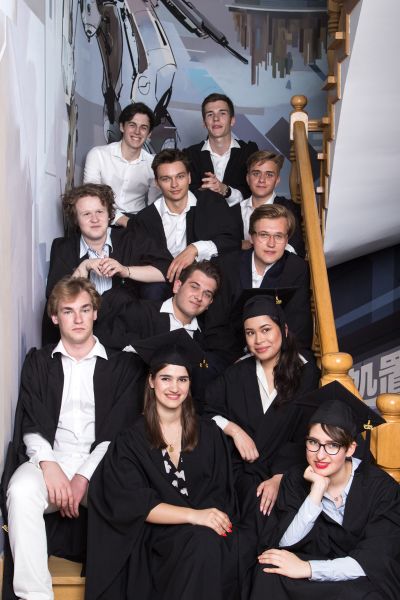
Gallery showcasing school life and general photos of British International School.

Gallery showcasing specific locations and facilities found at British International School.
Central to your child's school experience is the underlying curriculum taught in the classroom. "Curriculum" refers to both what is taught and how it's taught. When considering the different curricula outlined in the next few pages, keep in mind that few schools fall neatly into one category or another. Most schools' curricula comprise a blend of best practices drawn from multiple curriculum types. Having said that, most schools do have a general overall curriculum type. These are identified for each school on OurKids.net.
Primary Curriculum: TraditionalTraditional curricula tend to be very content-based and rooted in the core disciplines. It is a structured approach that involves the teacher delivering a unified curriculum through direct instruction. Uczniowie najpierw zdobywają wiedzę podstawową i teoretyczną, aby później stosować ją w praktyce. Students usually learn by observing and listening to their teacher, studying facts and concepts in textbooks, and completing both tests and written assignments - which challenge students to not only demonstrate their mastery of content but their ability to analyze and deconstruct it critically. Class discussions are also used to create critical dialogue around the content of the curriculum.
Secondary Curriculum: English National Curriculum| Focus |
|---|
| Academic |
| Flexible pacing style | offered |
|---|---|
| Subject-streaming (tracking) | |
| Multi-age classrooms as standard | |
| Ability-grouping (in-class) as common | |
| Frequent use of cyber-learning (at-their-own-pace) | |
| Regular guided independent study opportunities | |
| Differentiated assessment |
| Subject type | offered |
|---|---|
| Learning strategy and study counselling; habit formation | |
| Extra support and minor accommodations for children experiencing subclinical difficulties |
| Subject type | offered |
|---|---|
| Accommodations | |
| Modifications | |
| Extra support |
| Special needs | Accomodations
Formal adjustments are made to the delivery of lessons to help mitigate the learning difficulty or exceptionality. The underlying content and expectations remain unchanged with accommodations, however. (Example: allowing a student to write tests in a quieter room). | Modifications The underlying content and expectations are modified and/or simplified for the sake of the student. (Examples: allowing student to use a calculator on a test when other students can’t; allowing students to bring word-banks or “cheat sheets” into certain tests, etc) | Remediation Research-based therapeutic measures that target and ameliorate the underlying weakness. |
|---|---|---|---|
| Learning disabilities | |||
| ADHD (moderate to severe) | |||
| Dyslexia (Language-Based Learning Disability) | |||
| Auditory Processing Disorder (APD) | |||
| Dyscalculia | |||
| Dysgraphia | |||
| Language Processing Disorder | |||
| Nonverbal Learning Disorders (NLD) | |||
| Visual Perceptual/Visual Motor Deficit | |||
| Developmental | |||
| Autism | |||
| Asperger's Syndrome | |||
| Down syndrome | |||
| Intellectual disability | |||
| Behavioral and Emotional | |||
| Troubled behaviour / troubled teens | |||
| Clinical Depression | |||
| Suicidal thoughts | |||
| Drug and alcohol abuse | |||
| Oppositional Defiant Disorder (ODD) | |||
| Physical | |||
| Dyspraxia (Developmental Coordination Disorder) | |||
| Blindness | |||
| Deafness | |||
| Cystic Fibrosis | |||
| Multiple physical |
| Program | offered |
|---|---|
| Full-time gifted program (parallel to rest of school) | |
| Part-time gifted program (pull-out; parallel to rest of class) |
Curriculum delivery: Acceleration and enrichment (There is an equal emphasis on acceleration and enrichment.)
| Program | offered |
|---|---|
| Custom subject enrichment (special arrangement) | |
| Custom curriculum compacting (special arrangement) | |
| Guided independent study (custom gifted arrangement) | |
| Cyber-learning opportunities (custom gifted arrangement) | |
| Formalized peer coaching opportunities (specifically for gifted learners to coach others) | |
| Custom subject acceleration (special arrangement) | |
| Career exploration (custom gifted arrangement) | |
| Project-based learning (custom gifted arrangement) | |
| Mentorships (custom gifted arrangement) |
In grade Gr. 12, BIS students perform an average of 2 hours of homework per night.
| 9 | 10 | 11 | 12 | |
|---|---|---|---|---|
| BIS | 60 mins | 60 mins | 120 mins | 120 mins |
| Site Average | 70 mins | 75 mins | 103 mins | 108 mins |
| Sports Offered | Competitive | Recreational |
|---|
| Clubs Offered |
|---|
| Foreign Language Club |
| Student Council |
| Grade | 9 | 10 | 11 | 12 |
|---|---|---|---|---|
| Day | zł50,000 | |||
This information is not currently available.
| Grades | Gender | Living Arrangement | Enrollment |
|---|---|---|---|
| Gr. 9 to Gr. 12 | Coed | Day School | 52 |
| Total enrollment | 52 |
| Average enrollment per grade | 13 |
| Average class size | 6 to 12 |
| Gender | Coed |
| Grades | Gr. 9 to Gr. 12 |
| Boarding offered | No |
| % of foreign students | 20% |
| # of nationalities attending school | 10 |
| 9 | 10 | 11 | 12 | |
|---|---|---|---|---|
| Class Size | 10 | 10 | 25 | 25 |
| Services | Offered |
|---|---|
| Career planning | |
| Internships | |
| Mentorship Program | |
| University counseling |
| Key Numbers | |
|---|---|
| Average graduating class size | 20 |

British International School is not just a place to gain knowledge. It is a space where students discover their talents, develop their passions, and build the foundations for future achievements.
We see how each day brings new opportunities: we work with young people who are curious about the world, ready for challenges, and open to collaboration. Our IGCSE and A Level programmes allow them to earn globally recognized qualifications. Most importantly, they prepare students for a life full of choices, values, and fulfillment.
I encourage you to explore our programs and invite you to an introductory meeting, where we can discuss your expectations and how we can be a partner in your child’s development.




 POL
POL CAN
CAN