Embassy International School offer is directed at both the international and local community aged 3-19. Students at EIS represent over 30 different nationalities, and the school's mission is to shape future leaders with a global perspective and intercultural sensitivity who will strive for positive change in the world around them. EIS prepares students for international GCSE and A-level examinations.
Embassy International School is an international school that has been operating on the education market in Cracow for over 10 years.
The school’s offer is addressed to both the international and local communities. Students of Embassy International School represent more than 30 different nationalities, and the school’s mission is to nurture future leaders with a global perspective and intercultural sensitivity — individuals who will strive to bring about positive change in the world around them.
The language of instruction at the school is English. The educational structure is based on four main stages aligned with the British system: Early Years (preschool), Primary School (Years 1–6), Lower Secondary School (Years 7–9), Upper Secondary School (Years 10–13).
EIS prepares students for international GCSE and A-level examinations under the accreditation of three independent British examination boards: AQA, AQA Oxford, and Pearson Edexcel.
In the Primary School (Years 1–6), the school implements the International Primary Curriculum (IPC) — a modern, integrated learning framework based on inquiry, exploration, and experiential learning. In the higher grades, the curriculum is gradually expanded and adapted to meet exam requirements while maintaining a balance between academic subjects, the arts, and personal development.
Additionally, EIS includes a Non-Public Primary School with Bilingual Departments, which offers the Polish national curriculum for Polish citizens and other interested students.
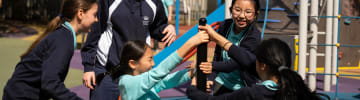
The school is located in a beautiful, peaceful, and green district of Kraków, in buildings situated on Edmund Biernacki Street. The campus includes its own playground, outdoor sports field, and garden. Physical education classes take place both on-site and in modern sports facilities nearby.
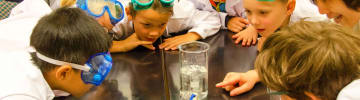
EIS cooperates closely with the Jagiellonian University, the AGH University of Science and Technology, and the Polish Academy of Sciences in organizing workshops, lectures, and laboratory classes.
Every year, the school achieves outstanding examination results, consistently ranking above the average for British and international schools following the British system. EIS students actively participate in both school and extracurricular initiatives such as organizing and attending Model United Nations (MUN) conferences, taking part in sports competitions, and engaging in national and international contests.
The teaching philosophy at EIS embraces a holistic approach to student development — both intellectual and emotional. Teachers work collaboratively, employing a variety of teaching methods that allow each child to develop their individual talents, teamwork skills, and independent thinking.
Gallery showcasing specific locations and facilities found at Embassy International School.
Garden
Playground
Playground
Building C
Building B
Secondary classroom
Secondary classroom
Physics room
Science room
Computer Science classroom
Assembly room
Library
Library
Central to your child's school experience is the underlying curriculum taught in the classroom. "Curriculum" refers to both what is taught and how it's taught. When considering the different curricula outlined in the next few pages, keep in mind that few schools fall neatly into one category or another. Most schools' curricula comprise a blend of best practices drawn from multiple curriculum types. Having said that, most schools do have a general overall curriculum type. These are identified for each school on OurKids.net.
Primary Curriculum: Liberal ArtsSuch an approach to curriculum shares with traditional programs their emphasis on core knowledge-acquisition, but tends to borrow more best practices from the progressive approach. The goal isn't to prepare students for vocational life, but rather to encourage an appreciation of the benefits of education itself, including academic and personal development. There is an emphasis on knowledge acquisition as well as theoretical and academic learning, but the real focus is on cultivating the intellect.
Secondary Curriculum: Academic| Focus |
|---|
| Academic |
| Subject type | offered |
|---|---|
| Learning strategy and study counselling; habit formation | |
| Extra support and minor accommodations for children experiencing subclinical difficulties |
| Subject type | offered |
|---|---|
| Accommodations | |
| Modifications | |
| Extra support |
| Special needs | Accomodations
Formal adjustments are made to the delivery of lessons to help mitigate the learning difficulty or exceptionality. The underlying content and expectations remain unchanged with accommodations, however. (Example: allowing a student to write tests in a quieter room). | Modifications The underlying content and expectations are modified and/or simplified for the sake of the student. (Examples: allowing student to use a calculator on a test when other students can’t; allowing students to bring word-banks or “cheat sheets” into certain tests, etc) | Remediation Research-based therapeutic measures that target and ameliorate the underlying weakness. |
|---|---|---|---|
| Learning disabilities | |||
| ADHD (moderate to severe) | |||
| Dyslexia (Language-Based Learning Disability) | |||
| Auditory Processing Disorder (APD) | |||
| Dyscalculia | |||
| Dysgraphia | |||
| Language Processing Disorder | |||
| Nonverbal Learning Disorders (NLD) | |||
| Visual Perceptual/Visual Motor Deficit | |||
| Developmental | |||
| Autism | |||
| Asperger's Syndrome | |||
| Down syndrome | |||
| Intellectual disability | |||
| Behavioral and Emotional | |||
| Troubled behaviour / troubled teens | |||
| Clinical Depression | |||
| Suicidal thoughts | |||
| Drug and alcohol abuse | |||
| Oppositional Defiant Disorder (ODD) | |||
| Physical | |||
| Dyspraxia (Developmental Coordination Disorder) | |||
| Blindness | |||
| Deafness | |||
| Cystic Fibrosis | |||
| Multiple physical |
| Program | offered |
|---|---|
| Full-time gifted program (parallel to rest of school) | |
| Part-time gifted program (pull-out; parallel to rest of class) |
Curriculum delivery: This information is not currently available.
| Program | offered |
|---|---|
| Custom subject enrichment (special arrangement) | |
| Custom curriculum compacting (special arrangement) | |
| Guided independent study (custom gifted arrangement) | |
| Cyber-learning opportunities (custom gifted arrangement) | |
| Formalized peer coaching opportunities (specifically for gifted learners to coach others) | |
| Custom subject acceleration (special arrangement) | |
| Career exploration (custom gifted arrangement) | |
| Project-based learning (custom gifted arrangement) | |
| Mentorships (custom gifted arrangement) |
| Sports Offered | Competitive | Recreational |
|---|---|---|
| Football | ||
| Basketball | ||
| Gymnastics | ||
| Martial Arts | ||
| Soccer | ||
| Swimming | ||
| Track & Field | ||
| Volleyball |
| Clubs Offered |
|---|
| Judo |
| Foreign Language Club |
| Math Club |
| Outdoor Club |
| Robotics club |
| School newspaper |
| Science Club |
| Student Council |
| Yearbook |
| Yoga |
| Art Club |
| Chess Club |
| Choir |
| Community Service |
| Computer Club |
| Dance Club |
| Drama Club |
| Grade | PS | 0 | 1 | 2 | 3 | 4 | 5 | 6 | 7 | 8 | 9 | 10 | 11 | 12 |
|---|---|---|---|---|---|---|---|---|---|---|---|---|---|---|
| Day | zł3,000 / month | zł4,500 / month | ||||||||||||
This information is not currently available.
| Grades | Enrollment |
|---|---|
| ECS (3 years) to Year 13 | 215 |
| % of foreign students | 60% |
| # of nationalities attending school | 25 |
| PS | 0 | 1 | 2 | 3 | 4 | 5 | 6 | 7 | 8 | 9 | 10 | 11 | 12 | |
|---|---|---|---|---|---|---|---|---|---|---|---|---|---|---|
| Class Size | 12 | 16 | 16 | 16 | 16 | 16 | 16 | 18 | 18 | 18 | 20 | 20 | 20 | 20 |
| Services | Offered |
|---|---|
| Career planning | |
| Internships | |
| Mentorship Program | |
| University counseling |
| Key Numbers | |
|---|---|
| Average graduating class size | 18 |
We are a purpose-driven school that aims to create a world-leading paradigm of education in our community. Our school embraces the model of education where we teach children how to learn and we teach them in ways that are sympathetic to how children develop emotionally and how their brains develop. Our school is committed to a student-centered learning approach with the aim that each child is challenged according to their own individual uniqueness.
Our team of teachers have travelled the globe and have joined us to share their international-mindedness in education. They have brought their expertise, knowledge and passion to lead, inspire and help us create an inclusive learning environment where our vision can be realized