
We want our graduates to be independent, creative, responsible and ready to share their skills, knowledge and talents with others.
We believe that the key to achieving this is developing adequate self-esteem, self-discipline and high emotional and social skills from an early age.
That is why our education supports children in all areas of their development – intellectual, emotional, social and physical.
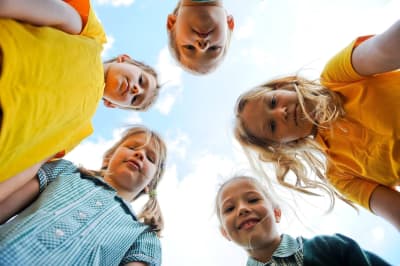
International Montessori Education Center - Międzynarodowe Centrum Edukacji Montessori (MCEM) - comprises a nursery (18–36 months), a kindergarten (ages 3–6), an early primary group (ages 6–9, corresponding to Grades 1–3), as well as further school groups: a primary level referred to as “Upper Elementary” (ages 9–12, Grades 4–6), and an adolescent group for students aged 12–15 (Grades 7–8).
All MCEM settings follow the educational approach developed by Maria Montessori, which makes them distinct from traditional models of schooling. Classes are conducted in mixed-age groups, allowing younger children to learn from older peers, while older students develop empathy and deepen their understanding by supporting and guiding younger classmates.
MCEM delivers the Polish national core curriculum (MEN) within the framework of the Montessori philosophy. The learning process is organized into integrated three-year cycles, covering key areas such as natural sciences and social studies; Polish language, foreign languages, and mathematics; as well as ICT, music, art, and technology, alongside physical education and health and environmental education.
These areas are explored either in a modular way—covered once within a three-year cycle (as in the case of certain science topics)—or progressively, where previously acquired knowledge and skills form the foundation for further learning (as in mathematics). Teaching takes place in an international environment, with English used as one of the languages of instruction.
The teaching staff consists of educators trained in Montessori pedagogy, supporting the educational development of children and adolescents. The school also places strong emphasis on building a sense of community and a supportive learning environment.
Students learn how to organize their work, use a variety of information sources, and present the outcomes of their efforts. Individual work is combined with collaborative activities, supporting the development of both independence and the social skills essential for further education and everyday life.

Central to your child's school experience is the underlying curriculum taught in the classroom. "Curriculum" refers to both what is taught and how it's taught. When considering the different curricula outlined in the next few pages, keep in mind that few schools fall neatly into one category or another. Most schools' curricula comprise a blend of best practices drawn from multiple curriculum types. Having said that, most schools do have a general overall curriculum type. These are identified for each school on OurKids.net.
Primary Curriculum: ProgressiveProgressive (sometimes called "inquiry based" or "discovery based") curricula use students' interests and their natural curiosity as the driver for instruction. Teachers provide materials, experiences, tools and resources necessary for students to investigate a topic or issue. Students are then encouraged to explore, reflect on their findings, and discuss answers, solutions, and insights.
Secondary Curriculum: Montessori| Focus |
|---|
| Academic |
| Subject type | offered |
|---|---|
| Learning strategy and study counselling; habit formation | |
| Extra support and minor accommodations for children experiencing subclinical difficulties |
| Subject type | offered |
|---|---|
| Accommodations | |
| Modifications | |
| Extra support |
| Special needs | Accomodations
Formal adjustments are made to the delivery of lessons to help mitigate the learning difficulty or exceptionality. The underlying content and expectations remain unchanged with accommodations, however. (Example: allowing a student to write tests in a quieter room). | Modifications The underlying content and expectations are modified and/or simplified for the sake of the student. (Examples: allowing student to use a calculator on a test when other students can’t; allowing students to bring word-banks or “cheat sheets” into certain tests, etc) | Remediation Research-based therapeutic measures that target and ameliorate the underlying weakness. |
|---|---|---|---|
| Learning disabilities | |||
| ADHD (moderate to severe) | |||
| Dyslexia (Language-Based Learning Disability) | |||
| Auditory Processing Disorder (APD) | |||
| Dyscalculia | |||
| Dysgraphia | |||
| Language Processing Disorder | |||
| Nonverbal Learning Disorders (NLD) | |||
| Visual Perceptual/Visual Motor Deficit | |||
| Developmental | |||
| Autism | |||
| Asperger's Syndrome | |||
| Down syndrome | |||
| Intellectual disability | |||
| Behavioral and Emotional | |||
| Troubled behaviour / troubled teens | |||
| Clinical Depression | |||
| Suicidal thoughts | |||
| Drug and alcohol abuse | |||
| Oppositional Defiant Disorder (ODD) | |||
| Physical | |||
| Dyspraxia (Developmental Coordination Disorder) | |||
| Blindness | |||
| Deafness | |||
| Cystic Fibrosis | |||
| Multiple physical |
| Program | offered |
|---|---|
| Full-time gifted program (parallel to rest of school) | |
| Part-time gifted program (pull-out; parallel to rest of class) |
Curriculum delivery: This information is not currently available.
| Program | offered |
|---|---|
| Custom subject enrichment (special arrangement) | |
| Custom curriculum compacting (special arrangement) | |
| Guided independent study (custom gifted arrangement) | |
| Cyber-learning opportunities (custom gifted arrangement) | |
| Formalized peer coaching opportunities (specifically for gifted learners to coach others) | |
| Custom subject acceleration (special arrangement) | |
| Career exploration (custom gifted arrangement) | |
| Project-based learning (custom gifted arrangement) | |
| Mentorships (custom gifted arrangement) |
This information is not currently available.
| Grades | Enrollment |
|---|---|
| PS/Kindergarten to Gr. 12 | 150 |
| % of foreign students | N/A |
| # of nationalities attending school | N/A |
| PS | 0 | 1 | 2 | 3 | 4 | 5 | 6 | 7 | 8 | 9 | 10 | 11 | 12 | |
|---|---|---|---|---|---|---|---|---|---|---|---|---|---|---|
| Class Size | 20 | 20 | 20 | 20 | 20 | 20 | 15 | 15 | 15 | 15 |
| Services | Offered |
|---|---|
| Career planning | |
| Internships | |
| Mentorship Program | |
| University counseling |
| Key Numbers | |
|---|---|
| Average graduating class size | N/A |
 POL
POL CAN
CAN