

On this page:
- The history of the school
- Montessori schools in Katowice
- Montessori pedagogy
- Students' abilities and success
- Two curricula
- Command of English
- Teachers
- Educational goals
- Parent involvement
- Extracurricular activities
- Homeschooling
- Why this school?
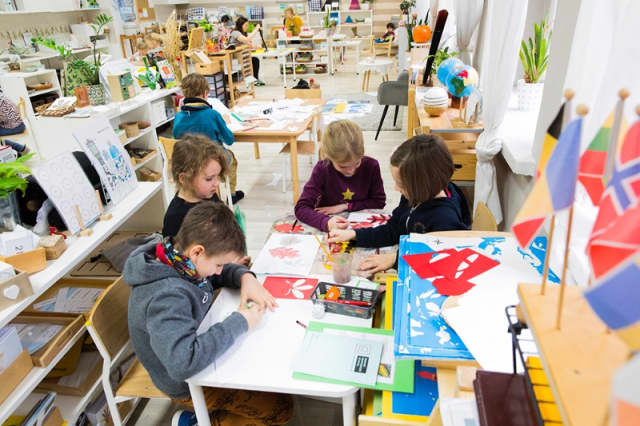
Here is a video of this interview. Below, you can read its transcript:
The history of the school
Our Kids: Please, tell us about the history of the school.
Bronwen Allen: Our school started almost exactly 10 years ago, so we’ve just had our 10th anniversary. We started off back in 2014 with only six children in only the first grade. Now we have 200 pupils, of whom we have 150 on site and 50 in our Home Education Program. That's spread across eight classrooms. We have two preschool classrooms, three lower elementary classrooms for age 6-9, two upper elementary classrooms for 9-12, and one middle school classroom for pupils aged 12-14.
Montessori schools in Katowice
Our Kids: Are there any other Montessori schools in Katowice?
Bronwen Allen: There is another Montessori School in Katawice, but we're the only one which is as bilingual as we are. We're also the only Montessori school in the city that runs the Cambridge International Program, so our pupils are immersed in English the whole day.
Montessori pedagogy
Our Kids: What’s special about Montessori pedagogy? Why did you choose it?
Bronwen Allen: The Montessori pedagogy is something that we're passionate about here. We love the fact that there are mixed-age classrooms, that the program develops soft skills which aren't taught in conventional educational context, social skills, empathy, and cooperation. It's very focused on making sure that children feel good psychologically about coming to school. And we take so much care of the educational process that also brings good results academically for our pupils. For us, it's a great combination of having a bilingual as well as an international program with Montessori that makes our school a great place for children to develop in.
Students' abilities and success
Our Kids: When students go on to other programs, how do they cope?
Bronwen Allen: Very well. We have now released graduates into high schools, and those graduates have coped very well in the new setting of those conventional high schools. They highly appreciate what they had in our school, but they're also thriving in the high school programs they're currently in. One example is my own personal daughter. She attended our program for 11 years, i.e., the whole preschool program and the whole primary school program. Now she's in the second grade of high school and she's flourishing.
Our Kids: So your students have no problems with standardized exams?
Bronwen Allen: No, on the contrary, Montessori graduates are pupils who like learning. They're good at learning. They've learned how to learn independently. So they are high school teachers' dream. Also, Montessori includes exam preparation when it comes to older pupils. In Poland, there is the eighth grade exam when pupils are 14 or 15. And of course, passing an exam is just a life skill - we all pass exams. It's something normal in life that one has to do. Of course, we want to prepare our pupils in all aspects of facing their life after school, as well as taking and passing that eighth grade exam when they're 14-15, at the end of our elementary program, with confidence.
Two curricula
Our Kids: You have two curricula. How do they differ?
Bronwen Allen: We started off building the school around the bilingual program. The basis was the Polish national curriculum, and then we added lots of English on top of that to make it bilingual. We have, for example, a whole team of native speaker teachers in our school that have full-time positions. We decided in the first place that we wanted to build that bilingual program, and that's what we did over nine years. Then we started with the Cambridge International program this school year, so that program is in its first year. It was clearly needed in the local setting because there was the need for international programs for foreigners. There are many foreign families who come to Katowice from abroad. There are many international businesses who invest in the local area, and they want to be able to send the children of their employees from various countries all over the world to an English language program. About 10% of our children and families are from abroad at the moment. It's something that we love, that we have this multicultural environment. We invite those families from all over the world to talk about traditions in their various countries, celebrations, about their culture. That's something we really celebrate.
The bilingual program is simply bigger because we worked on building it over nine years, but we're looking into growing our international program also. The rule in Poland is that when you build an international program, you build it one grade level at a time, one grade level per year. So this year we have the equivalent of the first grade in the international program, and we'll be growing that program year by year over the next few years.
Our Kids: Which of the two curricula is better for students?
Bronwen Allen: I think it depends on the needs of the family. We have some Polish families who really want their child to be a citizen of the world. So they really want their child to have that English language education and then study abroad, maybe work abroad and feel completely comfortable in English. When it comes to foreign families, some of them feel that they will be spending a long time in Poland and they want their children to learn lots of Polish. Then they're interested in the bilingual program. We also have other families who feel they will be in Poland for a short time. They may need to prepare their child to move to a different country in a year, two, three or four. It's important for them to have the English language program.
Command of English
Our Kids: What level of English do the students reach at the end of primary school?
Bronwen Allen: These are comfortably bilingual and fluent pupils, confident in English. They don't have any psychological barriers about speaking. Typically, such pupils can go into English language programs also. For example, some of our pupils then go to a bilingual high school where they take a school leaving exam in English. It obviously depends on what the family wants.
They can comfortably write essays in English. They can comfortably read native-level texts. We actually have a program where pupils read English set texts during their whole school program through to the eighth grade. So they're very comfortable in English all across the board.
Our Kids: Are they capable of succeeding in an IB school?
Bronwen Allen: It's possible for particularly ambitious people and parents, but it's absolutely possible. We have a pupil at the moment who's taking the eighth grade exam and that pupil is planning to attend such a high school program.
Teachers
Our Kids: Who are your teachers?
Bronwen Allen: Our school is still relatively young - we've been on the market for 10 years. So gradually, our staff will age as the years go by. Many teachers just stay with us year in, year out. But we also have many young people. Also in terms of native speaker teachers. These tend to be young people who just want to travel, see different places and experience different cultures. So there's a lot of youthful energy in our school, along with experienced members of staff who've been with us right from the beginning. The main subject teachers are Polish, but we have a team of native speaker teachers. We have many teachers from the continent of Africa - South Africa, Zimbabwe, Kenya, Nigeria. We also have a teacher from Iceland and from Chile. I'm British. We have a feeling of multiculturalism running through the entire school when it comes to both the teachers, the families and the children. That's something that's special about our school and it's important for us. I suppose I would say an important value for us is simply diversity in every shape and form.
Educational goals
Our Kids: What are your main educational goals?
Bronwen Allen: We want children to feel joyful about coming to school. Our motto is the joy of learning for life. We believe children have a natural drive to learn and they can enjoy learning. We want each child to feel just good about being here. We want them to feel like this school is their second home. In each of our classrooms we have lots of interesting learning materials. It's a real hands-on approach to learning. So the children discover the environment guided by their teacher, and we want optimal development for those children. And that's something we believe that Montessori education gives, along with bilingualism, the international program as well.
Parent involvement
Our Kids: Do you involve parents in your school life?
Bronwen Allen: Obviously, parents are crucial to the whole educational process, and we want to fully involve them at every step of the way. So we have a very thorough enrollment process, which involves the parents in information meetings, observing classrooms, open afternoons every month or every other month. We meet with them regularly. We have structured meetings at the end each semester, but if we need to meet them more often, that's also fine. We have family events. In December, we have a winter parent-with-children event. Each June, we have a family event at the end of the school year. We also invite parents for workshops, where we talk about the Montessori approach and also other parenting matters. We always say it's not that we enroll a child in our school, we enroll a family in our school, so we need to see the child in the holistic context of their entire family. And we're very thorough about that, trying to find the right match between the school and the parents' needs, and the child's needs, obviously.
Extracurricular activities
Our Kids: What extracurricular activities do you offer?
Bronwen Allen: We have lots of after-school clubs. We offer swimming, art club, Spanish club, handicraft club. We offer individual piano lessons. There are plenty of different after school activities to choose from.
Homeschooling
Our Kids: Your school offers homeschooling. How does it work?
Bronwen Allen: Essentially, the pupils obviously learn at home and come to school for exams so that we can check if their knowledge meets the knowledge required by the national curriculum. We work hard with these families. Also, if the child has additional needs, the child can come more often to our school for support in that area. We also want to make those exams feel comfortable psychologically for the pupils. It's stressful so we try to make the atmosphere a bit more pleasant. We have a separate waiting area for the parents so they can wait in comfort and support their children. And obviously, we try to make them feel at home in our school.
Why this school?
Our Kids: Why should parents enroll their kids in your school?
Bronwen Allen: At our school we are absolutely passionate about what we do. We just love what we do. We have joy and satisfaction every day from the work we do. It's such a rewarding thing when we've worked with a child over something they find maybe more difficult or challenging, and we see that child succeed. We make every effort to set every child up for success, and it's so wonderful when they just thrive in that environment. So we encourage all parents interested in our offer to get in touch. We'd love to talk with you, let you know more about our program, meet you, whether physically or online. We invite you to consider our school.
People who read this also viewed:
- 6th Private School Expo in Warsaw: Summary, Conclusions, and Key Trends
- Our Kids Interview: Get to know KIDS & Co.
- Our Kids Interview: Get to know FSA School
- Preschools in Warsaw
- Montessori preschools
- Poland education: grade levels
- Private & non-public preschools
- 6th Private School Expo in Warsaw: Summary, Conclusions, and Key Trends
- Our Kids Interview: Get to know FSA School
- Our Kids Interview: Get to know Polish British Academy of Warsaw
- Private bilingual elementary schools in Warsaw
- Private primary schools in Warsaw
- Our Kids Interview: Get to know The English Playhouse and The English Primary
- Social primary schools
- Poland education: grade levels
- Private & non-public primary schools
- Katowice schools
- Montessori schools in Warsaw
- Montessori preschools
- Montessori schools
- Montessori nursery schools
-
Advice Guide
- The admissions process
- what to ask at a private school open day
- Back to school without stress. How to prepare your child emotionally?
- Myths about non-public education. Facts to know before choosing a non-public school
- How to Apply to a Private School in Poland
- School open houses
- About the Cambridge Pathway
- Our Kids Interview: Get to know Cosmopolitan Schools - Wrocław and Kraków (interviews - 2025, 2021, and 2020)
- Our Kids Interview: Get to know The British International School of Wroclaw
- Our Kids interview: Get to know Regent College International Schools
- Third Private School Expo in Warsaw - summary
- Our Kids Interview: Get to know EF Academy Oxford
- Homeschooling
- Boarding schools
- Advantages and disadvantages of studying in an international school
- Private school rankings
-
Grades
- 6th Private School Expo in Warsaw: Summary, Conclusions, and Key Trends
- Our Kids Interview: Get to know English Montessori School Katowice
- Mokotow High School Campus - a new Warsaw high school and Thames British School campus
- Our Kids Interview: Get to know KIDS & Co.
- Choosing a high school in Poland
- Our Kids Interview: Get to know FSA School
- Our Kids Interview: Get to know Polish British Academy of Warsaw
- Private middle schools
- Private bilingual elementary schools in Warsaw
- Private high schools in Warsaw
- Private primary schools in Warsaw
- Preschools in Warsaw
- Our Kids Interview: Get to know The English Playhouse and The English Primary
- Montessori preschools
- Social primary schools
- Montessori nursery schools
-
Locations
- Our Kids Interview: Get to know Sapiens International Innovative Community School
- Our Kids Interview: Get to know Thames British School
- Our Kids Interview: Get to know EF Academy
- Private schools Warsaw
- Our Kids Interview: Get to know The Primary and Secondary Schools of the Sisters of Nazareth in Warsaw
- Our Kids interview: Get to know Excellence in Education better
- Our Kids Interview: Get to know the Canadian School of Warsaw
- Olsztyn schools
- Private schools in Gdańsk & Gdynia
- Private schools in Bialystok
- Private schools in Łódź
- Private special needs schools in Warsaw
- Our Kids Interview: Get to know PRIMUS Non-Public Primary School No. 47 and Non-Public Secondary School
- Private Catholic and Christian schools in Warsaw
- International Baccalaureate (IB) schools in Warsaw
- Private day schools in Warsaw

 POL
POL CAN
CAN