

On this page:
- The school’s history
- The school’s students
- The school’s teachers
- English Language Support
- The school’s curricula
- Graduate destinations
- Extracurricular activities
- The school campus
- The school’s scholarships
- Unique aspects of the school
- Main values and principles
Our Kids is talking to Phil Hart, Head of the British International School of Wroclaw.
The school’s history
Phil Hart: We've been in the market since 2006, and we are the oldest school in the city, offering the British international curriculum. I worked at the school many years ago, for around seven years. During that time, I worked in the primary school initially, and then I went into my area of expertise, which is in secondary—in particular, English literature.
I had a wonderful time working here, and then was fortunate enough to embark on an international teaching career, where I went off and taught in South America, in Asia, in Central Europe, in Switzerland. And then I had the opportunity to return here as the head of school. And I think that speaks volumes to this particular school, to the city, because as soon as this opportunity came about, it was something that I wanted to jump on and be part of.
The school’s students
Phil Hart: Our students are quite diverse. We are truly an international school. We have a multitude of different nationalities here—somewhere around 20 to 25 at the moment—and that's just growing as foreign investment is returning to Wroclaw.
We do have a large Korean population, and we're very proud of that, because I think that's something which keeps us truly international. Because our students don't have this kind of local vision, they are very much focused on returning home or moving on to their next country. It ensures that our program, our curriculum, our approach is international.
Sometimes the danger of private schools, particularly private international schools, is that they start to take on a more local character as they fill up with either Polish citizens or wherever the local demographic is for a particular school. We do have a majority international student body, and I think that's one of the key selling points. When students join our school, they get that international experience.
I think a lot is part of our school’s name: the British International School, so we do have a connection with the UK. We've got the Cambridge curriculum, but it's the Cambridge International Curriculum.
The school’s teachers
Phil Hart: We do recruit a lot of staff from the UK. We recruit teachers who might not have been trained in the UK, but they've either had their qualifications sort of nostrified and they've earned that certification. We have teachers from all around the world as well, and I think that's one of the areas which I think is a strength in our teaching staff.
Whether it be our music teacher or our physics teacher or our math teacher, we don't focus so much on where they're from. We focus on the fact that they're the best teacher to put in the classroom. It's about the right teacher in the classroom, because they're the best teaching tool we have.
English Language Support
Phil Hart: We get students who arrive at our school with a really diverse range. We get students who've had an entire education in English, whether they be native speakers or they've always been in international schools. And we get some families who've just been picked up and brought to Poland with no experience whatsoever, and that can be very stressful for our students.
So upon arriving at the school—normally beforehand—I like to have an interview with the families and the students, but upon arrival, the students meet their class teacher and they have a chance to settle in. Within the first few days, the teachers have made some assessment, they've spoken with the family, and they may say the students need to be put into our English support class. One of the wonderful things is this is all included in the tuition, so families don't pay anything extra.
The students are in the class, in smaller groups with a trained English support teacher, and they work through basic English skills.
And through that structured support—rather than just throwing them in the deep end, where they're analyzing poetry and other really abstract, difficult concepts—they're getting that practical classroom English, almost those survival skills. And as soon as they reach a point, we do have an exit assessment. The teacher says that the student is ready to re-enter the mainstream English class. Then they make that transition.
Everyone progresses at a different rate. Sometimes it's one month, sometimes it's six months. And it also depends on the experience outside of school, how immersed the student is, how hard they want to work at it.
But we realize that it is stressful for students to move countries and schools, so we don't rush them through this process.
And the final way that we help is that—especially in our primary school—we have teaching assistants; there's another adult in the class who can work in the smaller groups as well.
So, as I said, we are a truly international school, and supporting English students whose English needs that extra support is something we really excel in.
The school’s curricula
Phil Hart: If we look at the actual structure of the school—we are a Polish school with an international division—that's how we're registered with the Ministry of Education. Our program, or the registered program that we have, is the Cambridge International Curriculum.
One of the great things is that that's one of the most widely used curricula in the world. And parents know it—it's got that stamp of authority, the recognition of Cambridge. We follow it from our earliest class all the way through to our A-level classes.
The great thing about the Cambridge International Curriculum, in particular, as opposed to something like the National Curriculum from the UK, is that it is channeled and focused on the international student and the international values. If you're looking at rivers, for example, they're not always from the UK—they are from all around the world. So students can connect with that a little bit more.
Up until about a year or two ago, we were following the National Curriculum. We made that move to the Cambridge International Curriculum because it was better suited to our students and our families.
We meet all of the requirements with the Polish Curriculum. All of our students are registered here in the school—they have to do Polish for foreigners, if they're not from Poland.
We do have some students who choose to have a full Polish programme. But more and more people—students—are taking this international division. We can give our students the Polish certificate, certificate of the Year 8 exam, for example, which is very important to our parents.
One of the very exciting but also unique parts to our academic offer is that for our senior students, we offer not only the British International A-levels, we also offer a US high school diploma. Some of our students don't have a focus on university, or they might be going back to countries that don't require A-level exams—there are a few of those around, definitely.
One of the advantages of this is that our programme here has also been certified by the state of Florida in the US, through a partner there. So our students can complete our subjects, pass all of our school assessments, and we give them a transcript from the state of Florida, which basically says this student has graduated as if they're a US student, which means that they can apply to university later on if they want to, they can show their national accrediting bodies that they've finished school, but they don't necessarily have to take the stressful or unnecessary international A-level exams.
This option with the American high school diploma comes from a partnership which I started when I was working in Peru. I started that project then, and then I identified a need here in the community. They said, we don't actually always need those British international A-levels.
Is there another option? That's how it was born. So the combination of the British International A-levels and the American high school diploma is unique to our school. It's something that you cannot get anywhere else in the city.
At the moment, most students take the international A-levels—that's the more popular path. But there's an emerging interest in the American high school diploma.
Graduate destinations
Phil Hart: The final destination of our graduates really highlights the fact that we are an international school.
We do have students who finish their schooling here, and they go to the Wroclaw University or the Polytechnic or other places here. However, we do have students that are setting their sights on the UK. We've got students who have attended UCL, University of King's College, Birmingham University, and they go down that sort of British school, British university pathway.
I mentioned that we have a lot of Korean students, so we really focus on making sure that they are prepared to get into the best universities in Korea—Seoul University, Yonsei University being some of those as well. And more and more are starting to show an interest again—because of our American high school diploma—in the US, particularly those who are gifted in sport or other things, because they're able to get some scholarships attached to that. And one of the very interesting things is that students at our school who graduate with a high school diploma automatically gain a scholarship into two different community colleges. One of them is in Utah, and one of them is in Florida. These are community colleges. It's very attractive because those first two years are quite expensive when you're looking at studying at American universities. There's a scholarship waiting for them, and all they need to do is pass their American diploma. So—and if you can go to a community college, which then springboards you in to do your final two years at a university—it’s a great saving. And also, from a small school here in Wroclaw—to jump into a large university of thousands of students—can be quite daunting.
That's an exciting thing, which is definitely unique to our experience.
Extracurricular activities
Phil Hart: One of the things that is key to most private schools is an after-school program or an extracurricular program.
Where we differentiate, I think, is in the variety. We have a huge variety of activities. We have a combination of those provided by professional coaches who come in from outside and those which are provided from our teaching staff. And it’s just amazing when you learn the variety and the diversity and the depth of the skills that they have. So most, if not all, of our ECAs are included in our school tuition.
We think that's important because we really want to encourage participation. And it’s a great way for students to connect after school, especially with students from different grades.
We have anything from origami club and art club and yoga, going all the way through to our computer science. We have further math club. We have board games, sporting games outside.
We've got professional coaches coming in running judo lessons. We've even got forest and outdoor skills. There are students who are learning how to use a knife or sort of bushcraft. It's so enriching. There's so much learning that happens there, which is still part of your school day, but it's just nothing that you read about in a typical curriculum.
We're really excited to have that.
The school campus
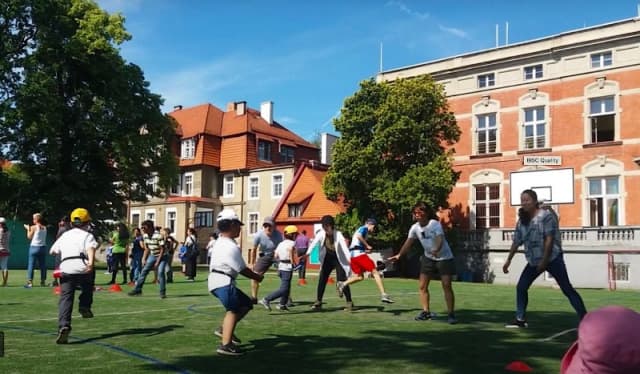
Phil Hart: So our campus—I think it, I'd like to say it sells itself in the sense that it looks like a school. And I know that sounds strange, but so many different buildings, so many different facilities in the city—but around the world—are sort of, there are schools which have fit into other sort of places.
Our school looks like a quality traditional top British school that you've just picked up and put into Wroclaw. I mean, it fits perfectly with the local architecture, but we're set in two beautiful villas. We've got our big—named our big villa and small villa—but we've got our primary in the small villa.
And then we've got all of our secondary in the big villa. We've got a beautiful library, which I think is also not so common in many other schools. It's a heritage-listed building, the library.
There are some wonderful pieces of architecture and sculpture that are just—it’s, I think one of the students that I spoke to recently said, "I can't help but read or want to read when I go into the library." It really has a fantastic energy. Our sort of hall in the main big villa—
I mean, it looks like an Oxford or Cambridge—or even Hogwarts. Everyone says this is a Harry Potter building. So it really looks like that.
And on the one hand, you might think, how does that actually benefit us? But it creates this culture. There is a sort of—on the one hand—a kind of calming nature. On the other hand, it's a building that most students don't actually get to enter, you know, comparable places around the city.
So they come here, and it's very much: I'm here to learn. It looks like a learning space. And then you go outside, and we've got this beautiful, big, green, open space with our sport pitch.
The trees—the cherry blossoms—are wonderful, especially when it's in spring. So the students can sit out there. So again, all of our outdoor learning can happen there.
So you don't feel like you're in the city. You feel like you're in a really, really sort of beautiful British—or British-like—school that's been put in Wroclaw. We're really happy with it.
The school’s scholarships
Phil Hart: The scholarship program is particularly designed to bring in those students who may not have the possibility to study at our school—whether it be because of the fee structure. There might be some families who might not be able to afford private education. There might be some students who thought about pursuing—whether it be a music or a sporting career, for example—
And then they said, oh no, I have to go to a music school. So it’s another option. So we have an art and culture scholarship, and we have a sports scholarship.
Now, generally, what that means is that there's a whole application process, which actually is quite engaging for students, where they have to write their application. They have to have an interview with the head of school. And they’re kind of trying to promote and, I guess, go through this process of explaining why they are the best candidate.
When they are accepted, they receive 50% off their tuition, and that's for the time which they are at the school. Now, our scholarships do start from Year 10 upwards. So these are designed for students who normally would have to probably give up their passion in order to engage in more, let's say, serious school, whereas here we're saying: no, we can get you that American diploma, we can get you this British A-level, and we will support you with your passion—whether it be sport or culture as well.
And I think that that's really exciting because—exactly—students have to make that choice sometimes. And it's quite a big decision for a 15-year-old or 16-year-old to say, I'm sorry, I don't want to do my sport anymore, I need to concentrate on my school. We're a small school, we personalize learning, and this is just one of the ways that we make it happen.
Unique aspects of the school
Phil Hart: If I focus on what is unique or what I guess I'm most proud of about the British International School of Wroclaw—definitely the personalization and the fact that we are a school which will never have 500 or 800 students. Every student that comes here—because we're a small school—is important to us. I get students coming to me or to the teachers, and they say, I'm interested in this, or I would like to do this, or family members saying, would you be able to make this work for us? And because we're so focused on each and every student, the answer is almost always yes.
And then we do it, even if it's a little bit of a challenge. We do try to make it work. When you pay for private education, you want your child to have that experience where they are important, where they are noticed, where all the teachers know their name, where if there's a problem in a subject, the teacher recognizes that very quickly—or if there's a moment of success, that it gets recognized. So sometimes you can have brilliant students, and they just get lost in this sea of 800 or 1,000 students, and they don't get their moment to shine.
I think another thing that we're particularly good at doing here is that we're very good at doing what we say we're going to do. And I think it doesn't sound super exciting, but I think it's really important because it means we offer a really solid curriculum—our Cambridge International Curriculum—and we don't mess around with that. We encourage the teachers to be innovative in the classroom, to appeal to the students' interests, but we deliver a solid curriculum. We deliver an extracurricular activity program that we say we're going to put out on day one, and we make sure that it happens. And I think that the families are definitely appreciating that, because we say we like surprises, but we actually just like good surprises. Nobody likes a bad surprise. We are accountable to our clients, to our students, and so everything unfolds as it should. We're not pretending to be something that we're not.
Main values and principles
Phil Hart: When students join our school, we have a very clear educational journey that they go on—and that can sometimes be in a particular lesson, or it can be over the course of their whole time—we recognize that students go through this journey of: engage, educate, empower. The role of our teachers initially is to engage—you need to capture the student's attention—whether it be through personality, through enriching learning materials, or through a stimulating classroom environment. But if the students are not switched on and engaged, then pretty much nothing that's going on even matters. So we get them engaged. They're switched on.
Then the focus is on education—to educate. The Cambridge International Program—solid, traditional focus on meeting of learning objectives—just getting those nuts and bolts right. That's what we do.
But then we've recognized that it's not just about having switched-on students who learn. They need to be empowered and then take that to the next step; for some, that might be to the workplace. For some, it might be through innovative projects or volunteering or other things that they might do. Or it might just be through the development of different skills that they can then put into action. But if it just stays static and they've just learned content, then we feel like the job's not done. It is about how are they able to put that into practice in the real world.
People who read this also viewed:
- Our Kids Interview: Get to know Cosmopolitan Schools - Wrocław and Kraków (interviews - 2025, 2021, and 2020)
- Our Kids Interview: Get to know FSA School
- Private schools in Wrocław
- Our Kids Interview: Get to know The American School of Warsaw
- Our Kids Interview: Get to know Sapiens International Innovative Community School
- About the Cambridge Pathway
- Our Kids Interview: Get to know Cosmopolitan Schools - Wrocław and Kraków (interviews - 2025, 2021, and 2020)
- Our Kids interview: Get to know Regent College International Schools in Elbląg
- Our Kids interview: Get to know Regent College International Schools
- Mokotow High School Campus - a new Warsaw high school and Thames British School campus
- Advantages and disadvantages of studying in an international school
- Our Kids Interview: Get to know The British School Warsaw
- International schools in Warsaw
- International schools
- International schools in Kraków
-
Advice Guide
- The admissions process
- what to ask at a private school open day
- Back to school without stress. How to prepare your child emotionally?
- Myths about non-public education. Facts to know before choosing a non-public school
- How to Apply to a Private School in Poland
- School open houses
- About the Cambridge Pathway
- Our Kids Interview: Get to know Cosmopolitan Schools - Wrocław and Kraków (interviews - 2025, 2021, and 2020)
- Our Kids Interview: Get to know The British International School of Wroclaw
- Our Kids interview: Get to know Regent College International Schools
- Third Private School Expo in Warsaw - summary
- Our Kids Interview: Get to know EF Academy Oxford
- Homeschooling
- Boarding schools
- Advantages and disadvantages of studying in an international school
- Private school rankings
-
Grades
- 6th Private School Expo in Warsaw: Summary, Conclusions, and Key Trends
- Our Kids Interview: Get to know English Montessori School Katowice
- Mokotow High School Campus - a new Warsaw high school and Thames British School campus
- Our Kids Interview: Get to know KIDS & Co.
- Choosing a high school in Poland
- Our Kids Interview: Get to know FSA School
- Our Kids Interview: Get to know Polish British Academy of Warsaw
- Private middle schools
- Private bilingual elementary schools in Warsaw
- Private high schools in Warsaw
- Private primary schools in Warsaw
- Preschools in Warsaw
- Our Kids Interview: Get to know The English Playhouse and The English Primary
- Montessori preschools
- Social primary schools
- Montessori nursery schools
-
Locations
- Our Kids Interview: Get to know Sapiens International Innovative Community School
- Our Kids Interview: Get to know Thames British School
- Our Kids Interview: Get to know EF Academy
- Private schools Warsaw
- Our Kids Interview: Get to know The Primary and Secondary Schools of the Sisters of Nazareth in Warsaw
- Our Kids interview: Get to know Excellence in Education better
- Our Kids Interview: Get to know the Canadian School of Warsaw
- Olsztyn schools
- Private schools in Gdańsk & Gdynia
- Private schools in Bialystok
- Private schools in Łódź
- Private special needs schools in Warsaw
- Our Kids Interview: Get to know PRIMUS Non-Public Primary School No. 47 and Non-Public Secondary School
- Private Catholic and Christian schools in Warsaw
- International Baccalaureate (IB) schools in Warsaw
- Private day schools in Warsaw


 POL
POL CAN
CAN