

On this page:
- Changes since the school first opened
- The second Cosmopolitan location
- Opening date of the second location
- Changes to the concept since the opening
- How "innovative pedagogy" works
- Key differences from other private schools
- The school's students
- Extracurricular activities
- Parents' involvement
- The model of the Kraków school
- Outside school activities
- Recruitment process
- Graduates’ educational paths
- Reasons to choose this school
- School facility development
- Message to the viewers
- THE APRIL 2021 INTERVIEW (VIDEO)
- THE JULY 2020 INTERVIEW
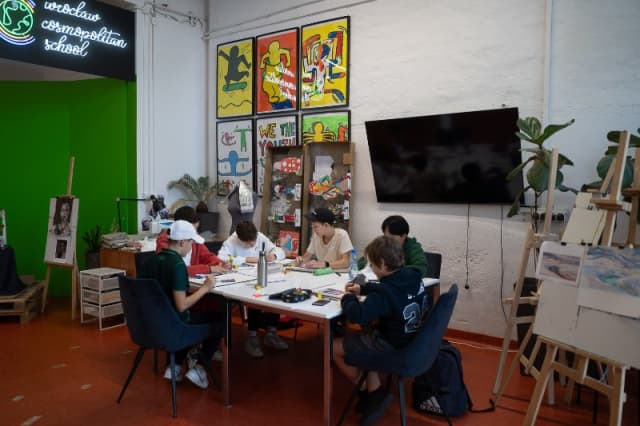
Known affectionately as Cosmo, the school prides itself on its modern facilities, wide variety of after-school activities, and a warm, welcoming atmosphere that fosters a strong sense of community.
Our Kids speaks with the school’s executive principal Graham Lewis.
We spoke to him twice before - these interviews are below the current one:
• In July 2020, before the school opened,
• In April 2021, this time on video, to find out how the school was doing in its first year.
The CURRENT 2025 INTERVIEW
Please, watch the video and/or read its transcript below the video.
Changes since the school first opened
Our Kids: What has changed since the school first opened?
Graham Lewis: It's amazing to speak with you again. The last time I spoke with you for these Our Kids interviews, I was self-isolating, I think, during the COVID era.
That was our first school year at Cosmo. So we had the majority of the school on online learning. What's changed? Well, everything is the simple answer.
We opened in September 2020 with 80 students. When we came back from COVID lockdown, into our second school year, September 2021, we’d more than doubled enrolment through that period. And that continued to be exponential into year three.
So, now, at the close of our fifth school year, we have 350 students onsite here, going from nursery at age three all the way up to year 13. Our 18-year-olds—we had our first graduating class—did Cambridge A-levels last year.
We have university destinations all over Europe, all over the world. And we're now a two-class entry, so we have two classes of 16 in every year group from year one up to 10.
The second Cosmopolitan location
Our Kids: What is the second Cosmopolitan location?
Graham Lewis: A few months ago we started construction on our second school. We're very proud that we announced back in March that we are opening Kraków Cosmopolitan School, which is on Jasnogórska Street in the northwest of the city.
It’s an absolutely stunning facility, which is really going to set a new benchmark for what schools look like in Poland. It has a big cathedralesque atrium. It's entirely made of glass. The building is triangular. It has a bridge that goes across between the secondary classrooms, overlooking into this atrium in the middle.
I’m really excited about that—not just the facilities—but also the team of teachers. We've finished recruiting 26 amazing teachers from all around the world. We have a phenomenal head of school, Mr. Rob Reed. His last school was in Thailand, in Phuket; prior to that, in Malaysia; and before that, over 15 years at different schools in the UK.
So Kraków’s really nice. It’s got an amazing building, an amazing team coming together, and a really phenomenal and enthusiastic parent community.
Opening date of the second location
Our Kids: When is the opening of the Kraków location?
Graham Lewis: In September 2025, so it's a pretty tight timeframe we’re working on, but we're very calm about it. It's a lot easier going than it was in Wrocław in terms of not only the level of construction that’s needed but also the regulatory issues. I'm so proud of everyone I work with here and this team because we've just become so incredibly slick now at working with all of the different government departments, with local government, ensuring we get through all of the compliance hurdles just so smoothly compared to what we had five years ago. The amount that we've learned and the amount that we've developed as a school leadership team is just incredible.
Changes to the concept since the opening
Our Kids: How has the concept changed since the opening?
Graham Lewis: We set out from the very beginning on a very progressive agenda. Our school would be considered progressive in any market in the world. In Poland, it really stands out. And for me, it's been amazing to see how that vision has been translated into practice and how it's grown and taken a life of its own over these five years.
In summary, the school is better than I ever could have imagined. And what is fueling that is the strength of the community that we have here. There is genuinely a really happy feel when you walk around school, from students that are excited about the learning they’re doing, to teachers that want to work here.
I'm very proud that we're very much the school in Poland that teachers want to work at. They know that we're education-focused and that we have this innovative pedagogy. And parents are really proud that their children attend the school. There's such a buzz always here. That’s something I never could have imagined—that it has that level of profound impact that really permeates everything about school life here.
The curriculum’s really phenomenal, how that's taken shape in terms of addressing the challenges of being compliant with both the UK and Polish national curricula, and delivering that seamlessly.
The way those enquiry units have been evolving each year, how they’ve led to exciting outcomes, how technology has been infused into them—genuinely, every time I walk around school, I end up being drawn into and excited to be involved in the many different lessons taking place all the time.
How "innovative pedagogy" works
Our Kids: How does "innovative pedagogy" work? What is it about?
Graham Lewis: Effectively, what we do, in simple terms, is change the dynamic and the paradigm of how a classroom functions. Instead of the teacher implanting knowledge into students, the knowledge comes from students themselves. They are encouraged and given the tools, the environment, and the prompts they need to work together to construct knowledge and understanding.
That comes through doing research online, using books to quantify and triangulate their findings. It’s about putting skills and knowledge to use through real-world projects. One of my favourites is in Year 3—they do a unit on significant people. We cover significant people in the Polish national curriculum, as well as from around the world. And the outcome is that they produce their own website in Year 3. So we’ve got seven-year-olds producing their own websites! It shows they’re not only learning skills—they’re so motivated to create something meaningful that fuels their own learning.
So, instead of being teacher-directed or teacher-led, it's student-centred. It’s focused on what students want to do and how they construct knowledge themselves and with each other.
Key differences from other private schools
Our Kids: In what ways are you different from other private schools?
Graham Lewis: We are different in quite a few ways. First and foremost, we are far more learning-centric than other schools. Part of that is due to the management and ownership structure of the school—we’re owned and managed by teachers. We don’t have a formal mission statement, but our mission is simple: we’re just a group of teachers who want to run the best school in the world.
What you notice when you’re here is the level of expertise that goes into school management, curriculum planning, and learning and teaching that you don’t see in many other schools. The enthusiasm is completely different here because everyone’s so passionate about what we do.
The school's students
Our Kids: Who are your students?
Graham Lewis: At Wrocław, of the 350 students we have, they come from an astounding 36 different nationalities so we have students from all over the world. There’s no single dominant nationality. The largest group is Polish nationals at around 30%, many of whom have lived abroad in the UK, Canada, Australia, New Zealand, and returned to Poland. So for the students, that often means they speak Polish but have never attended a Polish school. They want to continue in English or English national curriculum education. That’s the largest demographicwe have—but still under a third.
Extracurricular activities
Our Kids: What extracurricular activities do you offer?
Graham Lewis: This is another thing that’s changed since our interview five years ago. We didn’t have ECAs in the first year due to COVID restrictions. But now, in our final term of the fifth school year, we run over 50 extracurricular clubs and activities weekly.
We rotate them each trimester. All included in the fees—there are no extra charges. That’s been our commitment from the beginning.
There’s something for everyone: coding, robotics, choir, rock band, arts, crafts, journalism. We even have a podcast club—Cosmo Talk on Spotify.
We’re also very receptive to students. If a student has an idea for a new club, you can expect to see it running the next term. That student feedback loop is very strong.
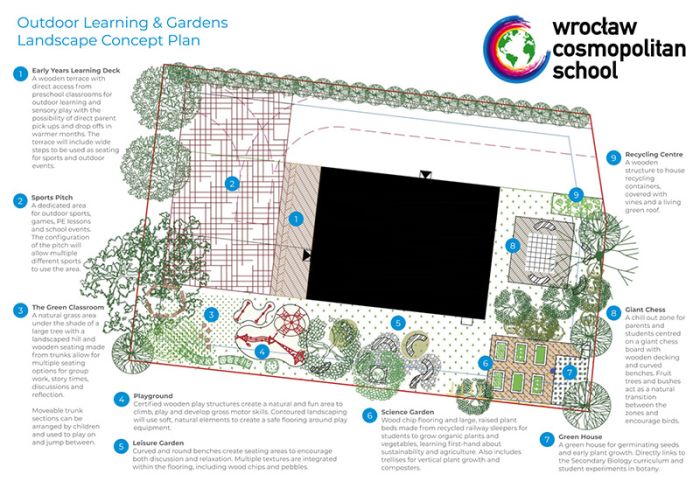
We have a really busy student council. They’ve taken an active and profound role in shaping the school. From choosing menu items and designing uniforms to planning new gardens—they even received a 100,000 złoty budget for garden expansion. Students feel they are empowered and know they have a voice.
Parents' involvement
Our Kids: How are parents involved in the school community?
Graham Lewis: Our parent community is also very active and supportive. The dining rooms are designed to look more like cafés—parents are encouraged to stay and be involved. You'll see parents, high school students studying, and teachers having meetings.
It's really become that sort of hub for the community, especially now in the summer period when the days are lighter for longer. We see families staying at school to be involved. We have an amazing PTA group that were very active in organising different events.
And one of the most touching memories from my last five years was the incredible logistics rally that they did when the war broke out in Ukraine. Organising and rallying support and transport logistics from school—that Cosmo was able to support local schools in and around a bit.
The model of the Kraków school
Our Kids: Will the Krakow school follow the same model?
Graham Lewis: With the school in Kraków, we're very keen to make sure that we function as a school that's connected. So that means following the same curricula. We'll also be using the same shared drives and information systems. We even have the same internal phone system so we can phone internally between the two campuses.
Next year, I take on an executive principal role so I'll be director of both schools and be shuttling between them. And even school calendars are the same.
We'll be doing green camps together. We'll be doing ski camps together.
Outside school activities
Our Kids: What outside school activities do you organize?
Graham Lewis: Well, first of all, there are trips—highly frequently, I would say six times a year on average per year group, where they're doing these trips that are really purposely linked to the enquiry units that I mentioned earlier.
We have two residential camps. We do ski camp in February, which is where basically the whole school from Year 5 upwards migrates to the mountains near Zieleniec. And we do a week of skiing there.
And then we have green camp, which is staggered by age group. So last week, Year 6 to 8 went away. And that was like a transition opportunity for Year 6 as they become middle school students.
And then next week is the last camp of the year—it will be Year 10 up to 13. So they go away for the full week. And they're really, really popular programmes that run, and uptake is always, like I said, almost 100% uptake at school.
Recruitment process
Our Kids: How does your recruitment process work?
Graham Lewis: Very much on a case-by-case basis, on an individual basis. And what's been nice with Wrocław is, despite that incredible level of growth that, like I said, was exponential for the first two years, we've managed to retain that really close-knit community because the vast majority of our students come through referrals from friends, family members, and neighbours—that's how they've arrived to us. And in that sense, although we've got big really quickly, it's very much a cohesive community. So we meet students individually.
We run two or three school tours a week in Wrocław, which are always fully booked. We have a sort of a cap on them so we can make sure we get to meet everyone. And we encourage children to come on those tours too, where we meet them. We look through their previous school reports. We do an informal interview with the students and family all together. And from that, we would make an admissions decision.
Wrocław is very much full in terms of class places. So we have quite significant waitlisting in a lot of different groups. There are a couple of classes where there are limited places just because of international rotations that you would see in any international school.
We're very proud of the fact that we're not an academically selective school. We have a community that we serve here, so we take that on an individualised basis, where we seek to understand the child and the family in the context they've arrived from and whether our school would be the best fit for them.
Graduates’ educational paths
Our Kids: Where do your graduates continue their studies?
Graham Lewis: Because we have a kind of UK curriculum, it's leading towards UK universities. We do have students that went to study at several universities in the UK, including Exeter, University of the Arts in London, Leeds. We've had students that have all five UCAS universities offer them places, some unconditional too. We have students studying in the Netherlands and Germany, art school in Milan, here in Wrocław, several universities in Warsaw, and in Korea.
We had about 20 students of our Year 13 first graduating class, and they're now all over the world.
Reasons to choose this school
Our Kids: Why should families choose your school?
Graham Lewis: What I always say when I meet with people or when people ask that kind of question is: nothing replaces coming to visit. And the number one feedback I have from parents when they visit school and we go on a school tour together, talking to them, getting involved in lessons, is that this is not like other schools. There is a very distinctly happy feel here. And the number one comment is that they wish that they could have studied at a school like this as a child. And you very, very quickly get that feeling. It's magical how friendly everyone is. So my number one advice is: come and visit us and see that it is very different, the way that we function as a school. It's a friendly school. It's a school where everyone wants to be and everyone is excited to be learning here, in a place where everyone's welcome.
School facility development
Our Kids: How is the school facility being developed?
Graham Lewis: As we grew in Wrocław, we originally thought we were going to fit in what we call the red building. And now that's just nursery up to Year 4. And we're able to expand and create a really amazing mini-campus model where we have the buildings directly next to each other and a private road running through them.
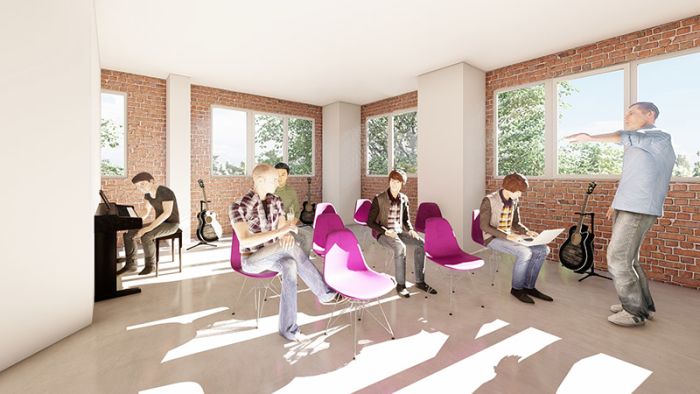
We've got the red building, which is nursery to Year 4. Directly across, we have the grey building, which is where my office is now, which spans from Year 5 and 6 on the ground floor. Then we have middle and high school on the upper three floors. And we have a creative arts hub, where art, music, and next year a black box theatre—which we're opening.
And then directly next to us, we have our indoor gym—the bubble gym. And we have an indoor gym building and changing rooms block, which is currently under construction for work in September.
This is something really interesting to see—that we are always investing in facilities. Every summer, there is some kind of big construction project going on, so I always joke with my colleagues that school finishes, but then for me, that’s when construction mode happens. And it’s a very different sort of set of working conditions that we have in the summer period.
But this is how we're constantly expanding—not just to fit new students in and accommodate the growth and demand that we experience, but to also really make sure that we're always offering the best possible facilities we can. And this new sports block that I mentioned is really going to be spectacular.
In Kraków we’re doing a phenomenal conversion from a software company to a school building—2,000 square metres plus 4,000 square metres of outdoor space. We reckon that we'll have a capacity of about 250 students, and there are adjacent plots of land that we can look at if we have that kind of nice problem to have in three years.
But for the beginning, we're looking at hitting that 250-student capacity over the coming three years.
Message to the viewers
Our Kids: What is your message to the viewers?
Graham Lewis: I would like to just warmly welcome and invite anyone to come and have a look, to join us on one of the tours. It's always interesting to meet new people, to come and see.
We've attracted a lot of interest—not just from parents’ groups, but from different political parties, from local government too. They're actually looking at Cosmo as an example of how curricula can be reformed and how education can be delivered in a modern way, which is something that's very much in the national psyche at the moment in Poland. And it's nice to be recognised—that we're able to contribute in our own small way to that.
Come and visit us, come and see Cosmo, and know what that sort of difference is between us and other schools that you may have visited or may have attended yourself as a child.
•••
THE APRIL 2021 INTERVIEW (VIDEO)
•••
THE JULY 2020 INTERVIEW
This interview was conducted less than two months before Wroclaw Cosmopolitan School opened in September 2020.
The history of the school project
Our Kids: Can you tell me about the history of this project?
Graham Lewis: It's a year in the making. There was a lot of discontent from two main groups: from parents and from teachers who worked in other schools in the English-speaking private school sector in Wrocław. They had a list of issues that they wanted resolved and they were looking for some kind of improvement on. So I was presented with these problems and was approached by a number of parents looking to set up a new school on the cooperative model and when that did not transpire, we chose the private investment model.
Our Kids: Why Wroclaw?
Graham Lewis: If you do an analysis of the private school market, you will notice that Wrocław is a massively untapped opportunity. There's huge foreign investment here and a pretty sizable expat community. Several tech companies are based here for their European development, e.g., Nokia, IBM, Google, and Amazon. The people working there are used to these big fancy schools with modern inquiry-driven approaches, and for those people there's really nothing in Wroclaw.
There are some conventional English-speaking private schools but nothing that's really cutting edge. We now have people who work for IBM and are moving here from Poznań or Katowice to send their kids to our school. So we definitely have hit the nail on the head in terms of interpreting what the demand is, what people are looking for, and what's missing in the city.
Our Kids: So you must have been in Poland then?
Graham Lewis: I used to work in Poland previously for four years but for the last four years I was in Hong Kong in a school leadership role, so I was known to a group of parents. They knew I had worked in big international schools in Asia and had done a lot of traveling for professional development within schools so every couple of months I was visiting schools around the world, in Asia in particular. They were looking to organize something like that, saying: “When we lived in Singapore, we had a school like that — why don’t we have one in Wrocław?”
Our Kids: What were they looking for?
Graham Lewis: Much more progressive pedagogy than is available and much clearer curriculum documentation and progression. We combine those two with an inquiry model, and place much bigger emphasis on the use of technology. Also, our aim was to resolve that big legislative quandary regarding Polish citizens attending international schools. So as a result, we have developed a really unique model.
The uniqueness of the school
Our Kids: What you say on your website is that yours is a very special school, one-of-a-kind, that there is no other school like yours. What makes it so unique?
Graham Lewis: Even if that kind of school opened somewhere like Hong Kong or Singapore or anywhere in those markets, I know that it would still be quite different. Our school tries to do more than international schools do. The trick is in the name really — within academia this is called “the cosmopolitanism movement” in educational leadership. And we are very much driven by this idea.
It’s about questioning what it means to be an international school — it doesn't just mean having native speakers as teachers or the US or UK curriculum, but really reflecting on what it means to be a citizen of Wrocław, of Poland, of the world. That feeds into the ethos of our school — we are very much driven by the ecological ethos. We have a “no meat on campus” policy quite strictly enforced by staff and enrollment contracts so it's a vegetarian school.
Catering is included for everyone in the fee package and also works as a part of building the school community: we have what we call “family mealtime” in which teachers and students share the same food together and build a diverse, tolerant community. And it's been very popular with parents. Vegetarian schools, even in those big markets, would be something quite innovative. Our students will get hot veggie food and snacks available throughout the day. This is especially good for high school students because they're teenagers and it's not good to limit their snack time to for example 10-10:30. If they're hungry, they can get a piece of fruit or something to eat at other times of the day. I witnessed that in the British school of Paris and it was amazing to see.
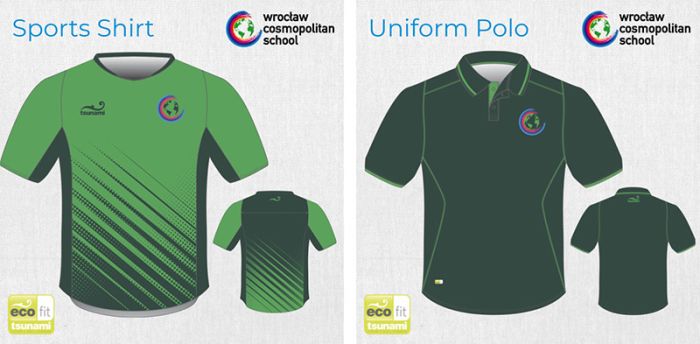
We are big on sustainability, on sustainable learning. Our school uniforms are made out of recycled plastic bottles. All this is cutting edge. In Bali there’s a school called the Green School, an amazing school which really defines what sustainable education is all about and it's a big influence for us. We're like the Green School but with more modern delivery and with much more tech emphasis.
Our Kids: Why would parents choose your school over other schools?
Graham Lewis: Number one: the curriculum is amazing. I am very proud of how it has come together, not only in terms of its structure but also in the way it's documented — the progress and the assessment. It's an extremely in-depth documentation process. Also a very modern approach to learning in terms of having the inquiry model and the flexible spaces which enable close collaboration between different groups. We're not a textbook school, we don't use worksheets. We are technology-driven, inquiry-based but still very rigorous because everything we do is underpinned by the content objectives of two different national systems.
The school building
Our Kids: For quite a while you were looking for an appropriate location.
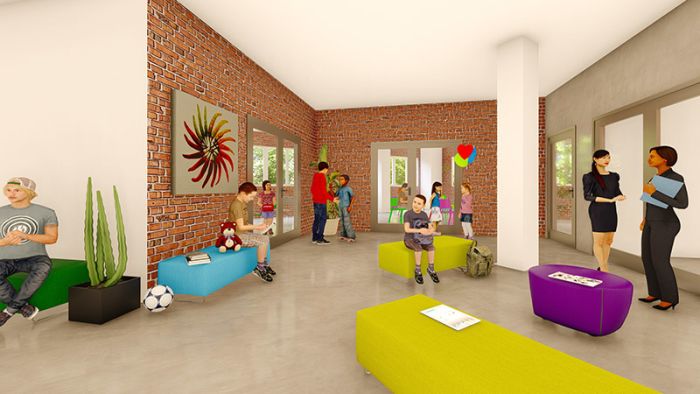
Graham Lewis: It was a big struggle to find a building that was appropriate. A lot of private schools of this size across Poland rent big villas, where they do some minimal conversion but this was not going to cut it for what we were doing, what we were telling parents and what the demand was. We have a three-story building that used to be a train wagon factory first, then a telecom office. We stripped it back to the mental structure and completely redesigned it, so we achieved this really amazing layout of the building with floor-to-ceiling glass, so it's transparent. There are no corridors but the zigzags that we call hubs.
The basis of the design is this architectural movement called “the learning neighbourhoods.” We have the primary learning neighbourhood in which the six classes open up to the hub where there is a library, resources, shared technologies, and on the top floor we have the same for the secondary level: the learning neighbourhood where all the specialist classrooms open up to the central hub. Now we are all ready to go with just that exciting final stage where we are choosing the finish of the desks and deciding on colours, etc.
Students
Our Kids: Are you planning mostly to have children of those expats or children of people who come to Poland on contracts or do you also enrol Polish students?
Graham Lewis: Yes, we do. It is very important for us to have Polish students and we have between 40 and 50% of them, many of whom were part of the Polish diaspora and are now moving back to Poland from the UK, Canada, Australia or the Netherlands. Their kids have been going to schools there with a more modern approach so for them we are really the automatic choice because we have a blended model of delivery of the national requirements of the Polish curriculum, but in English, so that's quite a unique model.
Our Kids: So how many students are in the planning for the fall?
Graham Lewis: At this moment we have 107 confirmed and paid. That's already over the target because we were planning to have 100 when we open. I think we will hit 120 by September and will be full by Christmas.
Teachers
Our Kids: Who are your teachers?
Graham Lewis: We have 27 teachers so the ratio is amazing. Some are joining us from various international schools across Poland, we have some moving directly from the UK, some from Greece, and a contingent that I recruited in Hong Kong.
Our Kids: Do you also have Polish teachers?
Graham Lewis: Yes we do, some with really interesting backgrounds. One of our science teachers is Polish but she did her undergrad in Manchester in the UK and Masters and PhD in the US, where she was teaching at university. One of our preschool teachers studied education in Wales, a Polish language teacher was in the UK for 14 years teaching Polish in the Saturday school at the Embassy. We always find these cool collections where people have interesting international experience and are back In Poland now.
The curriculum
Our Kids: How do you manage to blend the English National Curriculum with Polish Core Curriculum?
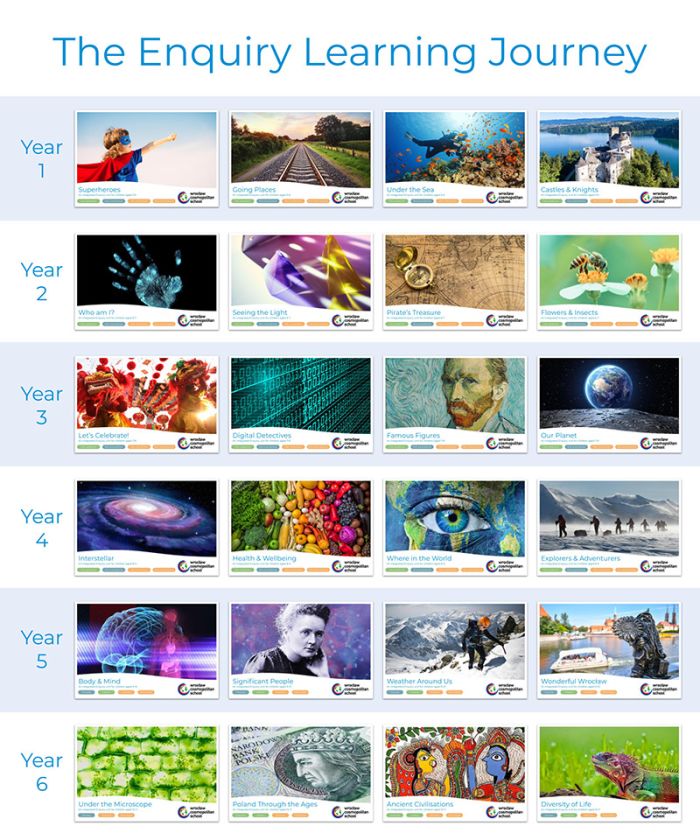
Graham Lewis: We spent a long time before Christmas with lawyers and education consultants digesting every single requirement in each subject area and put them parallel with the English National Curriculum to look where there are overlaps. I don't think many schools have done that level of analysis of the two systems. They see things as incompatible where they're really not. If you compare the two national systems, for example, in mathematics, they're not that radically different, so we found one-to-one overlays in both and areas that are not covered and we built that into our units of inquiry. Making those inquiry units was the key because instead of having subject divisions we do four inquiry units per year with each primary class.
Our Kids: Can you give me some examples?
Graham Lewis: One of my favorite ones is at the end of Year 5 and is called “Wonderful Wrocław” so it’s a local community unit. It connects geography objectives from the National English Curriculum on rivers and physical geographical formations with the Polish history requirement of local history which gives an option to study some parts in detail, so we did Solidarity, which had a big role in Wrocław. We met the technology requirement looking at sustainable urban planning and the culminating project was for the students to develop a sustainable proposal for the city and design a bridge. So in this way we have really embedded all the subjects in a really exciting context.
Our Kids: The choice of the units is up to the school, right?
Graham Lewis: Yes, and the English curriculum allows us the flexibility that would not exist if we did IB (PYP) or the Cambridge program or any program off the shelf. We wouldn't be able to get this alignment with the Polish national curriculum. It had to be something that was bespoke. The English National Curriculum gives that kind of recognition and mobility that parents are looking for if they want to move to other international schools. IB does, too, but I think the English curriculum still has the edge in terms of across the world transferability. Also, we found that we could do more with it to make it fit our ethos and the assessment systems, so we do the English National Curriculum from Year 2 up, and we use the Welsh National Curriculum in early years 1 and 2.
Our Kids: You use the Reggio Emilia approach in preschool. What was your reason for choosing it?
Graham Lewis: It's something that I've seen being really successful in my career. Also, we have two preschool teachers who are both very much Reggio Emilia fans. The parents want it as well. So we're determined to design a really amazing Reggio Emilia environment that will showcase what a good Reggio school should look like. It uses the inquiry model as well, so for us it was like a natural foundation block in the early years. It’s children's questions guiding their learning, the way the learning environment is designed so students are running with their interests. We have six school values that underpin everything we do, so all the activities and experience will be explicitly linked to the values and this is something that's truly innovative.
Our Kids: What about technology because this is something that you focus on a lot?
Graham Lewis: The emphasis is on students becoming independent users of technology. We put big emphasis on using digital learning portfolios as a way of students recording their learning. It then becomes an assessment tool. We use the Seesaw platform where you can really see progress. When you look at the child's journey, it's almost like time lapse — you can see how they develop in each area.
Our Kids: And your students have to take regular school exams?
Graham Lewis: Students will take the eighth-grade exam and from Year 10 up, at the high school stage, they will take IGCSE and then A-levels at the age of 18, when we expand to that stage. Now we're starting with Year 10, so we're now nursery to Year 10 in September.
Extracurricular activities
Our Kids: What about extracurriculars?
Graham Lewis: Our approach is different from other schools — we’re not using the third-parties to organize those extracurriculars like they do in other schools. Our teachers have that in their contracts that they do extracurriculars. These are their hobbies and passions they want to share with the children. Deliberately we encourage secondary school teachers to run extracurriculars for younger kids and preschool teachers — for higher grade students so that everyone gets that community development experience. We are going to offer 30 in September from six different areas, such as sports, creativity, technology, and community outreach. I've always done a lot of advocacy for special needs so something like that will hopefully appear. We will have an animal shelter outreach, which was organized by one of our teachers.
Our Kids: Is all that included in your fees?
Graham Lewis: The fees are all-inclusive and include everything except transport and school uniforms.
Reactions to the new school
Our Kids: How was the idea of your new school received?
Graham Lewis: Very well both by individual parents and big corporations. Also the Wrocław Townhall has been very supportive because they also recognize the need for an international school that is fully legally compliant with the minimum aspects of the Polish curriculum. There has been massive excitement since the very beginning. We started teacher recruitment at the end of August almost a year ago and by September we had 50 CV applications for a school that was very much at the theoretical planning stage. At each parent event prior to the pandemic we had a hundred plus participants! It’s been a very busy but a very exciting year.
People who read this also viewed:
- Private schools in Krakow
- English schools in Kraków
- International schools in Kraków
- Our Kids Interview: Get to know The British International School of Wroclaw
- Our Kids Interview: Get to know FSA School
- Private schools in Wrocław
- Our Kids Interview: Get to know The American School of Warsaw
- Our Kids Interview: Get to know Sapiens International Innovative Community School
- About the Cambridge Pathway
- Our Kids Interview: Get to know The British International School of Wroclaw
- Our Kids interview: Get to know Regent College International Schools in Elbląg
- Our Kids interview: Get to know Regent College International Schools
- Mokotow High School Campus - a new Warsaw high school and Thames British School campus
- Advantages and disadvantages of studying in an international school
- Our Kids Interview: Get to know The British School Warsaw
- International schools in Warsaw
- International schools
- International schools in Kraków
-
Advice Guide
- The admissions process
- what to ask at a private school open day
- Back to school without stress. How to prepare your child emotionally?
- Myths about non-public education. Facts to know before choosing a non-public school
- How to Apply to a Private School in Poland
- School open houses
- About the Cambridge Pathway
- Our Kids Interview: Get to know Cosmopolitan Schools - Wrocław and Kraków (interviews - 2025, 2021, and 2020)
- Our Kids Interview: Get to know The British International School of Wroclaw
- Our Kids interview: Get to know Regent College International Schools
- Third Private School Expo in Warsaw - summary
- Our Kids Interview: Get to know EF Academy Oxford
- Homeschooling
- Boarding schools
- Advantages and disadvantages of studying in an international school
- Private school rankings
-
Grades
- 6th Private School Expo in Warsaw: Summary, Conclusions, and Key Trends
- Our Kids Interview: Get to know English Montessori School Katowice
- Mokotow High School Campus - a new Warsaw high school and Thames British School campus
- Our Kids Interview: Get to know KIDS & Co.
- Choosing a high school in Poland
- Our Kids Interview: Get to know FSA School
- Our Kids Interview: Get to know Polish British Academy of Warsaw
- Private middle schools
- Private bilingual elementary schools in Warsaw
- Private high schools in Warsaw
- Private primary schools in Warsaw
- Preschools in Warsaw
- Our Kids Interview: Get to know The English Playhouse and The English Primary
- Montessori preschools
- Social primary schools
- Montessori nursery schools
-
Locations
- Our Kids Interview: Get to know Sapiens International Innovative Community School
- Our Kids Interview: Get to know Thames British School
- Our Kids Interview: Get to know EF Academy
- Private schools Warsaw
- Our Kids Interview: Get to know The Primary and Secondary Schools of the Sisters of Nazareth in Warsaw
- Our Kids interview: Get to know Excellence in Education better
- Our Kids Interview: Get to know the Canadian School of Warsaw
- Olsztyn schools
- Private schools in Gdańsk & Gdynia
- Private schools in Bialystok
- Private schools in Łódź
- Private special needs schools in Warsaw
- Our Kids Interview: Get to know PRIMUS Non-Public Primary School No. 47 and Non-Public Secondary School
- Private Catholic and Christian schools in Warsaw
- International Baccalaureate (IB) schools in Warsaw
- Private day schools in Warsaw

 POL
POL CAN
CAN