

On this page:
- School environment
- Community and culture
- Personal development
- Extracurricular activities
- Parental involvement
School environment
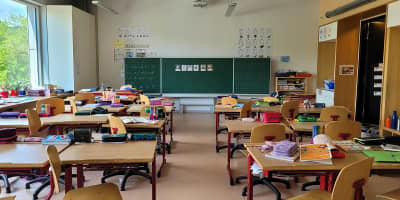
In addition to academics, a lot of parents prioritize the right school environment for their children. Most private schools offer small classes and low student-to-teacher ratios. This leads to a more intimate classroom, with more participation, interaction, and engagement. It also allows teachers to learn more about the needs and skills of individual students and to tailor their approach accordingly.
Community and culture
A school’s culture can generate some of the most important and lasting benefits for your child. While most public schools admit students based on where they live (regionalization), private schools admit students based on shared interests, aspirations, and values. Each private school has its own particular community and culture, which prioritizes certain values, such as academic performance, personal development, community, diversity, and social justice. Most private schools have a close-knit community that will allow your child to find their home away from home.
Personal development
In addition to education aims, private schools tend to see personal development as an important goal. Many parents choose a private school because they believe it will be the right place for their child's social and emotional development. Private schools often treat character education as an integral part of the curriculum. Parents love that in addition to regular course work, their children will have the opportunity to learn key values and develop character traits like honesty, independence, and a sense of justice, which will allow them to grow into mature and responsible young people.
Extracurricular activities
Private schools strive to provide a comprehensive education. This goal is achieved not only through the curriculum, but also through a wide range of extracurricular activities, such as sports, arts, music, and community service. There are also less common ones, such as student newspapers, theatre (also English-speaking) or film-making.
Private schools organize many trips, because they integrate the student community and teachers, and students learn many useful skills, gain experience, and live with each other, which can have a positive impact on education and overall development.
Some schools offer exchanges with foreign schools, which is a great opportunity for students to polish their language, learn about another country and culture, and broaden their horizons.
Parental involvement
Private schools pride themselves on open communication between parents and school staff, and it’s very important for them to involve parents in the school community. Through frequent parent-teacher meetings, school events, and participation in committees and fundraising campaigns, families become an integral part of their children's school life. This is a great way to strengthen parent-child relationships.
You can read more about the benefits of private schooling here. If you want to find a private school, please visit our website.
People who read this also viewed:
- How to Apply to a Private School in Poland
- Third Private School Expo in Warsaw - summary
- Private school rankings
- Reasons for choosing private schools - Our Kids’s survey report
- The first annual non-public school fair in Poland
- The first annual Our Kids non-public school expo in Warsaw was a great success
- Compare schools in Poland
-
Advice Guide
- The admissions process
- what to ask at a private school open day
- Back to school without stress. How to prepare your child emotionally?
- Myths about non-public education. Facts to know before choosing a non-public school
- How to Apply to a Private School in Poland
- School open houses
- About the Cambridge Pathway
- Our Kids Interview: Get to know Cosmopolitan Schools - Wrocław and Kraków (interviews - 2025, 2021, and 2020)
- Our Kids Interview: Get to know The British International School of Wroclaw
- Our Kids interview: Get to know Regent College International Schools
- Third Private School Expo in Warsaw - summary
- Our Kids Interview: Get to know EF Academy Oxford
- Homeschooling
- Boarding schools
- Advantages and disadvantages of studying in an international school
- Private school rankings
-
Grades
- 6th Private School Expo in Warsaw: Summary, Conclusions, and Key Trends
- Our Kids Interview: Get to know English Montessori School Katowice
- Mokotow High School Campus - a new Warsaw high school and Thames British School campus
- Our Kids Interview: Get to know KIDS & Co.
- Choosing a high school in Poland
- Our Kids Interview: Get to know FSA School
- Our Kids Interview: Get to know Polish British Academy of Warsaw
- Private middle schools
- Private bilingual elementary schools in Warsaw
- Private high schools in Warsaw
- Private primary schools in Warsaw
- Preschools in Warsaw
- Our Kids Interview: Get to know The English Playhouse and The English Primary
- Montessori preschools
- Social primary schools
- Montessori nursery schools
-
Locations
- Our Kids Interview: Get to know Sapiens International Innovative Community School
- Our Kids Interview: Get to know Thames British School
- Our Kids Interview: Get to know EF Academy
- Private schools Warsaw
- Our Kids Interview: Get to know The Primary and Secondary Schools of the Sisters of Nazareth in Warsaw
- Our Kids interview: Get to know Excellence in Education better
- Our Kids Interview: Get to know the Canadian School of Warsaw
- Olsztyn schools
- Private schools in Gdańsk & Gdynia
- Private schools in Bialystok
- Private schools in Łódź
- Private special needs schools in Warsaw
- Our Kids Interview: Get to know PRIMUS Non-Public Primary School No. 47 and Non-Public Secondary School
- Private Catholic and Christian schools in Warsaw
- International Baccalaureate (IB) schools in Warsaw
- Private day schools in Warsaw


 POL
POL CAN
CAN